Curated ToolThis tool is part of our curated AI directory. We only include tools that meet our standards for relevance, usability and real-world value.

Tagshop AI

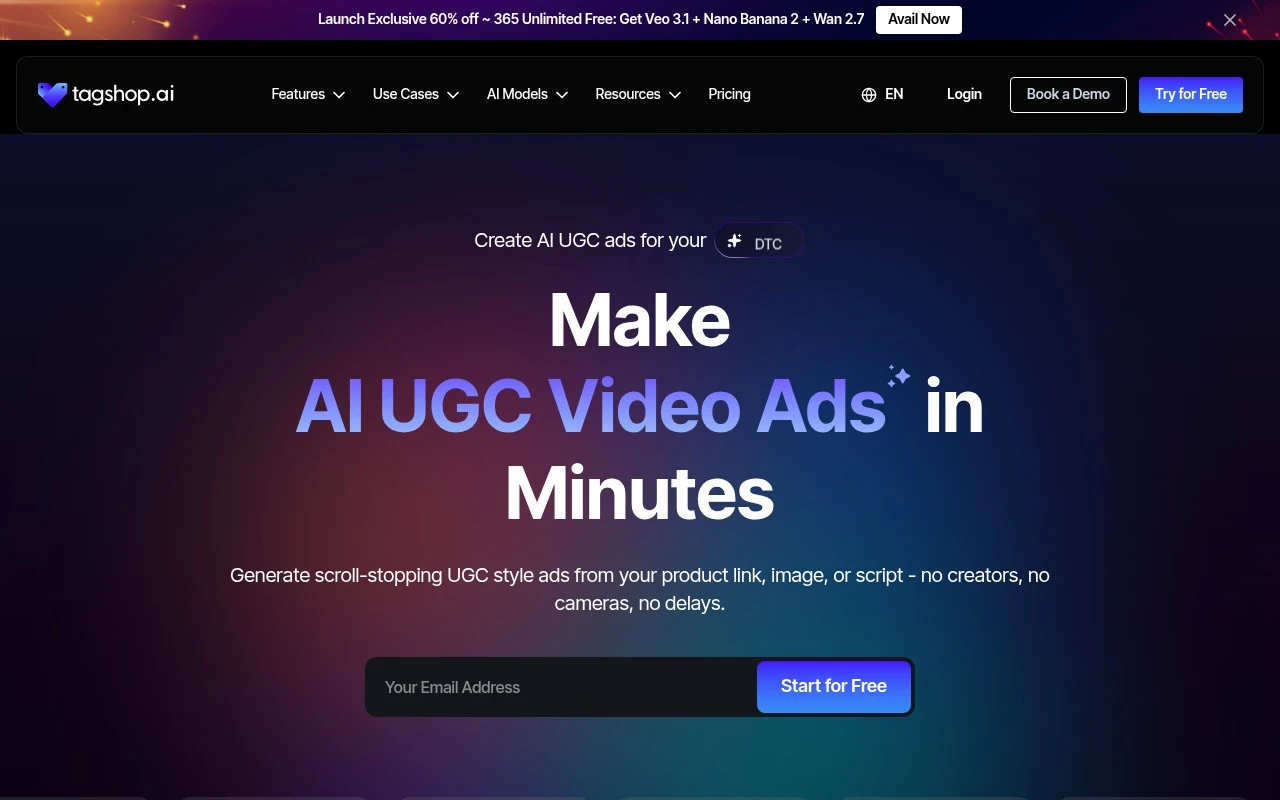
Tagshop AI is an AI video generation tool for ecommerce brands that helps create avatar video content from product details, scripts, and media, using AI avatars and voiceovers for shoppable marketing videos.
Short-form VideoProduct Demo & Screen Recording

FYAI Score

7.6 / 10

Based on 143 reviews

Pricing:

Freemium

Best for:

Performance marketers and agencies scaling UGC-style video ads

Score Breakdown

  • Ease of use8.4 / 10
  • Features7.7 / 10
  • Pricing7.1 / 10
  • Integrations7.1 / 10
  • Support7.5 / 10

PRODUCT PREVIEW

What this AI tool does

Tagshop AI is an AI UGC video ad generator for brands and agencies that need creator-style video ads without managing creators, studios, shoots, or post-production teams. It is built around the idea that video ad creation should start with campaign intent, not a blank timeline, and that a brand should be able to move from product information to a finished ad in one guided workflow. At the center of the platform is an AI Video Agent that interviews the user about the product, target audience, campaign goal, messaging angle, and preferred visual style. From those inputs, the tool assembles a complete UGC-style video with a script, avatar performance, voiceover, scenes, B-roll, subtitles, and ad-ready pacing. Tagshop AI is best at turning product context into short-form video creation assets that feel closer to social creator content than traditional brand commercials. For marketers, the appeal is speed and repeatability. A brand can create avatar video content for product launches, paid social tests, landing pages, seasonal campaigns, or direct-response ads without waiting for creator availability or reshooting minor changes. This makes the platform especially relevant for ecommerce teams and performance agencies that need multiple variations of the same idea for testing hooks, offers, and audiences. Rather than functioning only as a text-to-video generator, the workflow is designed around commercial storytelling. Users can start from a URL, written prompt, product image, or campaign brief, then let the system structure the message into a creator-style narrative. That can include a problem-solution angle, testimonial-style delivery, a quick product demo, or a scroll-stopping opening built for short video environments. The avatar and voice capabilities are an important part of the product story. Tagshop AI supports AI avatars, custom avatars, AI twin generation, and voice cloning, which allows brands to create consistent presenters without repeatedly filming people. The result is a practical middle ground between fully synthetic video and traditional influencer production, where the brand controls the message while keeping the look and rhythm of UGC content. Agencies can use the platform as a production layer for client campaigns, especially when they need quick ad iterations across products, markets, or creative angles. The ability to add subtitles, generate B-roll, and assemble complete scenes in one flow reduces the number of handoffs normally involved in social ad production. It also gives teams a way to prototype concepts before committing budget to larger creator partnerships or studio shoots. In positioning terms, Tagshop AI sits at the intersection of AI video generation, UGC ad production, and avatar-based marketing content. It is not primarily a cinematic filmmaking tool or a general-purpose video editor, but a focused system for creating persuasive, social-native product videos at scale. For teams evaluating a Tagshop AI review or comparing Tagshop AI pricing with the cost of creators, filming, editing, and reshoots, the core question is whether automated UGC-style production can shorten the path from campaign idea to usable ad creative.

Use cases

Best for

Video Ad Creation

Tagshop AI generates UGC-style video ads from your product and campaign inputs, including script, scenes, voiceover, B-roll, and captions.

Add Subtitles

It automatically adds timed subtitles to generated videos so captions match the spoken voiceover.

Create Avatar Video

Use AI avatars and voice cloning to create an avatar-led video from text, images, or a product URL.

ANALYSIS

Strengths & limitations

Strengths
  • Best suited to DTC and ecommerce marketing teams because it turns product inputs into complete UGC-style ad videos with script, avatar, voiceover, scenes, subtitles, and B-roll.
  • Useful for agencies producing ad variants because URL-to-video, text-to-video, image-to-video, avatars, and voice tools support fast creative iteration across campaigns.
  • Accessible for experimentation because the freemium model lets teams test AI-generated UGC ads before committing to a paid workflow.

Limitations
  • Less suitable for brands that rely on real creator relationships or filmed customer testimonials because the workflow is centered on AI-generated avatar-style UGC rather than live production.
  • Less suitable for cinematic, long-form, or documentary video projects because the product is optimized for short-form social and paid advertising creatives.
  • High-volume teams still need creative and compliance review because AI-generated scripts, visuals, avatars, and voice cloning can create brand, claims, or likeness risks before ads go live.

Evaluation

FYAI score breakdown

Our structured evaluation across five key criteria

7.6 / 10

Overall score

Based on 143 reviews

  • Ease of use8.4 / 10
  • Features7.7 / 10
  • Pricing7.1 / 10
  • Integrations7.1 / 10
  • Support7.5 / 10

What users say

Findings from public reviews, documentation and community sources.

  • Ease of use

    Tagshop AI presents the workflow as a 3-step process: share an idea or product URL, chat with the AI Video Agent, and receive a ready UGC video. G2’s review snippet says the platform is “very easy” and mentions strong lip-sync and video quality.

  • Features

    Tagshop AI’s product page lists product URL/image/prompt to video, an AI Video Agent, AI avatars, and voice cloning as part of its UGC-ad creation workflow.

  • Pricing

    Tagshop AI’s pricing page shows subscription and Agency/custom-plan paths, including custom packages for teams producing 50+ AI UGC ads and a demo-based sales route.

  • Integrations

    Tagshop AI’s Instagram source frames outputs as “ready for social media and ads” and highlights product-image-to-fashion-video use cases.

  • Support

    Tagshop AI’s pricing FAQ covers generation time, upgrading, canceling, and creating a first ad. Tagshop AI’s pricing FAQ gives an email contact if processing takes longer than the typical “5-10 minutes.”

Who is this for?

Best for ad-focused teams that want UGC-style videos from an idea or product URL, Tagshop AI presents a 3-step process ending in a ready UGC video. Less suited to teams that need fixed public amounts or quota tables for procurement, Tagshop AI’s pricing page emphasizes subscription and Agency/custom-plan paths, custom packages for teams producing 50+ AI UGC ads, and a demo-based sales route.

PRODUCT PREVIEW

Feature highlights

AI Video Agent

Answers a few prompts, then generates a complete UGC video ad.

URL-to-UGC Video

Turn a product page into a creator-style ad with scenes and captions.

Avatars + Voice Clone

Create consistent creator voices and AI twins for repeatable campaigns.

COMPARE

Discover curated alternatives worth comparing

Compare similar AI tools based on features, pricing and use cases

8.5/ 10Based on 16 reviews

Wondercraft

Short-form VideoVideo Editing
Creates editable videos and audio from text, prompts, media
Best for:
Video creators
Pricing
Freemium

8.5/ 10Based on 65 reviews

Wisecut

Short-form VideoVideo Editing
Finds highlights, removes pauses, captions and reframes clips
Best for:
Video creators
Pricing
Freemium

8.6/ 10Based on 2,521 reviews

Vizard.ai

Short-form VideoVideo Editing
Extracts short clips, adds captions, and resizes videos
Best for:
Social media managers
Pricing
Freemium

Create on-brand videos in minutes, not days. Start with Tagshop AI today and keep your campaigns moving faster with content that engages.

FAQ

Frequently asked
questions

Everything you need to know about this AI tool,
its features, pricing, use cases, and limitations.

Who is Tagshop AI best suited for?
Tagshop AI is best suited for ecommerce, DTC, SaaS marketing, and agency teams that need short UGC-style ad videos at scale. It is designed for turning product URLs, images, or campaign prompts into creator-style videos with scripts, avatars, voiceovers, captions, scenes, and B-roll.
Is Tagshop AI free to use, and what are the paid plan limits?
Tagshop AI uses a freemium pricing model, so users can start with a free option and upgrade for broader use. Before using it for production campaigns, teams should check the current plan details for limits on exports, credits, video length, watermarking, avatars, collaboration, and commercial usage.
How does Tagshop AI compare with other AI video ad tools?
Tagshop AI is more focused on UGC-style ad creation than general-purpose video editing. Its workflow combines product inputs, scripts, avatars, voiceovers, subtitles, scenes, and B-roll, which is useful for ad variant production. Broader video tools may offer deeper editing, while Tagshop AI is aimed at faster creator-style ads.
How quickly can a team get started with Tagshop AI?
The main trade-off with Tagshop AI is that its UGC is AI-generated, so authenticity is simulated rather than based on a real creator or customer experience. It may not replace creator partnerships, live-action shoots, or complex production work. Buyers should also verify editing controls, export options, integrations, and usage limits.
What privacy and compliance checks should teams make before using Tagshop AI?
Teams should review Tagshop AI’s current privacy terms before uploading product assets, campaign prompts, customer references, or unreleased marketing material. Important checks include data retention, model training use, access controls, deletion options, subprocessors, and any compliance requirements relevant to the company’s region, industry, and advertising workflow.