PixVerse
Curated ToolThis tool is part of our curated AI directory. We only include tools that meet our standards for relevance, usability and real-world value.

PixVerse

PixVerse is an AI video generation platform that creates short videos from text prompts, images, or character inputs. It supports features such as image-to-video animation, text-to-video generation, and style-driven video effects.
Short-form VideoVideo Generators

PixVerse

FYAI Score

7.7 / 10

Based on 122 reviews

Pricing:

Paid

Best for:

Creators and marketing teams producing cinematic clips and social ads

Score Breakdown

  • Ease of use8.0 / 10
  • Features8.1 / 10
  • Pricing7.4 / 10
  • Integrations7.5 / 10
  • Support7.2 / 10

PRODUCT PREVIEW

What this AI tool does

PixVerse
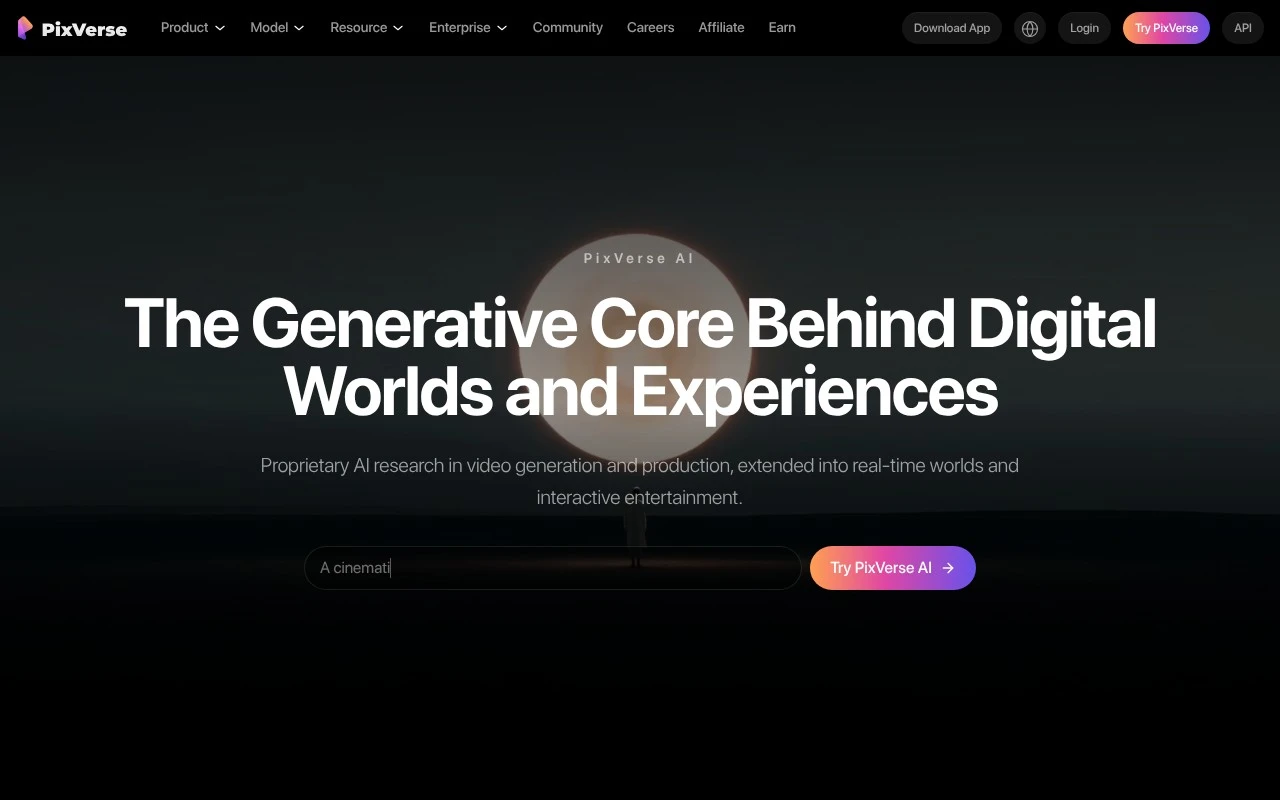
PixVerse is an AI video generation platform built around proprietary video foundation models for creating clips from prompts, images, templates, and guided creative direction. PixVerse is designed for creators, marketing teams, production groups, and developers that need to generate video quickly while retaining control over style, characters, motion, and output structure. At its core, the platform turns text-to-video and image-to-video generation into a practical creative workflow rather than a one-off novelty. A user can describe a scene, provide a visual reference, or start from a template, then refine the result toward cinematic shots, social clips, product visuals, or stylized sequences. PixVerse is best at combining fast AI video generation with tools for consistency, direction, and repeatable production. For creators working on short form video creation, the appeal is speed without giving up too much creative intent. The platform supports prompt-based scene creation, visual references, and template-led formats that make it easier to move from an idea to a shareable clip. This makes it useful for social content, creator experiments, music-driven visuals, story snippets, and concept shots that would otherwise require editing skills, stock footage, or manual animation. The conversational direction layer gives the product a more guided feel than a simple prompt box. Through an agent-style interface, users can shape a video by describing changes, asking for variations, or iterating on the tone and movement of a scene. That interaction model suits people who think in creative notes rather than technical settings, while still giving teams a way to steer generation toward a defined outcome. Character consistency and lip sync expand PixVerse beyond abstract video generation into repeatable storytelling. Consistent characters matter when a brand mascot, fictional persona, presenter, or narrative figure needs to appear across multiple clips. Lip sync adds another layer for dialogue, spokesperson-style assets, dubbing concepts, and character-led videos where speech and facial movement need to feel connected. Marketing teams can use the platform as a production engine for video ad creation and campaign variation. The Marketing Hub is positioned around making ad-style outputs easier to create, adapt, and scale, especially for teams producing many short assets for different audiences or channels. Instead of treating generative video as a single creative experiment, PixVerse frames it as a repeatable system for producing commercial media. More advanced production work is supported through Canvas, a node-based workflow environment for structuring video generation in a more modular way. This is useful when a team wants to connect inputs, references, scenes, styles, and outputs into a controllable pipeline. The node-based approach gives technical creators and production teams a bridge between generative prompting and more systematic media workflows. For developers and automation-focused teams, CLI generation and API access make PixVerse usable beyond the web interface. These access points allow video generation to be integrated into internal tools, batch pipelines, creative automation systems, or custom products. That gives the platform a broader role in scalable video workflows, not just individual content creation. Its overall character is that of a production-oriented AI video system rather than a lightweight effects app. PixVerse combines consumer-friendly creation paths with enterprise-facing infrastructure, aiming to serve both individual creators and teams that need more reliable, repeatable output. The result is a platform suited to AI-generated clips, cinematic sequences, social media assets, advertising concepts, and structured media generation at scale.

Use cases

Best for

Generate Video

PixVerse generates videos from text prompts or images using its proprietary video foundation models.

Video Ad Creation

It uses Marketing Hub templates and AI generation to create product video ads from prompts, images, or clips.

Short Form Video Creation

It turns prompts, images, templates, and lip sync into short social clips with consistent characters.

ANALYSIS

Strengths & limitations

Strengths
  • Strong fit for AI video production teams because it combines prompt generation, image references, templates, lip sync, character tools and workflow features in one platform.
  • Useful for marketing teams because the Marketing Hub provides guided ad-video creation rather than requiring every output to be built from raw prompts.
  • Well suited to technical and enterprise workflows because PixVerse offers CLI and API access for batch generation and integration into existing production pipelines.

Limitations
  • Less suitable for teams that need a traditional video editing suite because PixVerse is centered on AI generation workflows rather than full manual post-production editing.
  • Less suitable for static design, copywriting or image-only workflows because the product focus is video generation, motion, clips and related production tools.
  • Advanced use cases can require workflow design or technical setup because Canvas, CLI and API generation are aimed at users who can structure repeatable production processes.

Evaluation

FYAI score breakdown

Our structured evaluation across five key criteria

7.7 / 10

Overall score

Based on 122 reviews

  • Ease of use8.0 / 10
  • Features8.1 / 10
  • Pricing7.4 / 10
  • Integrations7.5 / 10
  • Support7.2 / 10

What users say

Findings from public reviews, documentation and community sources.

  • Ease of use

    The PixVerse website presents creation paths such as Text & Image to Video, Template, Agent, and guided Marketing Hub workflows. The PixVerse website also lists Canvas and CLI for advanced workflows.

  • Features

    The PixVerse product page lists features including CLI, Agent, Lip Sync, and API. The PixVerse product page lists multiple models including PixVerse V6, C1, and R2, while Reddit user commentary notes PixVerse is strongly leaning on Text/Image-to-Video and has less video-to-video reference depth than some alternatives.

  • Pricing

    The PixVerse API documentation includes pricing such as $1 = 5 videos and tiers including Essential $100 and Scale $1,500. Trustpilot complaints mention subscriptions still requiring tokens and credits issues.

  • Integrations

    The PixVerse product page lists API and CLI for production connectivity. The PixVerse product page describes terminal generation using prompts, references, output ratios, and batches.

  • Support

    The PixVerse site surfaces contact and information paths such as Get in touch, Official Updates, and platform documentation. Trustpilot shows 2.4/5 across 122 reviews, with complaints around subscription and credit handling.

Who is this for?

Best for creators and developers who want prompt or image-based video workflows, with the PixVerse product page listing Text & Image to Video, Template, Agent, Marketing Hub, Canvas, CLI, and API. Less suited to teams that need deep video-to-video reference workflows or many named third-party integrations, because Reddit user commentary says PixVerse is strongly leaning on Text/Image-to-Video and has less video-to-video reference depth, while the PixVerse page centers production connectivity on API and CLI.

PRODUCT PREVIEW

Feature highlights

Generate Video Fast

Create clips from prompts, images, templates, and guided direction.

Video Ad Creation

Use Marketing Hub templates to make scalable product and social ads.

Canvas to API

Build node-based workflows, then scale generation through CLI or API.

COMPARE

Discover curated alternatives worth comparing

Compare similar AI tools based on features, pricing and use cases

8.4/ 10Based on 85 reviews

Higgsfield

Short-form VideoAnimation
Creates and remixes images, videos, voice, VFX, and ads
Best for:
Video creators
Pricing
Paid

8.0/ 10FYAI score

Seedance

Short-form VideoVideo Generators
Creates 4K videos, keeps characters consistent, edits regions
Best for:
Video creators
Pricing
Paid

8.5/ 10FYAI score

Wondercraft

Short-form VideoVideo Editing
Creates editable videos and audio from text, prompts, media
Best for:
Video creators
Pricing
Freemium

PixVerse

Start turning ideas into polished AI videos today. See why creators and teams choose PixVerse to move from concept to share-ready clips faster.

FAQ

Frequently asked
questions

Everything you need to know about this AI tool,
its features, pricing, use cases, and limitations.

Who is PixVerse best suited for?
PixVerse is best suited for creators, marketers, production teams, developers and enterprises that need to generate and iterate on video content using AI. It fits teams creating short clips, ad videos, product-led marketing assets and repeatable video workflows from prompts, images, templates, conversational direction, CLI commands or APIs.
Is PixVerse free or paid?
PixVerse is a paid AI video generation platform, so buyers should expect plan-based access rather than a fully free production workflow. Teams evaluating PixVerse should review current pricing on pixverse.ai and compare limits such as generation volume, workflow access, API use, team features and export requirements.
How does PixVerse compare with other AI video generators?
PixVerse stands out most when a team needs both creative generation and scalable production workflows in one video-focused platform. Compared with simpler AI video tools, it is more relevant for teams using templates, image references, lip sync, character tools, Canvas workflows, CLI commands or API-based generation, rather than one-off prompt experiments.
How quickly can a team get started with PixVerse?
Teams can likely start fastest in PixVerse by using prompts, source images, templates and guided marketing workflows. More advanced rollout takes longer when teams want repeatable Canvas workflows, CLI generation, API integration or production processes that connect PixVerse to existing creative, approval or publishing systems.
What are the main limitations of PixVerse?
PixVerse is less suitable for teams looking for a traditional manual video editing suite or a broad static design and copywriting platform. Its strength is AI-generated video, motion and production workflows, so teams needing detailed post-production editing, image-only design work or non-video content operations may need other tools alongside it.
What should buyers check about PixVerse privacy and compliance?
Buyers should review PixVerse’s current privacy, data handling and compliance terms before uploading product assets, brand materials, customer data or confidential creative briefs. Enterprise teams should confirm retention controls, access management, API security, usage rights, model training policies and any required legal or compliance documentation directly with PixVerse.