Curated ToolThis tool is part of our curated AI directory. We only include tools that meet our standards for relevance, usability and real-world value.

Runway

Runway is an AI creative platform for generating and editing video, images, and audio. It offers tools such as text-to-video generation, video inpainting, background removal, and motion tracking for media production workflows.
Video GeneratorsAvatar / Talking Head

FYAI Score

8.0 / 10

Based on 276 reviews

Pricing:

Freemium

Best for:

Filmmakers and creative teams generating high-end AI video

Score Breakdown

  • Ease of use7.5 / 10
  • Features8.8 / 10
  • Pricing8.2 / 10
  • Integrations8.0 / 10
  • Support7.1 / 10

PRODUCT PREVIEW

What this AI tool does

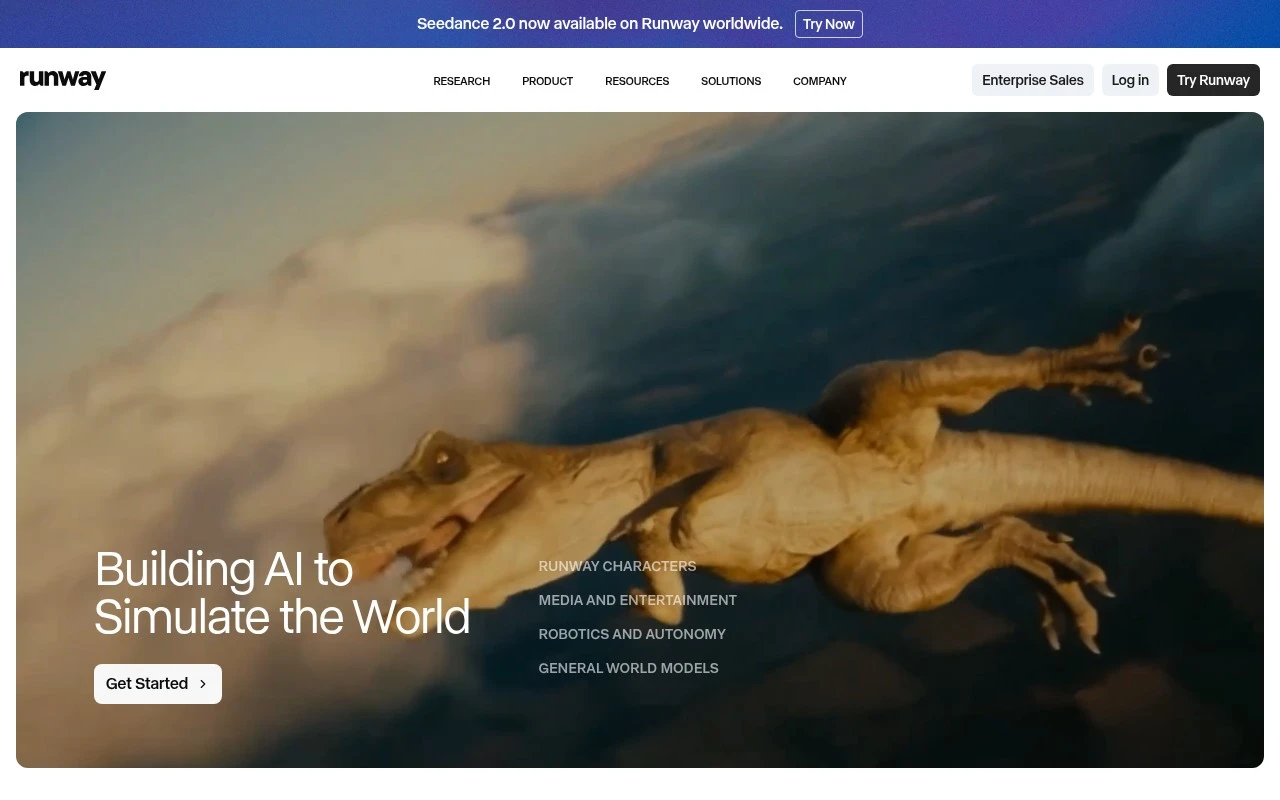
Runway is a creative AI and world-simulation platform for filmmakers, studios, designers, and developers who want to generate video, build controllable characters, and experiment with simulated visual worlds. Runway is best understood as a specialist platform for generative video and world models, not as a general productivity assistant or office automation tool. At the center of the product story is Gen-4.5, the company’s flagship video generation model. It is positioned around higher-fidelity motion, cinematic image quality, and stronger scene coherence, giving creators a way to move from written prompts, visual references, and creative direction into generated footage. The emphasis is not only on producing short clips, but on making video generation more usable for serious visual production. For filmmakers and visual teams, the platform acts like a creative engine rather than a conventional editor. It can help prototype shots, explore moods, visualize scenes before production, and create video material that would otherwise require cameras, sets, actors, or complex post-production workflows. Runway is especially relevant when the goal is to invent moving images from concept, not simply trim or polish existing footage. Real-time video agents through Runway Characters extend the platform beyond static generation. This direction connects generative media with agent building, allowing developers and creative teams to create responsive video characters that can speak, react, and appear as interactive presences. For products that need to create avatar video or build video-based interfaces, this makes Runway part of a broader shift toward live, AI-driven visual agents. The General World Model work gives the platform a wider ambition than text-to-video alone. GWM variants point toward explorable environments, simulated spaces, avatars, and robotics simulation, where generated video becomes a way to model how worlds look and behave. In that sense, the platform sits at the intersection of creative tooling, synthetic media, and early world simulation. Creative control is a defining part of the experience. The platform is designed for users who care about direction, continuity, character presence, camera feel, and the look of a generated scene. Rather than treating AI output as a one-shot novelty, it encourages iterative creation, where prompts, references, model choices, and edits become part of a production workflow. As a company and product ecosystem, Runway has become closely associated with the professionalization of AI video. Its tools are used by independent creators, advertising teams, film and media studios, design departments, and developers building new visual applications. Runway is best at helping users turn visual ideas into moving images and interactive media through purpose-built generative models. In practice, the platform is most useful when video is the medium and imagination is the starting point. It is not trying to replace every creative application or become a general chatbot. Its identity is clearer and more focused: an AI platform for generating, directing, and simulating visual experiences that would be difficult, expensive, or impossible to produce with traditional methods alone.

Use cases

Best for

Generate Video

Generate high quality videos from text prompts or images using Runway ML Gen-4.5, with controls for style and motion.

Agent Building

Build real time video agents by calling Runway Characters APIs to generate, control, and stream character video responses.

Create Avatar Video

Create avatar videos by generating a consistent character and animating it into clips from prompts or reference images.

ANALYSIS

Strengths & limitations

Strengths
  • Best suited to filmmakers and video creators because its core strengths are AI-generated video, cinematic visual experimentation, and high-quality generative visuals.
  • Useful for creative technologists because Runway Characters adds real-time video agent APIs for building custom conversational video experiences.
  • Strong fit for research and experimental teams because its General World Model work supports explorable worlds, avatars, and simulation-oriented workflows.

Limitations
  • Less suitable for teams seeking a general productivity assistant because Runway is focused on creative AI, video generation, virtual characters, and world simulation.
  • Production use can become cost-sensitive because the freemium model typically pushes heavier generation, iteration, and team workflows into paid usage.
  • Less suitable for teams that need mature, validated simulation infrastructure because its world-model and robotics simulation capabilities are best framed as early exploration rather than conventional production tooling.

Evaluation

FYAI score breakdown

Our structured evaluation across five key criteria

8.0 / 10

Overall score

Based on 276 reviews

  • Ease of use7.5 / 10
  • Features8.8 / 10
  • Pricing8.2 / 10
  • Integrations8.0 / 10
  • Support7.1 / 10

What users say

Findings from public reviews, documentation and community sources.

  • Ease of use

    G2 reviewers describe Runway as “straightforward,” and one G2 reviewer specifically highlights the image/text-to-video tool as easy to use.

  • Features

    Runway’s pricing page lists Gen-4.5 video generation, image generation, text-to-speech, and 4K upscaling.

  • Pricing

    Runway’s pricing page lists 5 tiers, from Free to Enterprise. Runway’s pricing page lists monthly prices, credit allowances, model usage rates, rollover rules, and the minimum extra-credit purchase for paid plans.

  • Integrations

    Runway’s developer docs say its API “allows you to bring” its generative models into apps, products, platforms, and websites.

  • Support

    Trustpilot’s review summary says “customer support takes forever to respond.” Runway’s pricing page references enterprise onboarding and priority support.

Who is this for?

Best for creators and teams that want several media-generation tools in one workflow, Runway’s pricing page lists Gen-4.5 video generation, image generation, text-to-speech, and 4K upscaling. Less suited to users who want simple included video generation, Runway’s paid plans use credit allowances and model usage rates, and the pricing note says short included Gen-4.5 generation amounts affect value.

PRODUCT PREVIEW

Feature highlights

Gen-4.5 Video Gen

Generate high-quality, cinematic video from prompts and references.

Runway Characters API

Real-time video agent APIs for interactive characters and scenes.

General World Models

Build explorable worlds for avatars, simulation, and robotics R&D.

COMPARE

Discover curated alternatives worth comparing

Compare similar AI tools based on features, pricing and use cases

8.5/ 10Based on 16 reviews

Wondercraft

Short-form VideoVideo Editing
Creates editable videos and audio from text, prompts, media
Best for:
Video creators
Pricing
Freemium

8.5/ 10Based on 65 reviews

Wisecut

Short-form VideoVideo Editing
Finds highlights, removes pauses, captions and reframes clips
Best for:
Video creators
Pricing
Freemium

8.6/ 10Based on 2,521 reviews

Vizard.ai

Short-form VideoVideo Editing
Extracts short clips, adds captions, and resizes videos
Best for:
Social media managers
Pricing
Freemium

Bring your ideas to life faster with Runway ML. Create cinematic videos that look polished, bold, and ready to share—start your next story today.

FAQ

Frequently asked
questions

Everything you need to know about this AI tool,
its features, pricing, use cases, and limitations.

Who is Runway best for?
Runway is best for teams that need AI-generated video, cinematic visual experimentation, custom video characters, or early world-simulation prototypes. It fits filmmakers, video creators, media teams, creative technologists, researchers, and organizations exploring generative video workflows rather than basic image editing or simple template-based video production.
Can I use Runway for free, or do I need a paid plan?
Runway uses a freemium pricing model, so users can typically start with a free option and move to paid access for broader production use. Teams should check Runway’s current pricing page for plan limits, usage allowances, export options, rights, and any restrictions that affect commercial video workflows.
How does Runway compare with other AI video tools?
Runway is most competitive when the priority is advanced generative video, cinematic output control, real-time video characters, and experimental world-model capabilities. Other AI video tools may be a better fit for simpler marketing videos, editing automation, lower learning effort, or teams that need clearer packaged workflows and operational limits.
How quickly can a team get started with Runway?
The main trade-off with Runway is that its most advanced areas, especially world models and robotics-related simulation, may be closer to research or frontier-product territory than standard self-serve software. Buyers should test output quality, motion consistency, prompt adherence, production limits, pricing fit, rights, and integration requirements before relying on it at scale.
What should teams check about privacy and compliance before using Runway?
Teams should review Runway’s current terms, privacy policy, security practices, and data-handling controls before uploading confidential footage, likenesses, voices, or proprietary creative assets. Important checks include content rights, consent for avatars, retention policies, model training use, access controls, compliance requirements, and whether the tool fits internal review processes.