Curated ToolThis tool is part of our curated AI directory. We only include tools that meet our standards for relevance, usability and real-world value.

Rask.ai

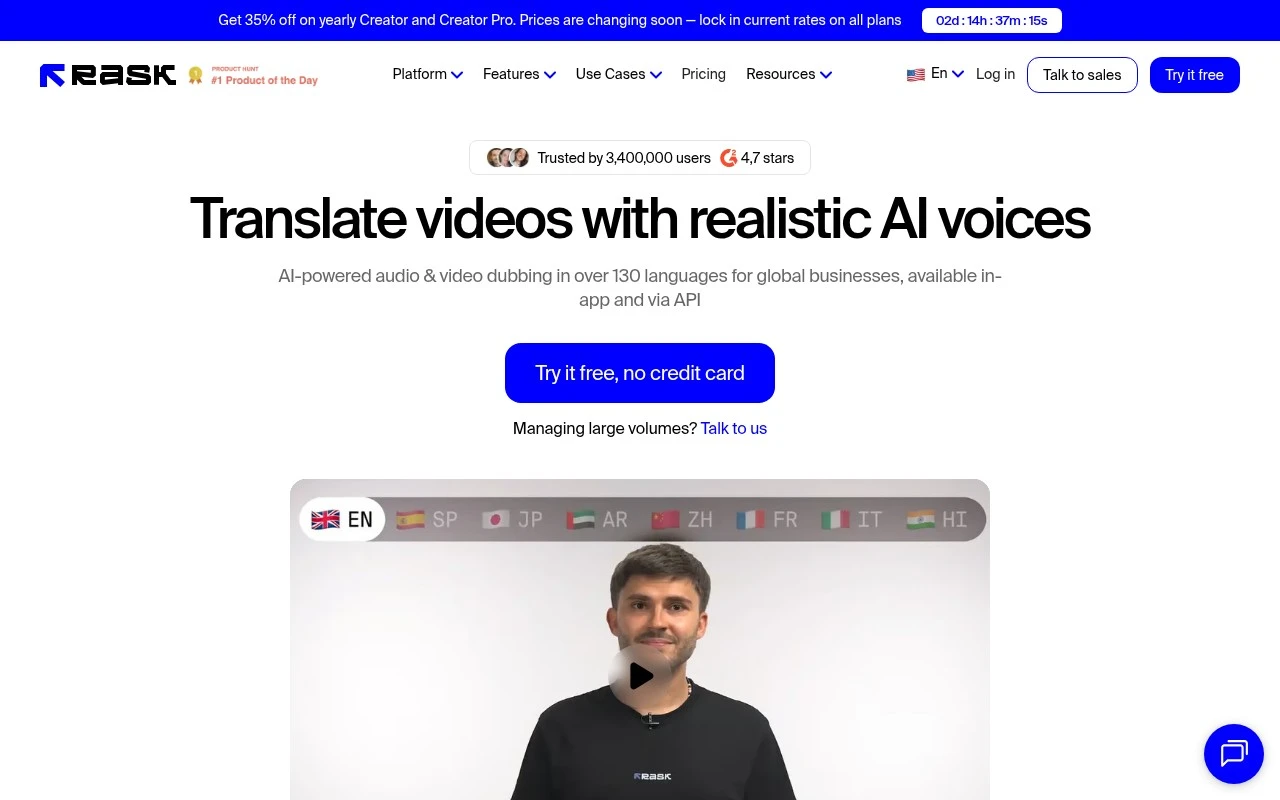
Rask.ai is an AI video localization platform for translating, dubbing, and adding subtitles to videos, with clone voice technology that can recreate a speaker’s voice in another language.
Video LocalizationAvatar / Talking Head

FYAI Score

8.3 / 10

Based on 270 reviews

Pricing:

Freemium

Best for:

Media and marketing teams localizing video at scale

Score Breakdown

  • Ease of use9.1 / 10
  • Features7.9 / 10
  • Pricing7.8 / 10
  • Integrations7.4 / 10
  • Support8.9 / 10

PRODUCT PREVIEW

What this AI tool does

Rask.ai is an AI video localization and dubbing platform for creators, educators, marketers, media teams, and businesses that need to translate video and audio content into other languages while keeping speech natural and audience-ready. It turns localization from a specialist studio workflow into a more accessible online process, combining video translation, AI dubbing, captions, voice cloning, and lip-sync tools in one place. The platform is especially useful when spoken content needs to travel across markets without being rebuilt from scratch. A training video, YouTube episode, product demo, course module, webinar, or internal company update can be adapted into many languages from a single source file. Instead of simply adding a translated text track, the tool can generate voiceover in a multilingual voice style that matches the tone of the original speaker more closely than generic text-to-speech. For creators and teams that need to clone voice characteristics, Rask.ai supports voice cloning across 32 languages, helping localized versions feel more consistent with the original performance. This matters for founder-led content, creator channels, branded education, and personality-driven media where the speaker’s voice is part of the identity. The goal is not just to translate words, but to preserve familiarity, pacing, and emotional continuity across languages. A major part of Rask.ai’s value is its handling of videos with more than one speaker. Multi-speaker detection helps separate voices, assign dialogue, and keep conversations understandable in the translated version. For interviews, panels, podcasts, documentaries, and customer stories, this reduces the manual coordination usually required to produce a clean multilingual dub. Lip sync video capabilities add another layer of polish for content where the viewer is watching the speaker’s face, not just listening in the background. By aligning dubbed speech more closely with mouth movement, the platform helps translated videos feel less disconnected. Auto-generated captions also make it easier to add subtitles, support accessibility, and offer viewers a readable version alongside the dubbed audio. Teams processing large volumes of media can use the Rask.ai API to connect localization into broader production systems. This makes the tool relevant beyond individual creators, especially for e-learning companies, media operations, localization agencies, and global marketing teams that need repeatable workflows. Rask.ai is best at helping organizations scale multilingual video production without managing every translation, voiceover, subtitle, and export step manually. Compared with many Rask.ai alternatives, the platform’s positioning is broader than basic subtitle translation or simple AI voice generation. It brings together translation, dubbing, voice cloning, captions, speaker handling, and lip-sync in a workflow designed specifically for video. That makes it a practical choice for users who want localized media output rather than isolated audio or transcript tools. Overall, Rask.ai sits at the intersection of AI dubbing, video translation, and content localization. It is designed for people who already have valuable spoken content and want to make it understandable, watchable, and more culturally accessible in many languages. For any Rask.ai review, the central point is that the tool focuses on reducing the friction of multilingual video production while keeping the final result closer to a real human viewing experience.

Use cases

Best for

Video Translation

Rask.ai translates video audio and captions into other languages and generates dubbed tracks with multi-speaker detection.

Lip Sync Video

It aligns translated speech to the original mouth movements using AI lip sync for localized video versions.

Clone Voice

It clones a speaker’s voice from a sample and uses it to dub translated scripts in supported languages.

ANALYSIS

Strengths & limitations

Strengths
  • Strong fit for international content teams because it combines 130+ language dubbing with captions, lip-sync, and realistic AI voices in one localization workflow.
  • Useful for multi-speaker videos and podcasts because speaker detection and voice cloning help preserve distinct voices across translated versions.
  • Well suited to teams processing large media volumes because the API supports scalable localization workflows beyond one-off manual uploads.

Limitations
  • Less suitable for teams that need a full video editing or animation suite because its focus is localization, dubbing, captions, and voice adaptation.
  • The freemium model is best for testing and lighter use, while teams localizing large content libraries should expect production-scale needs to require paid access.
  • AI-translated dubbing still needs human review for nuanced wording, pronunciation, cultural fit, and brand-sensitive content.

Evaluation

FYAI score breakdown

Our structured evaluation across five key criteria

8.3 / 10

Overall score

Based on 270 reviews

  • Ease of use9.1 / 10
  • Features7.9 / 10
  • Pricing7.8 / 10
  • Integrations7.4 / 10
  • Support8.9 / 10

What users say

Findings from public reviews, documentation and community sources.

  • Ease of use

    G2’s 270-review product page says users “consistently praise the ease of use” and the “intuitive interface that simplifies the dubbing process.” Rask’s own page highlights users calling Rask.ai “very user friendly” with an “easy to use interface.”

  • Features

    Rask’s own page lists video/audio translation into “130+ languages,” VoiceClone in “32 languages,” multi-speaker detection, and lip-sync. Rask’s own page also lists auto-generated captions, text-to-speech, SOC 2 Type II certification, and API-based scale.

  • Pricing

    Rask’s pricing page shows a free trial, Creator at “$33+/month” billed annually with 300 minutes/year, Creator Pro at “$78+/month” with 1,200 minutes/year, and Business at “$500+/month.” Rask’s pricing page lists $3 extra minutes on higher annual plans, and Reddit comments say Rask.ai “costs a fortune.”

  • Integrations

    Rask’s API page provides workflow connectivity through an API for “transcription, translation, dubbing and caption creation.” Rask’s pricing tiers reference Limited API, Production API with webhooks, and Dedicated API + integrations.

  • Support

    Rask’s own customer quote says “the support team is responsive and very helpful.” Rask’s pricing page references security review, contracts, invoicing, dedicated capacity, and SLA, and G2 reports 4.7/5 from 270 reviews.

Who is this for?

Best for teams localizing video and audio into multiple languages, Rask’s own page lists video/audio translation into “130+ languages” and VoiceClone in “32 languages.” Less suited to teams that mainly need a broad native integration marketplace, Rask’s cited connectivity is through an API for “transcription, translation, dubbing and caption creation,” with pricing tiers referencing Limited API, Production API with webhooks, and Dedicated API + integrations.

PRODUCT PREVIEW

Feature highlights

130+ Language Dubbing

Translate and dub videos into 130+ languages with realistic voices.

Voice Cloning

Clone voices in 32 languages to keep a consistent brand sound.

API for Media Pipelines

Automate high-volume localization workflows with a team-ready API.

COMPARE

Discover curated alternatives worth comparing

Compare similar AI tools based on features, pricing and use cases

8.5/ 10Based on 16 reviews

Wondercraft

Short-form VideoVideo Editing
Creates editable videos and audio from text, prompts, media
Best for:
Video creators
Pricing
Freemium

8.5/ 10Based on 65 reviews

Wisecut

Short-form VideoVideo Editing
Finds highlights, removes pauses, captions and reframes clips
Best for:
Video creators
Pricing
Freemium

8.6/ 10Based on 2,521 reviews

Vizard.ai

Short-form VideoVideo Editing
Extracts short clips, adds captions, and resizes videos
Best for:
Social media managers
Pricing
Freemium

Reach global audiences faster with videos that feel native in every market. Start localizing your content with Rask.ai today and ship more campaigns with less effort.

FAQ

Frequently asked
questions

Everything you need to know about this AI tool,
its features, pricing, use cases, and limitations.

Who is Rask.ai best suited for?
Rask.ai is best suited for teams that need to localize existing video or audio content for international audiences. It fits businesses, educators, creators, media teams, marketers, and enterprises translating videos, podcasts, courses, lectures, and marketing assets with AI dubbing, captions, voice cloning, lip-sync, and API-based workflows.
Does Rask.ai have a free plan, and when would I need a paid plan?
Rask.ai uses a freemium pricing model, so users can typically try the product before committing to paid usage. Paid plans are more relevant for teams handling longer content, higher localization volume, advanced dubbing workflows, or API-based automation. Check rask.ai for current plan limits and included features.
How does Rask.ai compare with other video translation and dubbing tools?
Rask.ai stands out by covering a broad localization workflow in one platform, including translation, AI dubbing, captions, voice cloning, multi-speaker handling, lip-sync, and API access. The best alternative depends on your budget, required languages, voice quality expectations, editing needs, compliance requirements, and production volume.
How quickly can a team get started with Rask.ai?
Rask.ai is mainly a localization and dubbing platform, not a full video production or editing suite. Voice cloning is listed for fewer languages than its broader translation and dubbing coverage, and AI-generated voices, translations, captions, or lip-sync may still need human review for accuracy, tone, timing, and brand fit.
Is Rask.ai suitable for business content from a privacy and compliance perspective?
Rask.ai is positioned for business and enterprise localization, and its official site lists SOC 2 Type II certification. Buyers should still review current security documentation, data retention terms, access controls, API handling, and consent requirements for voice cloning, especially when localizing confidential, regulated, or talent-owned media.