Curated ToolThis tool is part of our curated AI directory. We only include tools that meet our standards for relevance, usability and real-world value.

Pika

Pika is an AI video generation tool that creates and edits short videos from text prompts, images, or existing clips. It supports features for modifying motion, style, and specific parts of a scene.
Short-form VideoVideo Generators

FYAI Score

7.7 / 10

Based on 64 reviews

Pricing:

Freemium

Best for:

Creators making short-form AI videos from prompts, images, or clips

Score Breakdown

  • Ease of use7.1 / 10
  • Features7.3 / 10
  • Pricing9.2 / 10
  • Integrations8.1 / 10
  • Support7.3 / 10

PRODUCT PREVIEW

What this AI tool does

Pika is an AI video platform for turning prompts, images, and creative ideas into short AI-generated videos for creators, marketers, and anyone experimenting with visual storytelling. It is built around the idea that video generation should feel closer to playful direction than traditional production, with users describing a scene, supplying a visual reference, or applying an effect to create motion quickly. At its core, the platform is about helping people generate video without needing a camera crew, animation software, or advanced editing skills. Pika 2.5 represents the main video generation experience, giving users a way to move from concept to short clip through text and visual inputs. The result is a tool that fits naturally into short form video creation, concept development, and rapid creative testing. For social media content creation, Pika is especially relevant because its output is oriented toward brief, eye-catching clips rather than long-form production workflows. A creator might use it to animate a product idea, create a surreal visual gag, remix a selfie into a trend video, or build a stylized moment for TikTok, Instagram, YouTube Shorts, or other platforms. The appeal is not only speed, but the ability to make scenes that would be difficult, expensive, or impossible to film in real life. A broader creative ecosystem is what separates the platform from a simple prompt-to-video generator. Alongside Pika 2.5, the company presents experiments such as a video effects app, AI Trendmaker, Pika Agent, and Pika MCP. Together, these point to a product direction where AI video is not just a single creation box, but a set of interfaces for making, transforming, automating, and sharing visual content. Reality-bending effects are a major part of the product’s character. Instead of asking users to manually keyframe transformations or composite layers, the effects experience focuses on one-tap or simple-input changes that can alter a subject, environment, or moment in a visually dramatic way. This makes the platform feel accessible to casual users while still being useful for professionals who need fast ideation. Conversational creation adds another layer to the story. Pika Agent suggests a future where users can guide video creation through dialogue, asking an AI system to help shape an idea rather than only entering a static prompt. That matters for users who know the mood, joke, or visual outcome they want, but need assistance translating it into a video-ready direction. For developers and agent builders, Pika MCP extends the concept beyond the front-end creator experience. By giving other agents access to Pika-style content generation, the platform positions AI video as something that can be embedded into larger workflows, applications, and automated creative systems. This makes it relevant not only to individual creators, but also to teams exploring how generative media can fit into products and content pipelines. The platform’s best use cases are fast visual exploration, social-first content, stylized effects, AI-generated clips, and creative experiments that benefit from immediacy. It is less about replacing every stage of professional filmmaking and more about opening a new lane for people who want to create motion from imagination, references, and prompts. Pika is best at making AI video feel approachable, expressive, and connected to internet-native creative culture. Pika is designed for creators, brands, meme makers, artists, and technically curious teams that want to generate video quickly while experimenting with new forms of visual expression. Its identity is playful but increasingly expansive, combining consumer-friendly video effects with more advanced ideas around agents and interoperable creative tools. In that sense, it sits at the intersection of AI video generation, social media creativity, and the emerging world of agent-driven media production.

Use cases

Best for

Generate Video

Use Pika to generate short AI videos from text prompts or visual inputs like images and clips.

Social Media Content Creation

Create social posts by applying Pika one tap video effects and trend templates to selfies and audio.

Short Form Video Creation

Produce short form videos by iterating prompts and effects to quickly output multiple clip variations.

ANALYSIS

Strengths & limitations

Strengths
  • Best suited to social video creators because it combines prompt-based generation, image-to-video workflows, stylized effects, and trend-format clips in one creative ecosystem.
  • Useful for marketers and creative teams because it can turn ideas and visual inputs into short videos without a traditional shoot, edit, and post-production workflow.
  • Strong fit for experimental AI workflows because Pika Agent and Pika MCP extend video generation into conversational creation and agent-accessible content generation.

Limitations
  • Less suitable for long-form video production because Pika is centered on short AI-generated clips, visual effects, and social-style outputs rather than full-length editing workflows.
  • Less suitable for teams needing frame-accurate control or strict brand continuity because generative video tools prioritize rapid variation over deterministic scene-by-scene production.
  • The freemium model is better for testing and light creation because higher-volume use, advanced capabilities, or fewer usage constraints are likely to require a paid plan.

Evaluation

FYAI score breakdown

Our structured evaluation across five key criteria

7.7 / 10

Overall score

Based on 64 reviews

  • Ease of use7.1 / 10
  • Features7.3 / 10
  • Pricing9.2 / 10
  • Integrations8.1 / 10
  • Support7.3 / 10

What users say

Findings from public reviews, documentation and community sources.

  • Ease of use

    A Reddit user in r/StableDiffusion says Pika’s interface “drives me crazy” when trying to demo image-to-video/Pikaframes. Pika’s own copy emphasizes simple creation.

  • Features

    The Pika pricing page lists text-to-video, image-to-video, video-to-video, and Pikaformance audio/video options.

  • Pricing

    The Pika pricing page lists a Free plan plus paid tiers at $8/month, $28/month, and $76/month billed yearly. The Pika pricing page details monthly credits, per-video credit costs, resolutions, duration limits, watermark removal, and commercial use.

  • Integrations

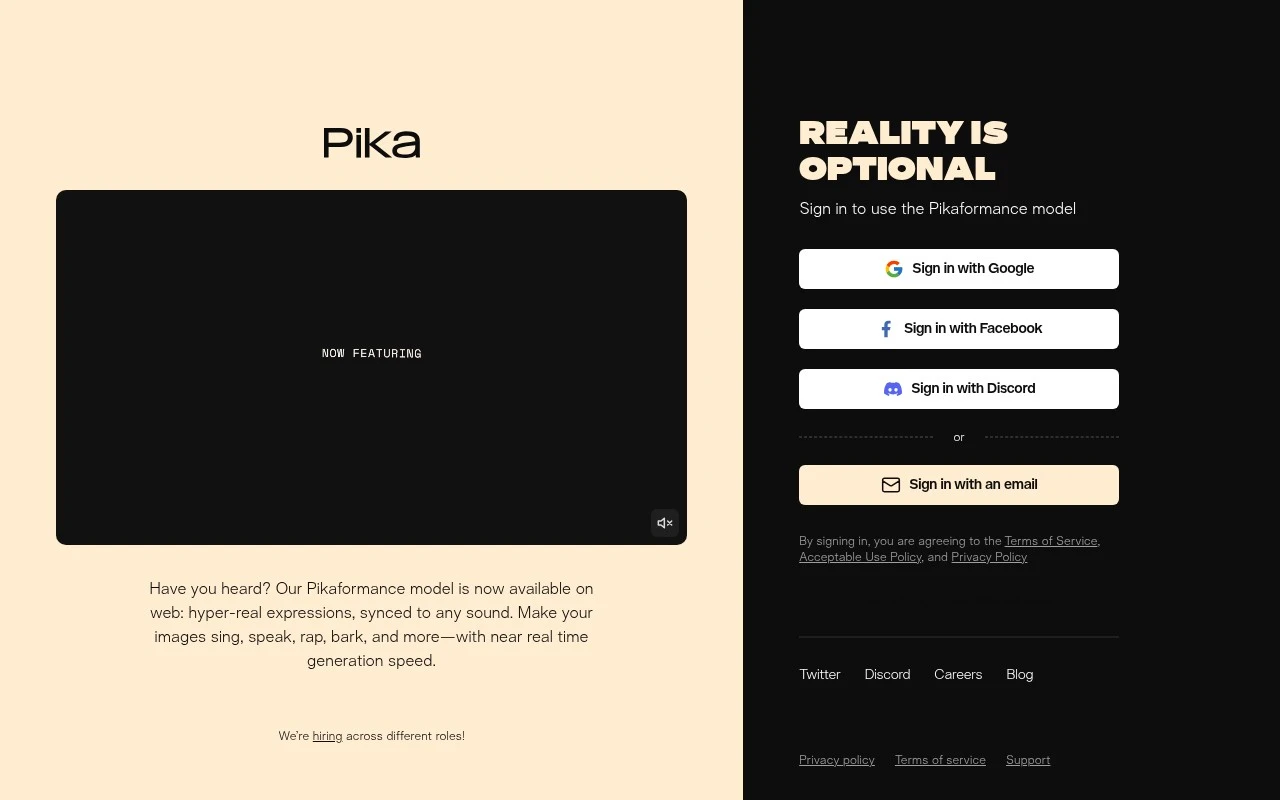
    The Pika pricing page references “API Connect.” The provided integrations page mainly surfaces sign-in options rather than a broad named integration catalog.

  • Support

    A Reddit r/pika_ai community signal includes complaints about “technical issues” and accusations from Pika users. The provided docs/support page mainly surfaces sign-in and footer links rather than detailed public documentation.

Who is this for?

Best for creators who want multiple AI video generation modes, the Pika pricing page lists text-to-video, image-to-video, video-to-video, and Pikaformance audio/video options. Less suited to users who need a clear onboarding and support path, a Reddit user says Pika’s interface “drives me crazy,” and the provided docs/support page mainly surfaces sign-in and footer links rather than detailed public documentation.

PRODUCT PREVIEW

Feature highlights

Prompt-to-video

Generate short AI videos from text prompts and creative direction.

One-tap effects

Apply reality-bending video effects to transform existing footage fast.

Pika Agent + MCP

Use agents and MCP to automate and extend Pika-style video creation.

COMPARE

Discover curated alternatives worth comparing

Compare similar AI tools based on features, pricing and use cases

8.5/ 10Based on 16 reviews

Wondercraft

Short-form VideoVideo Editing
Creates editable videos and audio from text, prompts, media
Best for:
Video creators
Pricing
Freemium

8.5/ 10Based on 65 reviews

Wisecut

Short-form VideoVideo Editing
Finds highlights, removes pauses, captions and reframes clips
Best for:
Video creators
Pricing
Freemium

8.6/ 10Based on 2,521 reviews

Vizard.ai

Short-form VideoVideo Editing
Extracts short clips, adds captions, and resizes videos
Best for:
Social media managers
Pricing
Freemium

Turn ideas into eye-catching animated videos in minutes. Start creating content that grabs attention and boosts your brand with Pika today.

FAQ

Frequently asked
questions

Everything you need to know about this AI tool,
its features, pricing, use cases, and limitations.

Who is Pika best suited for?
Pika is best suited for creators, social video makers, marketers, and creative teams making short AI-generated videos or stylized visual effects. It fits workflows built around prompts, photos, selfies, sounds, and trend-style formats rather than traditional long-form video production or frame-by-frame editing.
Is Pika free, and what do paid plans usually affect?
Pika uses a freemium pricing model, so users can typically start with free access and upgrade for broader usage. Paid access commonly matters for higher output limits, more generation capacity, faster workflows, or additional creative controls, but current plan details should be checked directly on pika.art.
How does Pika compare with other AI video creation tools?
Pika stands out for short-form AI video creation, one-tap visual effects, selfie-based trend clips, and agent-oriented creative workflows. Similar tools may offer stronger editing timelines, brand asset management, longer-form production, or more granular controls, so the better choice depends on content format, budget, and production needs.
How quickly can a team get started with Pika?
Pika’s main trade-off is that it appears focused on short, effect-driven, trend-style content rather than long-form editing or highly controlled video production. Buyers should evaluate output limits, generation controls, editing depth, consistency, export needs, and whether its creative effects match the level of precision required.
What should companies check before using Pika with brand or customer content?
Companies should review Pika’s current privacy terms, data usage policies, retention practices, and account controls before uploading sensitive brand, employee, or customer media. Teams handling regulated data should confirm compliance requirements directly, limit uploads to approved assets, and set internal rules for prompts, selfies, sounds, and generated outputs.