Curated ToolThis tool is part of our curated AI directory. We only include tools that meet our standards for relevance, usability and real-world value.

SiteChecker

Tracks AI search visibility alongside SEO audits, rankings, and traffi

SEO MonitoringTechnical & Audit
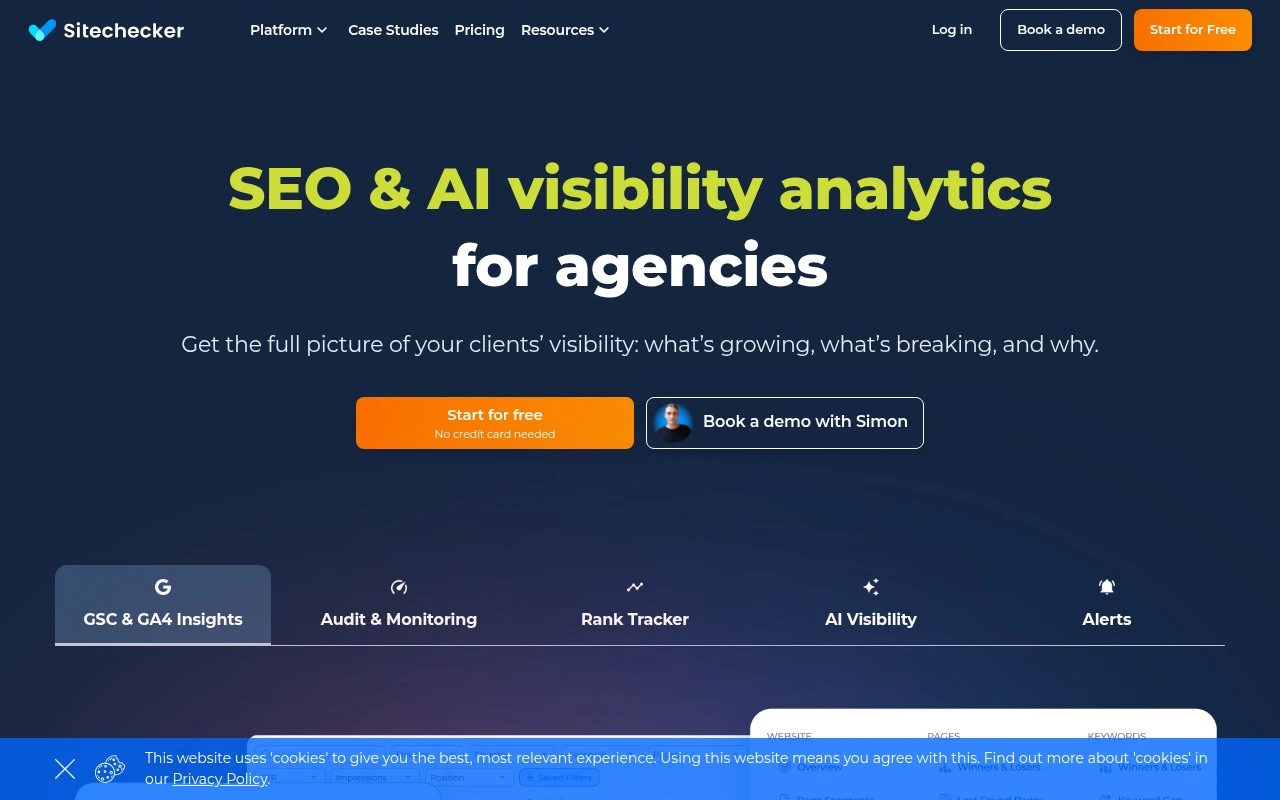
SiteChecker is an SEO command center built mainly for agencies that manage many websites. It centralizes rank tracking, AI visibility analytics, technical SEO audits, Google Search Console and GA4 insights, site monitoring, alerts, exports, and client reporting so teams can spot ranking drops, traffic changes, technical issues, or content changes without switching between multiple tools.

FYAI Score

8.1 / 10

Based on 365 reviews

Pricing:

Freemium

Best for:

SEO agencies managing many client websites

Score Breakdown

  • Ease of use8.5 / 10
  • Features7.6 / 10
  • Pricing8.1 / 10
  • Integrations7.7 / 10
  • Support8.9 / 10

PRODUCT PREVIEW

What this AI tool does

SiteChecker is an AI-assisted tool for reviewing a website and surfacing common issues that can affect how it works for visitors and how it appears in search results. It’s designed for people who want a quick, readable overview of what may need attention without digging through multiple reports or tools. You can use it to scan pages and get guidance on areas such as technical SEO, on-page structure, and basic site health signals. The output is written to support informational research and planning, helping you decide what to fix first and what to monitor over time. Because it focuses on clarity rather than volume, sitechecker is useful for routine checkups, pre-launch reviews, or validating changes after updates. It won’t replace a full manual audit, but it can help you spot patterns and prioritize follow-up work.

Use cases

Best for

SEO Client Reporting

Generate client-ready SEO reports using GA4, Search Console, ranks, audits, and alerts with scheduled exports.

SEO Audit

SiteChecker runs technical SEO audits to flag crawl errors, broken links, redirects, indexability issues, and page changes.

Rank Tracking

Track keyword rankings over time and get alerts on position drops, with visibility analytics tied to monitored pages.

ANALYSIS

Strengths & limitations

Strengths
  • Combines SEO audits, rank tracking, GSC and GA4 insights, AI visibility analytics, monitoring, alerts, and reporting in one platform.
  • Designed for multi-site agency workflows, including dashboards for many client sites, invited users, exports, and optional white-label reporting.
  • Uses connected Google Search Console and GA4 data for client-site analysis rather than relying only on modeled third-party traffic estimates.
Limitations
  • The positioning is strongest for agencies managing many sites, so very small teams or single-site owners may not need the full workflow.
  • Custom scaling is based on websites and keywords, so larger agency usage may require a custom plan rather than simple fixed pricing.
  • The official page emphasizes SEO monitoring and reporting, not broader all-in-one marketing functions outside SEO visibility, audits, and analytics.

Evaluation

FYAI score breakdown

Our structured evaluation across five key criteria

8.1 / 10

Overall score

Based on 365 reviews

  • Ease of use8.5 / 10
  • Features7.6 / 10
  • Pricing8.1 / 10
  • Integrations7.7 / 10
  • Support8.9 / 10

What users say

Findings from public reviews, documentation and community sources.

  • Ease of use

    G2 summarizes that users “consistently praise the user-friendly interface and detailed reports” for Sitechecker.

  • Features

    Sitechecker describes an agency-focused SEO suite with “AI Visibility,” “GSC & GA4 Insights,” “Audit & Monitoring,” and “Rank Tracker.” Sitechecker also references alerts, customizable reports, white labeling, and multi-site dashboards.

  • Pricing

    G2 lists Sitechecker paid tiers as “Basic $49.00,” “Standard $199.00,” and “Premium $399.00.” Sitechecker’s own positioning emphasizes scalable agency usage with no extra user fees.

  • Integrations

    SoftwareFinder names Sitechecker integrations with “Looker Studio, Slack, Google Analytics, and Google Console.”

  • Support

    Capterra lists Sitechecker at 4.6/5 across 365 reviews, and the Capterra snippet notes that “the support team is responsive.”

Who is this for?

Best for agencies managing SEO monitoring and audits across multiple sites. Sitechecker references multi-site dashboards, white labeling, customizable reports, and no extra user fees. Less suited to teams looking for a full all-in-one research suite, the facts describe Sitechecker more as an SEO monitoring/audit command center with “AI Visibility,” “GSC & GA4 Insights,” “Audit & Monitoring,” and “Rank Tracker.”

PRODUCT PREVIEW

Feature highlights

Alerts & Monitoring

Get notified on traffic, ranking, or content changes.

Unified Command Center

Track performance, audits, and insights for all sites in one place.

Instant Alerts & Fixes

Get notified fast when issues hit, and export reports for clients.

COMPARE

Discover curated alternatives worth comparing

Compare similar AI tools based on features, pricing and use cases

8.8/ 10Based on 846 reviews

Yoast SEO

Content & On-pageTechnical & Audit
Generates and optimizes SEO titles, descriptions, and content
Best for:
SEO teams
Pricing
Freemium

8.1/ 10Based on 1.124 reviews

Yext

SEO MonitoringAI Search / GEO
Manages verified business data for search and AI discovery.
Best for:
SEO teams
Pricing
Paid

7.7/ 10Based on 5.772 reviews

Writesonic

Copy Optimization
Monitors brand visibility in answer engines and flags citation gaps
Best for:
Marketing teams
Pricing
Freemium

See what’s holding your rankings back and turn audits into clear fixes. Start improving visibility and conversions with SiteChecker today.

FAQ

Frequently asked
questions

Everything you need to know about this AI tool,
its features, pricing, use cases, and limitations.

Who is SiteChecker a good fit for, and when should I choose another SEO tool?
SiteChecker fits small to mid-sized teams that need repeatable SEO audits, clear issue prioritization, and basic competitor benchmarking. It’s a practical choice for ongoing site health checks and content/technical cleanup. If you manage very large, complex sites or need deep log-file analysis and enterprise workflows, you may outgrow it and want a more specialized platform.
Does SiteChecker have a free plan, and what are the main limitations compared to paid tiers?
SiteChecker typically allows limited access for evaluation, but the more advanced audit depth, higher crawl limits, and some competitive features are usually gated behind paid plans. Expect restrictions around the number of projects, pages crawled, and reporting frequency on lower tiers. If you need scheduled audits across multiple sites, you’ll likely need a higher subscription level.
How does SiteChecker compare with alternatives like Semrush, Ahrefs, or Screaming Frog?
SiteChecker is more audit- and issue-fix oriented, with a simpler interface than all-in-one suites like Semrush or Ahrefs. Compared with Screaming Frog, it’s generally easier to use and more guided, but less customizable for power users. If your priority is a broad marketing suite (keywords, PPC, content) you may prefer Semrush/Ahrefs; if you want maximum crawl control, Screaming Frog can be stronger.
How quickly can I get value from SiteChecker, and what onboarding work is required?
Some capabilities may be locked to higher tiers, which can matter if you need large crawl volumes or multiple client sites. For very large websites, the depth and performance may not match enterprise-focused crawlers. Also, if your workflow depends on tight integrations with other marketing tools, confirm compatibility before committing.
What should I check about SiteChecker’s data handling, privacy, and compliance before using it?
Review what SiteChecker stores from your crawls (URLs, metadata, page content snippets) and how long it retains project data. Confirm where data is hosted, whether you can delete projects on demand, and what access controls exist for team accounts. If you operate under GDPR/CCPA or have client confidentiality requirements, verify the DPA, subprocessors, and security measures in their policy documentation.