Curated ToolThis tool is part of our curated AI directory. We only include tools that meet our standards for relevance, usability and real-world value.

Similarweb

Similarweb is a digital intelligence platform that estimates website and app traffic, engagement metrics, audience demographics, traffic sources, and search keyword performance. It is used for market research, benchmarking, and digital strategy analysis.
SEO MonitoringKeyword & Research

FYAI Score

8.6 / 10

Based on 1,174 reviews

Pricing:

Freemium

Best for:

Growth and market intel teams tracking competitors and demand

Score Breakdown

  • Ease of use8.3 / 10
  • Features9.2 / 10
  • Pricing7.7 / 10
  • Integrations9.1 / 10
  • Support8.6 / 10

PRODUCT PREVIEW

What this AI tool does

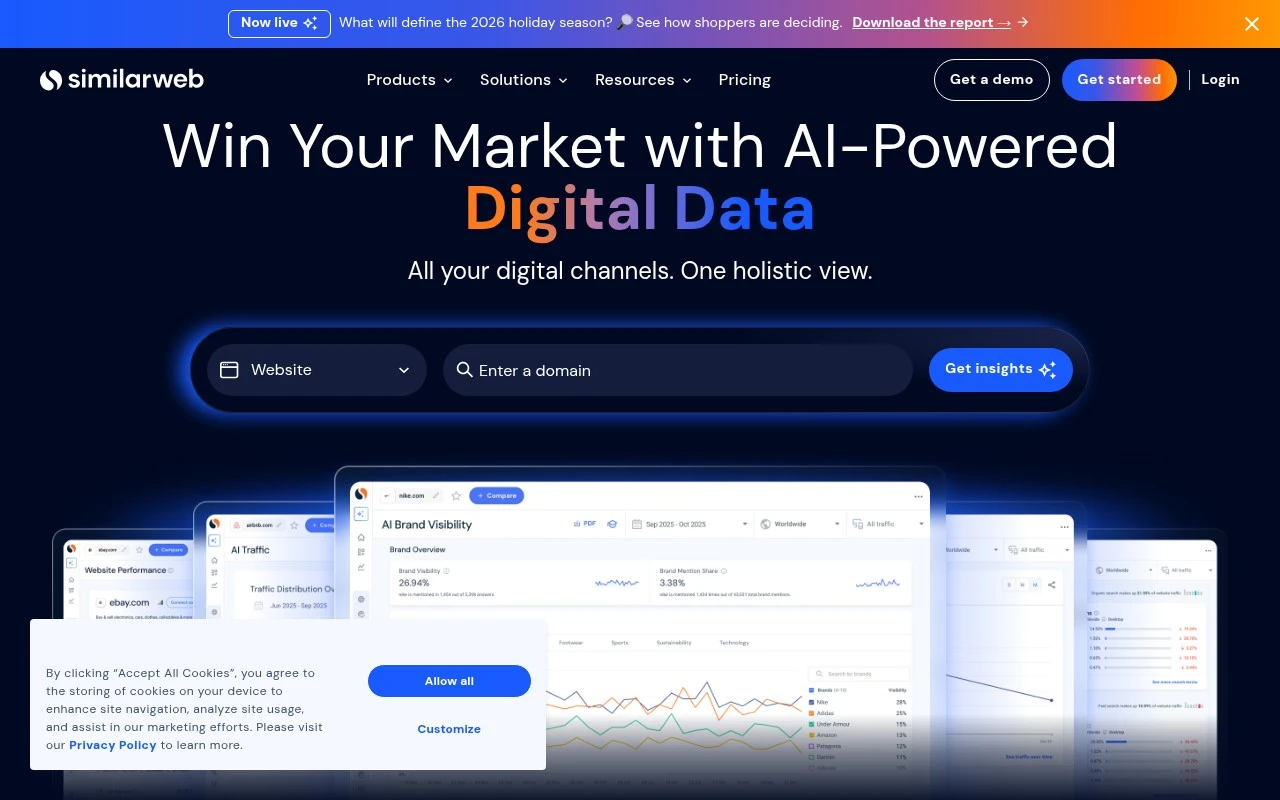
Similarweb is an AI-powered digital data intelligence platform for companies that need to understand online markets, competitors, audiences, search demand, apps, retail channels, and buying signals from one connected source. Similarweb is best at turning large-scale web, app, search, marketplace, and company data into business intelligence that teams can use for strategy, marketing, sales, ecommerce, and investment decisions. For market and strategy teams, the platform provides a broad view of how digital categories move. It helps users see which websites are gaining traffic, where audiences are coming from, how competitors acquire users, and which channels are shaping demand. This makes it useful when a company needs context beyond its own analytics, especially in markets where competitor analysis and audience behavior matter. Search and performance teams use Similarweb to connect keyword research with real competitive behavior. Instead of looking only at isolated rankings, they can study traffic sources, organic and paid search demand, SERP analysis, and the terms competitors depend on. The result is a more market-aware approach to SEO, rank tracking, ad campaign optimization, and content planning. In retail and ecommerce settings, the tool shifts from website visibility to marketplace performance. Retail intelligence helps brands, sellers, and category managers understand product demand, Amazon performance, category movement, and competitive positioning across digital shelves. That perspective is especially valuable when ecommerce teams need to see not just their own sales data, but the wider market signals surrounding it. Sales organizations approach the platform from another angle. Similarweb supports sales intelligence by helping revenue teams identify accounts with relevant digital activity, category fit, growth signals, and potential buying intent. Those company-level indicators can support prospecting, account prioritization, and lead scoring without relying only on static firmographic data. App intelligence adds another layer for teams that operate in mobile-first markets. It gives product, growth, and investment teams a way to understand app performance, engagement, audience overlap, and category dynamics. For companies competing across both web and mobile, this helps connect the customer journey across channels rather than treating app and site behavior as separate worlds. AI search intelligence extends the product into a newer visibility problem: how brands appear across AI-powered search and answer experiences. As discovery moves beyond traditional blue links, ai search visibility tracking helps teams understand whether their brand, competitors, and topics are being surfaced in emerging AI search environments. This makes the platform relevant not only for current SEO workflows, but also for future-facing search strategy. For analysts and data teams, Similarweb can also function as a data infrastructure layer. API data services allow organizations to bring digital market data into internal dashboards, models, report generation systems, and recurring business intelligence workflows. Advisory services complement the software for companies that need expert interpretation, custom analysis, or support translating digital signals into strategic decisions. The platform’s character is breadth. It is not only an SEO tool, a sales prospecting database, an app analytics product, or an ecommerce research system, although it touches each of those areas. Its larger role is to help organizations read the digital economy from the outside in, using observed market behavior to make better decisions about where to compete, how to allocate budget, which accounts to pursue, and how competitors are changing.

Use cases

Best for

Competitor Analysis

Compare competitors by estimating traffic, channels, audience overlap, and top referral sites to infer their acquisition tactics.

Keyword Research

Use Similarweb to research keywords by viewing search demand, related queries, and which sites capture traffic from each term.

Business Intelligence

Track market and company signals by combining web, app, retail, and sales intelligence data into dashboards and API feeds.

ANALYSIS

Strengths & limitations

Strengths
  • Best suited to teams that need a broad market view because it combines web, app, search, retail, sales, API, and advisory intelligence in one platform.
  • Strong fit for SEO and GEO teams because it tracks search demand, AI brand visibility, citations, sentiment, and visibility across AI search engines and chatbots.
  • Useful for agencies, consultants, and enterprise teams because competitor traffic sources, audience behavior, and marketplace performance can support client reporting and strategic planning.

Limitations
  • Less suitable for teams that only need basic rank tracking or on-page SEO tasks because the platform is broader and heavier than a narrow SEO workflow tool.
  • Freemium access is best for exploration because deeper competitive intelligence, higher limits, APIs, and advisory use cases typically require paid access.
  • Not ideal as the sole source for exact internal performance reporting because third-party market intelligence is designed for estimates, benchmarking, and directional analysis rather than replacing first-party analytics.

Evaluation

FYAI score breakdown

Our structured evaluation across five key criteria

8.6 / 10

Overall score

Based on 1,174 reviews

  • Ease of use8.3 / 10
  • Features9.2 / 10
  • Pricing7.7 / 10
  • Integrations9.1 / 10
  • Support8.6 / 10

What users say

Findings from public reviews, documentation and community sources.

  • Ease of use

    Software Advice review-site feedback describes Similarweb as a “fast and valuable tool” with “clear insights.” Similarweb's pricing page highlights usability aids including “AI Studio,” “Natural language queries,” and “AI-generated dashboards.”

  • Features

    Similarweb's website lists category coverage including “SEO & AEO,” “Keyword Research,” “AI Brand Visibility,” and “AI Citation Analysis.” Similarweb's website states data scale of “100M+ Website,” “4M+ Apps,” “5B Search Terms,” and “10Y Historical Data.”

  • Pricing

    Similarweb's pricing page lists “Web Intelligence plans from $125/mo” and a free trial, while business and enterprise packages require users to “Talk to sales” for a custom package.

  • Integrations

    Similarweb's pricing page lists “Data integrations & APIs,” “Real-time and bulk APIs,” “BI tool Integrations,” and “MCP for AI workflows.” Similarweb's pricing page also references “Custom data feeds” and integrations with “Snowflake, AWS, and more.”

  • Support

    Similarweb's pricing page lists “dedicated enterprise support” and support-ticket handling via “[email protected].” Similarweb's pricing page says business plan changes or cancellation use account-representative assistance.

Who is this for?

Best for SEO and market-intelligence teams that need search and competitor data at scale, Similarweb's website states “100M+ Website,” “4M+ Apps,” “5B Search Terms,” and “10Y Historical Data.” Less suited to buyers who need fully self-serve price comparison before contacting vendors, Similarweb's pricing page lists “Web Intelligence plans from $125/mo” but says business and enterprise packages require users to “Talk to sales” for a custom package.

PRODUCT PREVIEW

Feature highlights

Traffic & share trends

Benchmark sites by traffic, channels, engagement, and market share.

Buyer intent signals

Find in-market accounts with company-level research and buying signals.

Market & Rival Insights

Track traffic, apps, and search trends to spot growth and threats.

COMPARE

Discover curated alternatives worth comparing

Compare similar AI tools based on features, pricing and use cases

7.5/ 10Based on 12,890 reviews

Zoominfo

Lead GenerationCRM & Segmentation
Finds prospects, enriches accounts, and flags buyer signals
Best for:
Sales teams
Pricing
Paid only

8.6/ 10Based on 6,982 reviews

Zoho CRM

Sales & OutreachAnalytics & Reporting
Rewrites emails, detects anomalies, and builds CRM modules
Best for:
Sales teams
Pricing
Freemium

8.0/ 10Based on 1,041 reviews

Zoho Campaigns

Lead GenerationCRM & Segmentation
Builds email and SMS campaigns, automates and analyzes results
Best for:
Marketing teams
Pricing
Freemium

See what’s driving growth in your market. Start using Similarweb to spot winning channels, benchmark rivals, and prioritize opportunities with confidence.

FAQ

Frequently asked
questions

Everything you need to know about this AI tool,
its features, pricing, use cases, and limitations.

Who is Similarweb best suited for?
Similarweb is best suited for teams that need competitive digital market intelligence across websites, apps, search, ads, ecommerce, and AI search visibility. It is commonly relevant for marketing leaders, SEO teams, market researchers, growth teams, agencies, ecommerce teams, RevOps teams, and enterprises benchmarking digital performance.
Does Similarweb have a free plan, and what do paid plans add?
Similarweb uses a freemium pricing model, with free access suited to initial research and paid access typically needed for deeper analysis. Advanced capabilities such as broader competitive datasets, richer reporting, APIs, data partnerships, or enterprise-oriented services may require paid or sales-led access through Similarweb.
How does Similarweb compare with other SEO and competitor analysis tools?
Similarweb is broader than many SEO-only or rank-tracking tools because it focuses on digital intelligence across multiple channels. It can support keyword research, competitor analysis, SERP research, traffic benchmarking, ad insights, ecommerce analysis, and AI search visibility, but it may need to be paired with execution tools.
How quickly can a team get started with Similarweb?
Similarweb’s main trade-off is that it provides market intelligence and benchmarks rather than directly executing campaigns or managing outreach end to end. Its traffic and market figures are estimates, so teams should validate important decisions against first-party analytics, and some advanced products may have less transparent pricing.
What should buyers check about data privacy and compliance before using Similarweb?
Buyers should review Similarweb’s current security, privacy, compliance, and data processing terms before deploying it in regulated or enterprise environments. This is especially important for API usage, CRM enrichment, sales intelligence workflows, internal data sharing, user permissions, and any use case involving customer or account-level business data.