Curated ToolThis tool is part of our curated AI directory. We only include tools that meet our standards for relevance, usability and real-world value.

Serpstat

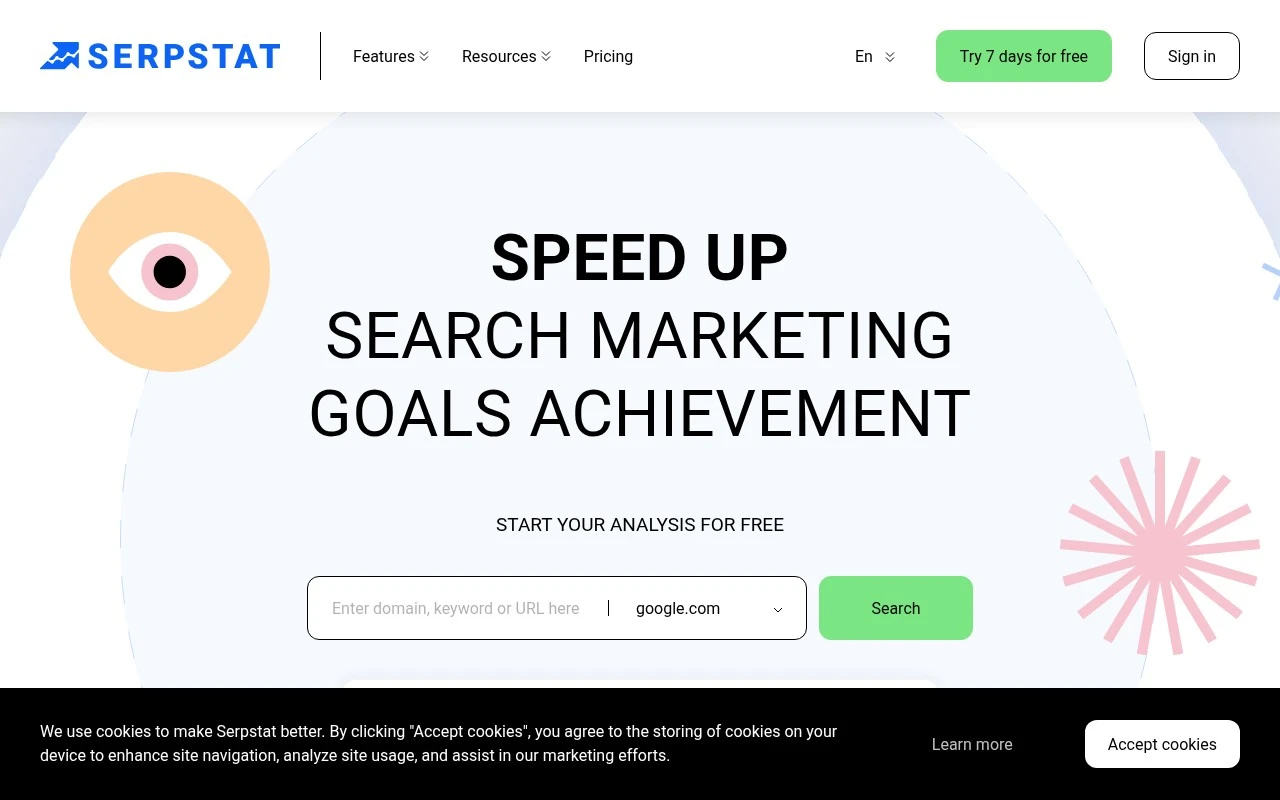
Serpstat is an SEO platform for keyword research, rank tracking, backlink analysis, site audits, and competitor research. It helps teams evaluate search visibility and identify technical and content opportunities.
Content & On-pageSEO Monitoring

FYAI Score

8.2 / 10

Based on 464 reviews

Pricing:

Freemium

Best for:

In-house SEO teams and agencies managing multi-market search performance

Score Breakdown

  • Ease of use8.3 / 10
  • Features8.0 / 10
  • Pricing8.4 / 10
  • Integrations8.1 / 10
  • Support8.5 / 10

PRODUCT PREVIEW

What this AI tool does

Serpstat is a search marketing toolset for SEO, content, and competitive research teams that need to understand search visibility, discover keyword opportunities, monitor rankings, and diagnose website issues from one platform. It brings together keyword research, competitor analysis, SEO audit workflows, rank tracking, backlink analysis, SERP analysis, and API access in a single environment. For in-house marketers, the platform is designed to reduce dependence on scattered spreadsheets, disconnected rank trackers, and fully outsourced SEO reporting. Teams can use it to see which domains compete for the same search demand, what pages attract organic traffic, and where their own site is gaining or losing visibility across Google markets. Keyword discovery is one of the central parts of the product. The tool helps users move from broad topics to usable search queries by showing volume, keyword difficulty, related phrases, questions, and search results context. This makes it useful for planning landing pages, blog clusters, product category pages, and content updates based on measurable search demand rather than assumptions. Competitive research gives Serpstat much of its strategic value for SEO teams, agencies, and content departments. By comparing domains and URLs, users can identify overlapping keywords, missing topics, high-performing competitor pages, and content gap analysis opportunities. The goal is not only to collect data, but to reveal where a site can realistically compete and where it needs stronger pages, better structure, or more authority. Technical site quality is handled through audit features that scan websites for SEO issues affecting crawlability, indexation, metadata, links, redirects, page performance signals, and other structural factors. This technical SEO analysis is especially helpful for teams that need a repeatable way to spot errors after site changes, migrations, content publishing, or development releases. Instead of treating audits as occasional projects, the platform supports ongoing monitoring of site health. Rank tracking adds a performance layer by showing how selected keywords move over time in Google across many countries and locations. Marketers can monitor priority terms, compare desktop and mobile visibility, and connect ranking changes with content work, technical fixes, or algorithm shifts. For teams reporting to clients or leadership, this turns SEO progress into a more traceable timeline. Backlink-related data broadens the view beyond on-page and keyword signals. The platform can be used to inspect referring domains, evaluate link profiles, and understand how competitors may be earning authority in a niche. While backlink analysis is only one part of search marketing, it helps teams connect content performance with the off-site signals that often influence organic visibility. API access makes Serpstat suitable for teams that want search data inside internal dashboards, reporting systems, or automated workflows. Agencies, larger marketing teams, and data-oriented SEO specialists can pull keyword, ranking, competitor, and audit data into their own processes instead of working only inside the interface. This gives the product a role not just as a research tool, but as a data source for recurring SEO operations. Overall, Serpstat is best understood as a practical search intelligence platform for teams that want to research markets, plan content, track rankings, and maintain technical SEO discipline without building a stack from many separate tools. Its character is broad and operational rather than narrowly specialised, making it useful for ongoing SEO management, competitor monitoring, and content planning across multiple projects or websites.

Use cases

Best for

Competitor Analysis

Compare competitor domains by analyzing their top keywords, ranking pages, and backlink metrics in Serpstat.

Keyword Research

Generate keyword ideas with search volume, difficulty, and SERP analysis to prioritize topics for content planning.

SEO Audit

Crawl your site to flag technical SEO issues like broken links, duplicate content, and missing meta tags.

ANALYSIS

Strengths & limitations

Strengths
  • Combines competitor research, keyword research, rank tracking, backlink metrics, site audit, and API access in one suite, which suits teams that want consolidated SEO data rather than separate point tools.
  • Supports Google rank monitoring across many countries, which is useful for agencies and businesses managing search visibility in multiple markets.
  • Provides API data access, which fits teams that want to feed SEO, keyword, ranking, and competitor data into dashboards or AI-assisted marketing workflows.

Limitations
  • Less suitable for teams looking for generative AI content creation because Serpstat primarily supplies search marketing data rather than producing finished content.
  • The freemium model can constrain ongoing SEO work because higher-volume keyword research, audits, rank tracking, and API use typically require a paid plan.
  • The broad toolset can be heavier than a single-purpose keyword or audit tool for small teams that only need one narrow SEO workflow.

Evaluation

FYAI score breakdown

Our structured evaluation across five key criteria

8.2 / 10

Overall score

Based on 464 reviews

  • Ease of use8.3 / 10
  • Features8.0 / 10
  • Pricing8.4 / 10
  • Integrations8.1 / 10
  • Support8.5 / 10

What users say

Findings from public reviews, documentation and community sources.

  • Ease of use

    Serpstat’s website includes a customer quote saying, “Serpstat UI is one of the most user-friendly and intuitive in any SEO tools I use.”

  • Features

    Serpstat’s features page lists keyword research, rank tracking, backlink analysis, site audits, and “over 55 SEO features.” Serpstat’s features page also lists keyword clustering, AI content tools, local SEO, and white-label reporting.

  • Pricing

    Serpstat’s subscription-plans blog says the Individual plan starts from “$50” on annual subscription. G2 summarizes Serpstat users as consistently praising “affordable pricing.”

  • Integrations

    Serpstat’s features page presents “API & Data Solutions” and describes Serpstat as a cost-effective API SEO data provider. Serpstat’s features page also lists “Ready integrations and apps for fast work with any site.”

  • Support

    Serpstat’s website highlights “Easy to handle and transparent documentation” for API/data solutions. Serpstat’s website includes a customer quote saying, “Most of all, I like all of the training and support they provide.”

Who is this for?

Best for SEO teams that want keyword research, rank tracking, backlink analysis, and site audits in one platform, Serpstat’s features page lists those workflows and “over 55 SEO features.” Less suited to buyers choosing primarily by named integration marketplaces, Serpstat’s features page references “API & Data Solutions” and “Ready integrations and apps for fast work with any site,” so teams may need to verify specific app fit.

PRODUCT PREVIEW

Feature highlights

Rank Tracking

Monitor Google rankings across countries and devices with daily updates.

Competitor Insights

Benchmark rivals and spot growth opportunities across your market.

Site Health Audits

Find and fix technical issues that hurt performance and visibility.

COMPARE

Discover curated alternatives worth comparing

Compare similar AI tools based on features, pricing and use cases

8.8/ 10Based on 846 reviews

Yoast SEO

Content & On-pageTechnical & Audit
Optimizes SEO titles, descriptions, and product content
Best for:
SEO teams
Pricing
Freemium

8.1/ 10Based on 1,124 reviews

Yext

SEO MonitoringAI Search / GEO
Publishes verified business data, tracks AI and search discovery
Best for:
SEO teams
Pricing
Paid

7.7/ 10Based on 5,772 reviews

Writesonic

Copy Optimization
Surfaces answer-engine visibility and citation gaps for GEO fixes
Best for:
Marketing teams
Pricing
Freemium

See why growth teams choose Serpstat to uncover opportunities, outrank competitors, and grow organic traffic with confidence. Start optimizing today.

FAQ

Frequently asked
questions

Everything you need to know about this AI tool,
its features, pricing, use cases, and limitations.

Who is Serpstat best suited for?
Serpstat is best suited for SEO professionals, digital marketers, PPC teams, content marketers, agencies, and businesses managing search visibility. It supports keyword research, competitor analysis, site audits, rank tracking, backlink analysis, and SEO data access, making it most useful for teams improving organic and paid search performance.
Does Serpstat have a free plan, and when would I need a paid plan?
Serpstat uses a freemium pricing model, so users can typically start with limited access before moving to paid usage. A paid plan is more relevant when teams need higher usage limits, broader keyword or competitor research, ongoing rank tracking, site audit capacity, or API-based SEO data workflows.
How does Serpstat compare with other SEO tools?
Serpstat competes with other SEO platforms by combining keyword research, competitor analysis, site audits, rank tracking, backlink analysis, and API access in one product. The best choice depends on search markets, reporting needs, data depth, team size, budget, and whether the team prioritizes organic SEO, PPC research, or technical audits.
How hard is it to set up Serpstat?
Serpstat is primarily an SEO and search marketing platform, not a general-purpose AI writing or marketing automation tool. Buyers should also evaluate whether its Google-focused keyword and ranking data, backlink coverage, audit depth, reporting workflow, and API limits match their markets, websites, and campaign requirements.
What should teams check about Serpstat data privacy and compliance?
Teams should review Serpstat’s current privacy, security, and data processing terms before connecting websites, exporting reports, or using the API. Important checks include account access controls, data retention, third-party integrations, contractual terms, regional compliance requirements, and whether internal policies allow sharing SEO, ranking, audit, and competitor research data with the platform.