Curated ToolThis tool is part of our curated AI directory. We only include tools that meet our standards for relevance, usability and real-world value.

Semrush

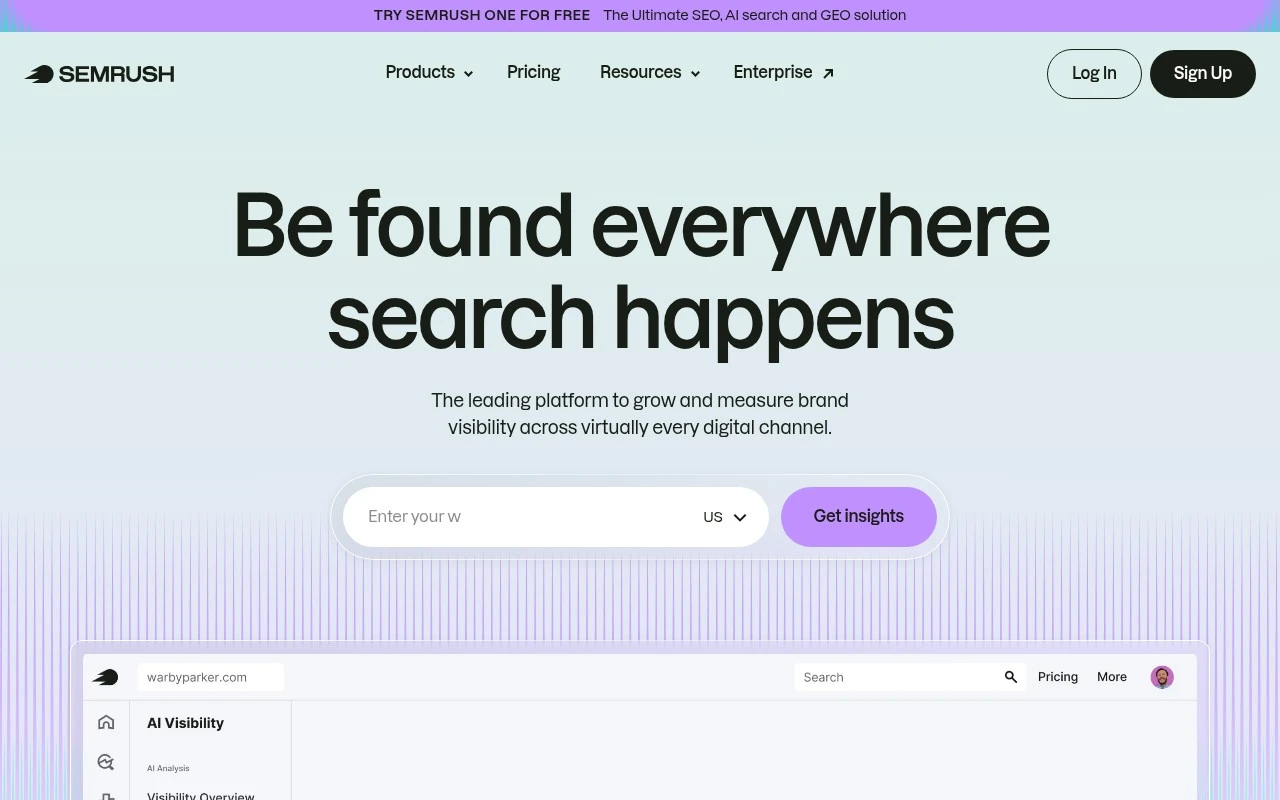
Semrush is an online visibility and SEO platform used for keyword research, competitor analysis, site audits, backlink analysis, and rank tracking. It helps marketers plan and measure search, content, and advertising efforts using web traffic and search data.
Content & On-pageSEO Reporting

FYAI Score

8.5 / 10

Based on 4,016 reviews

Pricing:

Free trial

Best for:

Marketing teams managing SEO, content, and competitive visibility

Score Breakdown

  • Ease of use7.8 / 10
  • Features9.4 / 10
  • Pricing7.5 / 10
  • Integrations9.3 / 10
  • Support8.6 / 10

PRODUCT PREVIEW

What this AI tool does

Semrush is a brand-visibility and digital marketing intelligence platform for teams that need to understand, measure, and improve how their organisation is discovered online. Semrush is best known for search data and competitor analysis, but its scope now extends across SEO, content, advertising, local presence, social media, AI search visibility, and PR intelligence. At its core, the platform helps marketers turn fragmented digital signals into planning and performance decisions. Keyword research, SERP analysis, backlink analysis, rank tracking, and traffic estimates are brought together so teams can see where demand exists, who is winning attention, and which opportunities are realistic to pursue. For SEO teams, Semrush works as both a research environment and an operational workspace. A site can be audited for technical SEO analysis, on page optimization issues, crawl problems, internal linking gaps, and content weaknesses, then monitored over time as fixes are implemented. This makes it useful not only for diagnosis, but also for prioritising work across large or complex websites. Competitive visibility is one of the platform’s defining strengths. Semrush can show how competitors appear in organic search, paid search, backlinks, content topics, and traffic patterns, giving marketing teams a wider view than a single analytics account can provide. That perspective is especially useful when a brand wants to understand why competitors are gaining rankings, capturing demand, or appearing more consistently across search results. Content teams use the platform to connect strategy with search intent. Topic clustering, content gap analysis, seo content optimization, and writing guidance help users plan pages around real queries rather than assumptions. Instead of treating content as isolated articles, the workflow encourages teams to build topical coverage that can support rankings, relevance, and conversion paths. Local marketing is another important part of the product story. For businesses with physical locations or regional service areas, local seo workflows help manage listings, monitor visibility, and understand how location-based discovery affects customer acquisition. This matters for brands whose search performance depends not only on national rankings, but also on maps, directories, reviews, and local search behaviour. Paid media and advertising intelligence broaden the platform beyond organic growth. Marketers can study competitor ad copy, paid keywords, landing pages, and market activity, then use those insights for ad campaign optimization. The value is not simply in seeing what others are doing, but in connecting paid and organic intelligence so budget, messaging, and landing page strategy are better aligned. As search behaviour changes, the platform has also moved into AI search optimization and brand monitoring across emerging discovery surfaces. AI search visibility tracking helps teams understand how brands, products, and competitors may appear in AI-generated answers and assistant-style search experiences. This positions Semrush as a tool for search visibility in a broader sense, not only for traditional blue-link rankings. Agencies and in-house marketing departments often rely on Semrush for reporting and stakeholder communication. SEO client reporting, ranking updates, audit results, competitor movement, and content performance can be packaged into recurring views that make progress easier to explain. For teams managing multiple brands, markets, or clients, that reporting layer helps translate large volumes of data into decisions and accountability. The platform is best suited to users who want depth rather than a lightweight single-purpose tool. Semrush is especially valuable for SEO specialists, content strategists, performance marketers, agencies, and digital leaders who need a shared source of intelligence for planning and measuring visibility. Its character is that of a data-rich command centre: broad, analytical, and built for teams that treat online discovery as a long-term competitive discipline.

Use cases

Best for

Keyword Research

Use Semrush to find keywords by volume and difficulty, and review SERP features and top-ranking pages for each query.

Local SEO

Track local rankings by city or ZIP and manage business listings to keep NAP data consistent across directories.

Competitor Analysis

Compare competitor domains for traffic estimates, keyword overlap, backlinks, and paid search ads to spot gaps and threats.

ANALYSIS

Strengths & limitations

Strengths
  • Best suited to multi-channel marketing teams because it combines SEO, AI-search visibility, content, ads, local, social and PR intelligence in one workflow.
  • Strong for competitive research because teams can compare keywords, backlinks, rankings, traffic estimates and market visibility across multiple rivals.
  • Useful for agencies and enterprise brands because its reporting and monitoring breadth supports ongoing planning, measurement and client or stakeholder communication.

Limitations
  • Less suitable for very small teams that only need basic rank tracking because the platform’s breadth adds workflow complexity and setup overhead.
  • The free-trial model leads into paid access for sustained use, so costs can grow for teams managing many projects, users or data-heavy workflows.
  • Semrush’s traffic, competitor and AI-visibility metrics are modeled intelligence rather than first-party analytics, so teams that need exact performance records still need to validate against their own data sources.

Evaluation

FYAI score breakdown

Our structured evaluation across five key criteria

8.5 / 10

Overall score

Based on 4,016 reviews

  • Ease of use7.8 / 10
  • Features9.4 / 10
  • Pricing7.5 / 10
  • Integrations9.3 / 10
  • Support8.6 / 10

What users say

Findings from public reviews, documentation and community sources.

  • Ease of use

    G2 rates Semrush 4.4/5 across 4,016 reviews, and a surfaced G2 review says the “SEO tools with SEMRush are great” while the “Social tools are simple and powerful.”

  • Features

    Semrush’s own page describes a suite across “AI search, SEO, PPC, social, and more,” with SEO, AI Visibility, Traffic and Market, and Content toolkits. Semrush’s own page lists “28B Keywords,” “43T Backlinks,” “142 Geo databases,” and “289M+ LLM prompts.”

  • Pricing

    Semrush’s pricing page publishes tiers at $139, $199, $299, and $549 per month, with annual discounts and plan limits. Semrush’s pricing page lists add-ons such as additional users “Starting at $45/mo.”

  • Integrations

    Semrush’s pricing page includes “Google Analytics and Google Search Console integrations,” “20+ external integrations” for Pro Reports, and “API data integration” on the Advanced plan. Zapier lists Semrush as connecting with “9000 other apps.”

  • Support

    Semrush’s site surfaces self-serve resources including “Knowledge Base,” “Academy,” “Webinars,” and “Contact Us.”

Who is this for?

Best for teams that need SEO and GEO research in one platform, Semrush’s own page lists SEO, AI Visibility, Traffic and Market, and Content toolkits, plus “28B Keywords,” “43T Backlinks,” “142 Geo databases,” and “289M+ LLM prompts.” Less suited to individuals or smaller teams with limited budgets, the pricing page publishes tiers at $139, $199, $299, and $549 per month, with additional users “Starting at $45/mo.”

PRODUCT PREVIEW

Feature highlights

Rank Tracking

Monitor rankings over time and measure wins across markets and devices.

Competitive Insights

Benchmark competitors to uncover traffic, content, and gap opportunities.

Competitive Insights

Benchmark rivals, track rankings, and spot growth opportunities fast.

COMPARE

Discover curated alternatives worth comparing

Compare similar AI tools based on features, pricing and use cases

7.5/ 10Based on 12,890 reviews

Zoominfo

Lead GenerationCRM & Segmentation
Finds prospects, enriches accounts, and flags buyer signals
Best for:
Sales teams
Pricing
Paid only

8.6/ 10Based on 6,982 reviews

Zoho CRM

Sales & OutreachAnalytics & Reporting
Rewrites emails, detects anomalies, and builds CRM modules
Best for:
Sales teams
Pricing
Freemium

8.0/ 10Based on 1,041 reviews

Zoho Campaigns

Lead GenerationCRM & Segmentation
Builds email and SMS campaigns, automates and analyzes results
Best for:
Marketing teams
Pricing
Freemium

Join thousands of marketers using Semrush to grow rankings and traffic. Turn competitor insights into a clear SEO plan you can act on today.

FAQ

Frequently asked
questions

Everything you need to know about this AI tool,
its features, pricing, use cases, and limitations.

Who is Semrush best suited for?
Semrush is best suited for marketing teams, SEO professionals, agencies, advertisers, PR teams, and enterprise brands that need broad visibility and competitive intelligence. It is most useful when teams want to track SEO rankings, AI-search visibility, keywords, backlinks, content opportunities, advertising activity, local presence, and market trends in one platform.
Does Semrush have a free plan or free trial?
Semrush uses a free trial pricing model, so buyers can test parts of the platform before committing to a paid plan. The practical limitation is that access can vary by toolkit, plan, and usage level, so teams should confirm which SEO, AI-search, local, content, advertising, and reporting features are included.
What should I compare when looking at Semrush alternatives?
When comparing Semrush with similar tools, focus on whether you need a broad digital visibility platform or a narrower SEO, content, rank tracking, backlink, or reporting tool. Semrush stands out for combining SEO, AI-search visibility, competitor benchmarking, advertising insights, content workflows, local visibility, PR, social, and market analysis.
How hard is it to set up Semrush for an SEO or marketing team?
The main trade-off with Semrush is breadth: it covers many marketing visibility areas, which can make it more complex than a single-purpose SEO or content tool. Teams should also treat traffic, market, competitor, and AI-search visibility metrics as estimates, and verify which modules and limits apply to their chosen plan.
What privacy or compliance questions should buyers ask before using Semrush?
Buyers should review Semrush’s current security, privacy, data processing, and compliance terms before connecting websites, projects, reporting workflows, or client accounts. Agencies and enterprise teams should confirm user permissions, data retention, integrations, export controls, and whether the platform’s handling of marketing and visibility data fits their internal policies.