Curated ToolThis tool is part of our curated AI directory. We only include tools that meet our standards for relevance, usability and real-world value.

Rankscale

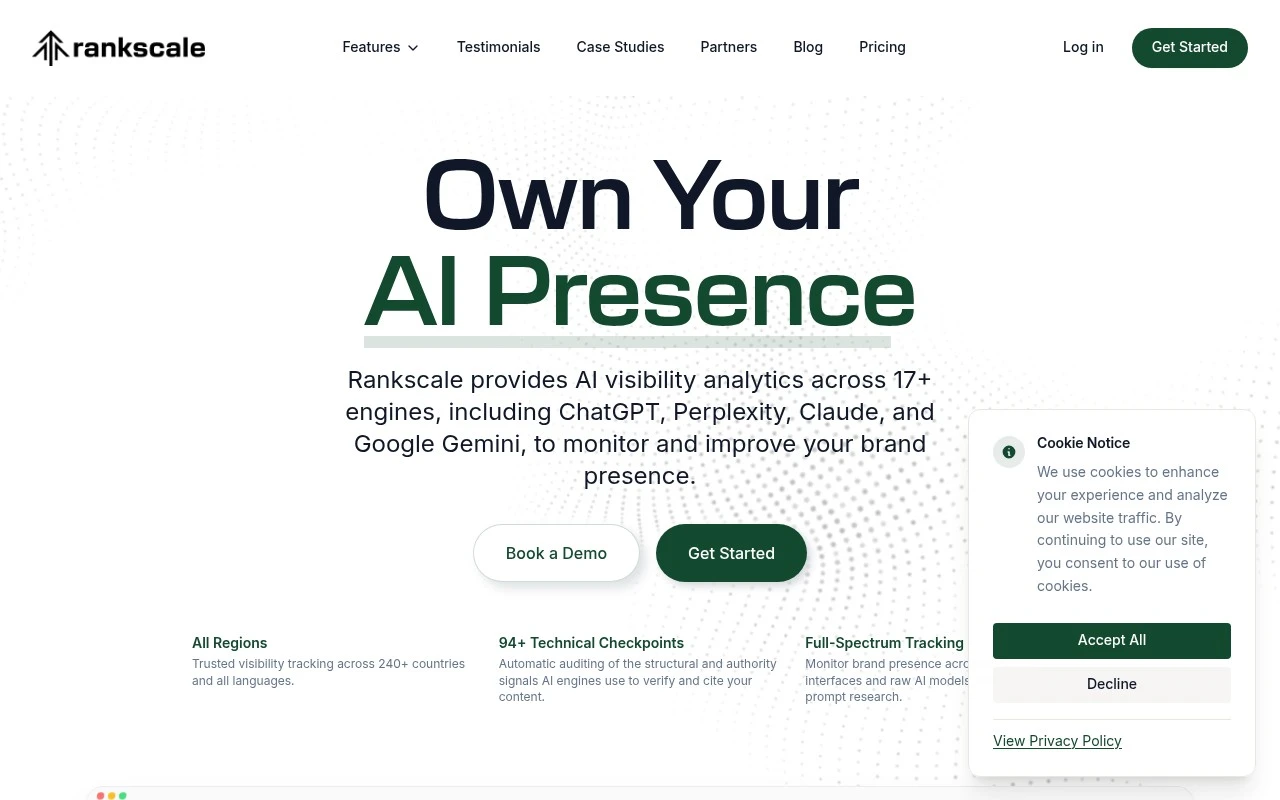
Rankscale is an ai search optimization platform that monitors how brands appear in AI-generated search answers and provides recommendations to improve visibility across conversational and generative search experiences.
Technical & AuditAI Search / GEO

FYAI Score

8.2 / 10

Based on 1 reviews + FYAI product analysis

Pricing:

Free trial

Best for:

SEO and brand teams improving visibility in AI search and answer engines

Score Breakdown

  • Ease of use7.4 / 10
  • Features8.3 / 10
  • Pricing8.6 / 10
  • Integrations8.0 / 10
  • Support8.8 / 10

PRODUCT PREVIEW

What this AI tool does

Rankscale is an AI search optimization platform for marketing, SEO, and brand teams that need to understand how their brand appears inside AI answer engines. It focuses on AI search visibility tracking across systems such as ChatGPT, Perplexity, Gemini, Claude, Google AI Overviews, and other generative search experiences where users receive answers instead of traditional blue-link results. As AI answers become a discovery layer for products, services, and expertise, traditional rank tracking is no longer enough. The platform is built around the idea that brands need to know whether they are mentioned, how they are described, which competitors are recommended, and what sources AI systems rely on when forming responses. For SEO teams, Rankscale connects familiar search measurement habits with the newer world of generative search. Instead of only monitoring keyword positions, teams can research prompts, track recurring questions, and see how different AI engines respond to commercially important topics. This makes it useful for organizations trying to extend organic search strategy into AI search optimization without losing the discipline of measurement. Visibility data is presented through dashboards that show where a brand appears, how often it is included, and whether its presence is improving or declining over time. Rankscale is especially useful for AI search visibility tracking because it gives teams a structured way to monitor mentions, citations, and answer patterns across multiple AI platforms rather than checking each system manually. Competitive context is a major part of the product story. The platform helps teams see which rival brands are surfaced in the same answer sets, what language is used to compare them, and where competitors may be earning stronger visibility. This competitor analysis is important for categories where AI assistants increasingly influence vendor shortlists, product research, local recommendations, and B2B buying journeys. Citation analysis adds another layer by showing which pages, publications, or domains are shaping AI-generated answers. For content strategists, this can reveal whether owned content is being used, whether third-party references carry more weight, and where new authority-building work may be needed. The result is a clearer connection between content, digital PR, SEO, and AI answer presence. Content and technical teams can use page audits to understand why certain pages may or may not be useful to AI systems. These audits complement technical SEO analysis by looking at structure, clarity, relevance, and the likelihood that a page can support accurate answers. In practice, the tool helps turn vague concerns about AI visibility into specific improvements that can be assigned and tracked. Sentiment analysis gives the platform a brand-monitoring dimension beyond simple inclusion. Being mentioned in an AI answer is not always positive if the description is outdated, incomplete, or unfavorable. By tracking tone and positioning, teams can identify whether AI systems are reinforcing the brand message they want or introducing reputation risks that need attention. For agencies and in-house growth teams, Rankscale fits into reporting workflows where stakeholders need evidence that AI search is being measured seriously. It can support recurring visibility reports, client audits, competitive reviews, and roadmap planning. Teams evaluating Rankscale pricing will likely be comparing it not just with SEO tools, but with a broader class of AI visibility, brand intelligence, and generative search optimization platforms. Rather than treating AI search as a black box, the platform gives teams a practical framework for observing, diagnosing, and improving how they appear in machine-generated answers. Rankscale is best at turning scattered AI search checks into repeatable visibility intelligence for brands that want to compete in answer engines as deliberately as they compete in Google search.

Use cases

Best for

AI Search Visibility Tracking

Rankscale tracks brand mentions, citations, and rankings across ChatGPT, Perplexity, Gemini, Claude, and Google AI Overviews.

Competitor Analysis

Compares competitor visibility across AI engines and surfaces shared citations, prompts, and pages driving their AI answers.

Sentiment Analysis

Monitors sentiment tied to brand mentions in AI answers and dashboards changes over time by engine and query.

ANALYSIS

Strengths & limitations

Strengths
  • Strong fit for SEO and brand teams tracking AI search visibility because it monitors mentions, citations, rankings, and omissions across major answer engines.
  • Useful for agencies and competitive markets because competitor analysis, sentiment tracking, and visibility dashboards help compare brand presence across AI-generated results.
  • Actionable for GEO workflows because prompt research, citation analysis, and page audits connect visibility measurement with content improvement priorities.

Limitations
  • Less suitable as a complete traditional SEO suite because its core focus is AI visibility and generative search optimization rather than broad backlink, technical SEO, or keyword research workflows.
  • Less suitable for very small teams or casual website owners because meaningful AI visibility tracking requires setting up prompts, competitors, entities, and recurring monitoring.
  • The free-trial pricing model is less suitable for teams wanting permanently free monitoring because ongoing use requires moving to a paid plan after evaluation.

Evaluation

FYAI score breakdown

Our structured evaluation across five key criteria

8.2 / 10

Overall score

Based on 1 reviews + FYAI product analysis

  • Ease of use7.4 / 10
  • Features8.3 / 10
  • Pricing8.6 / 10
  • Integrations8.0 / 10
  • Support8.8 / 10

What users say

Findings from public reviews, documentation and community sources.

  • Ease of use

    A G2 reviewer says, “The UI feels a little bit overwhelming at first,” and also says Rankscale is “actively working on improving the UX and UI.”

  • Features

    The Rankscale site lists “17+ engines” including ChatGPT, Perplexity, Claude, Gemini and Google AI Overviews, plus “240+ countries and all languages.” The Rankscale site also lists brand visibility dashboards, AI rank tracking, competitor analysis, citation analysis, sentiment analysis, page audits, and prompt research.

  • Pricing

    The Rankscale pricing page lists Pro at “$99” with “1,200 credits per month,” Growth at “$385” with “5,500 credits,” and Enterprise at “$780” with “12,000 credits.” The Rankscale pricing page also references yearly savings, a Pro trial, unlimited search terms, rollover, and agency/API tiers.

  • Integrations

    The Rankscale pricing page lists “REST API” for higher tiers, “shareable dashboard links,” and “Data exports (CSV, Sheets).” The Rankscale pricing page also references Looker Studio sharing/dashboard language.

  • Support

    The Rankscale site quotes a customer saying Rankscale’s “rate of responsiveness and updates whenever a new… tool emerges, is just impressive.” The Rankscale Enterprise plan includes “premium support” with “a dedicated partner.”

Who is this for?

Best for teams tracking AI visibility across many search and answer engines. Rankscale lists “17+ engines” and “240+ countries and all languages.” Less suited to teams that need many named native app integrations, the pricing page lists “REST API” for higher tiers, “shareable dashboard links,” “Data exports (CSV, Sheets),” and Looker Studio sharing/dashboard language, so reporting workflows may depend on API, exports, or shared dashboards.

PRODUCT PREVIEW

Feature highlights

AI Visibility Tracking

Track how your brand appears in AI answers over time.

Prompt Research

Find prompts that trigger your category and map intent to pages.

Citations & Sentiment

See which sources AI cites and how your brand is described.

COMPARE

Discover curated alternatives worth comparing

Compare similar AI tools based on features, pricing and use cases

8.8/ 10Based on 846 reviews

Yoast SEO

Content & On-pageTechnical & Audit
Optimizes SEO titles, descriptions, and product content
Best for:
SEO teams
Pricing
Freemium

8.1/ 10Based on 1,124 reviews

Yext

SEO MonitoringAI Search / GEO
Publishes verified business data, tracks AI and search discovery
Best for:
SEO teams
Pricing
Paid

7.7/ 10Based on 5,772 reviews

Writesonic

Copy Optimization
Surfaces answer-engine visibility and citation gaps for GEO fixes
Best for:
Marketing teams
Pricing
Freemium

Start showing up where nearby customers are searching. Use Rankscale to boost local visibility and win more calls, visits, and leads from your area.

FAQ

Frequently asked
questions

Everything you need to know about this AI tool,
its features, pricing, use cases, and limitations.

Who is Rankscale best suited for?
Rankscale is best suited for SEO teams, content marketers, agencies, publishers, and brand teams that need to monitor and improve visibility in AI-generated search answers. It is particularly relevant for teams working on generative engine optimization, competitor tracking, citation analysis, sentiment monitoring, and AI search visibility across multiple engines and regions.
Does Rankscale have a free plan or paid plans?
Rankscale offers a free trial model, so teams can evaluate the platform before committing to a paid plan. Buyers should check rankscale.ai for current plan details, usage limits, supported engines, regions, seats, and reporting options, since exact pricing and package limits can affect the right fit.
How does Rankscale compare with other AI search visibility tools?
Rankscale competes with tools focused on AI search visibility, GEO monitoring, and brand tracking in generative answer engines. Its strength is combining AI engine monitoring, competitor comparison, citation analysis, sentiment tracking, prompt research, and technical audits in one platform. The best choice depends on team size, budget, reporting needs, and workflow fit.
How quickly can a team get started with Rankscale?
Rankscale is focused on AI search and generative engine visibility, so it should not be treated as a full replacement for traditional SEO platforms. Teams may still need separate tools for keyword databases, backlink analysis, site crawling at scale, and broader organic search reporting. Buyers should also validate pricing, methodology, and plan limits.
What privacy or compliance checks should buyers make before using Rankscale?
Teams considering Rankscale should review how the platform handles brand data, prompts, reports, user access, retention, and any integrations before adopting it. Buyers in regulated industries should confirm current security practices, compliance documentation, data processing terms, and access controls directly with Rankscale, especially if sensitive content or customer information may be analyzed.