Curated ToolThis tool is part of our curated AI directory. We only include tools that meet our standards for relevance, usability and real-world value.

PageOptimizer Pro

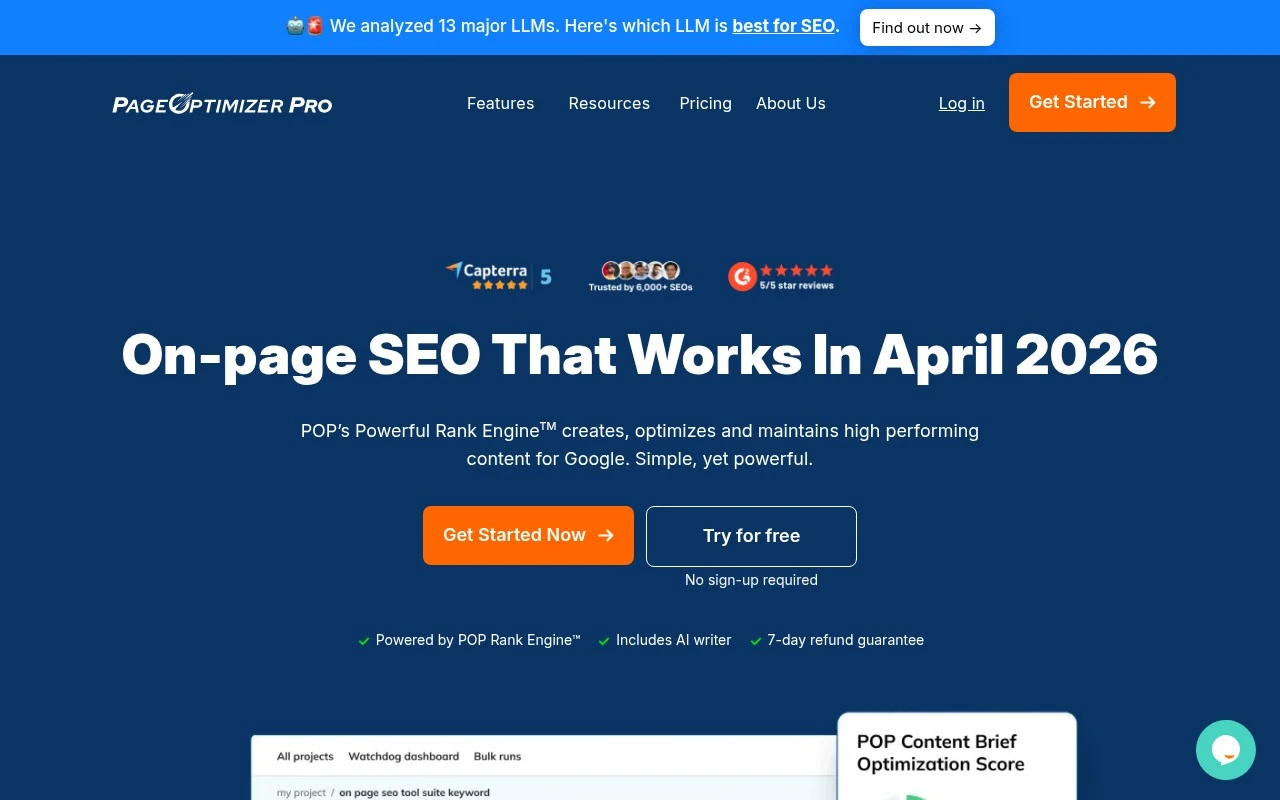
PageOptimizer Pro is an on-page SEO tool that analyzes a target page against top-ranking competitors and recommends changes to keyword usage, content structure, and related terms. It can support topic clustering by helping map and optimize pages around connected search topics.
Content & On-pageTechnical & Audit

FYAI Score

8.7 / 10

Based on 71 reviews

Pricing:

Paid

Best for:

SEO consultants and in-house SEOs optimizing pages to rank

Score Breakdown

  • Ease of use8.4 / 10
  • Features8.7 / 10
  • Pricing8.6 / 10
  • Integrations8.6 / 10
  • Support9.1 / 10

PRODUCT PREVIEW

What this AI tool does

PageOptimizer Pro is an on-page SEO tool suite for marketers, agencies, affiliate publishers, and content teams that want data-backed guidance for improving how pages perform in Google and AI-driven search. Also known as POP, it is built around the POP Rank Engine, which turns SEO testing and competitive analysis into practical recommendations for page structure, wording, entities, schema, and ongoing optimization. At its core, the platform treats on page optimization as an evidence problem rather than a guessing exercise. Instead of simply scoring content against generic best practices, it analyzes the search results for a target keyword and compares a page against patterns found among ranking competitors. That makes it useful when a team needs to know what to add, reduce, rewrite, or restructure before publishing or updating a page. PageOptimizer Pro is best suited to SEO professionals and content operators who want repeatable workflows for seo content optimization, from initial research through maintenance. A user can start with a keyword, inspect SERP-level signals, generate a brief, optimize a draft, and continue monitoring the page after it goes live. This positions the tool less as a one-time checker and more as a working system for keeping content aligned with changing search expectations. For writers and editors, its value is in translating technical SEO into page-level instructions that can be acted on without turning every article into a keyword-stuffed document. The tool can help identify missing NLP terms, entity gaps, headings, word count ranges, and content sections that competitors are covering. When content underperforms, it can support rewrite content workflows by showing where a page is thin, over-optimized, or misaligned with the current SERP. Topic clustering also fits naturally into the PageOptimizer Pro story because modern SEO depends on more than individual keyword targeting. The platform’s keyword research and content brief features can help teams map related terms, supporting pages, and topical coverage around a broader subject. For publishers building authority in a niche, that kind of planning helps connect individual page optimization with a larger content strategy. Beyond traditional search, the product has expanded toward generative engine optimization and LLM visibility. Its positioning reflects a wider shift in SEO, where pages need to be understandable not only to Google’s ranking systems but also to AI answer engines that rely on entities, clarity, trust signals, and structured information. Features around schema, EEAT auditing, and entity coverage support that broader goal of making content machine-readable and credible. A typical seo audit with the tool is not limited to flagging broken basics. It can surface competitive gaps, content relevance issues, and optimization opportunities that are specific to the keyword and page being analyzed. This is why a PageOptimizer Pro review often focuses on its opinionated, experiment-led approach, since the platform is designed for users who want recommendations grounded in observed ranking behavior rather than broad SEO theory. In practice, PageOptimizer Pro sits between an SEO audit platform, a content optimization assistant, and an AI writing workflow. It does not replace strategic judgment, brand expertise, or editorial quality, but it gives teams a structured way to make those decisions with clearer search data. For organizations that publish at scale or manage many client pages, the main appeal is consistency: a repeatable process for creating, improving, and maintaining content that can compete in organic search and emerging AI discovery environments.

Use cases

Best for

On Page Optimization

PageOptimizer Pro compares your page to top SERP pages and outputs on page edits for terms, entities, and headings.

SEO Audit

Run an seo audit by checking EEAT signals, schema coverage, and NLP entity gaps, then export prioritized fixes.

Generative Engine Optimization

Use generative engine optimization to align content with LLM visibility by adding entities, schema, and citations from POP recommendations.

ANALYSIS

Strengths & limitations

Strengths
  • Best suited to SEO teams that want prescriptive on-page guidance because the POP Rank Engine turns ranking experiments into page-level optimization recommendations.
  • Useful for content operations because it combines AI writing, content briefs, schema generation, EEAT checks, NLP and entity gap analysis, keyword research, and page monitoring in one workflow.
  • Strong fit for teams optimizing for both Google search and AI answer visibility because its recommendations are framed around traditional SEO and LLM discoverability.

Limitations
  • Less suitable for teams that need a full all-in-one SEO platform because PageOptimizer Pro is focused on on-page content optimization rather than replacing technical SEO, rank tracking, backlink, and site audit stacks.
  • Less suitable for casual site owners with low publishing volume because its paid model and SEO-focused workflow make more sense when there are enough pages to optimize regularly.
  • Less suitable for teams wanting fully automated content publishing because its recommendations still require SEO judgment, editorial review, and implementation in the site workflow.

Evaluation

FYAI score breakdown

Our structured evaluation across five key criteria

8.7 / 10

Overall score

Based on 71 reviews

  • Ease of use8.4 / 10
  • Features8.7 / 10
  • Pricing8.6 / 10
  • Integrations8.6 / 10
  • Support9.1 / 10

What users say

Findings from public reviews, documentation and community sources.

  • Ease of use

    Capterra lists PageOptimizer Pro at 5/5 across 71 reviews, and a Capterra user snippet describes PageOptimizer Pro as “quite an intuitive tool if you're familiar with SEO.” A Capterra user snippet also notes “good onboarding with helpful Q&A and walkthrough session.”

  • Features

    The PageOptimizer Pro product page lists POP Rank Engine, AI Writer, EEAT analysis, and 61 languages. The PageOptimizer Pro product page also references keyword research, content briefs/editor, and bulk optimization.

  • Pricing

    The PageOptimizer Pro pricing page lists Basic at $40/month, Unlimited at $72/month monthly or $62/month annually, and Teams at $143/month monthly or $119/month annually. The PageOptimizer Pro pricing page also references credit limits, an annual discount, and a 7-day refund guarantee.

  • Integrations

    The PageOptimizer Pro site states users can “Edit in Google Docs,” edit inside “20+ web builders,” use a Chrome Extension, connect a BYO OpenAI API key, and get “API Access” to integrate POP into an app or data warehouse.

  • Support

    The PageOptimizer Pro pricing page highlights “Live chat support 19 hours / day,” and a Capterra user snippet mentions “good onboarding with helpful Q&A and walkthrough session.”

Who is this for?

Best for SEO practitioners who want on-page optimization in existing writing and site workflows, the PageOptimizer Pro site states users can “Edit in Google Docs,” edit inside “20+ web builders,” and use a Chrome Extension. Less suited to complete beginners, the Capterra user snippet describes PageOptimizer Pro as “quite an intuitive tool if you're familiar with SEO,” which means prior SEO familiarity matters.

PRODUCT PREVIEW

Feature highlights

POP Rank Engine

Get experiment-based on-page targets to improve ranking potential.

NLP Entity Gaps

Find missing entities/topics and close relevance gaps fast.

Page Monitoring

Track on-page changes and keep optimized content from drifting.

COMPARE

Discover curated alternatives worth comparing

Compare similar AI tools based on features, pricing and use cases

8.8/ 10Based on 846 reviews

Yoast SEO

Content & On-pageTechnical & Audit
Optimizes SEO titles, descriptions, and product content
Best for:
SEO teams
Pricing
Freemium

8.1/ 10Based on 1,124 reviews

Yext

SEO MonitoringAI Search / GEO
Publishes verified business data, tracks AI and search discovery
Best for:
SEO teams
Pricing
Paid

7.7/ 10Based on 5,772 reviews

Writesonic

Copy Optimization
Surfaces answer-engine visibility and citation gaps for GEO fixes
Best for:
Marketing teams
Pricing
Freemium

Join thousands optimizing pages with confidence. Start improving rankings and organic traffic faster with PageOptimizer Pro today.

FAQ

Frequently asked
questions

Everything you need to know about this AI tool,
its features, pricing, use cases, and limitations.

Who is PageOptimizer Pro best suited for?
PageOptimizer Pro is best suited for SEO professionals, content marketers, agencies, site owners, and teams improving search-focused web pages. It fits workflows that need page audits, on-page recommendations, content rewriting, schema generation, EEAT checks, NLP and entity analysis, keyword strategy, and content briefs.
Is PageOptimizer Pro free or paid?
PageOptimizer Pro is a paid SEO and content optimization tool. Teams evaluating it should check pageoptimizer.pro for current plan details, including any limits on reports, users, content workflows, API access, multilingual features, integrations, and advanced optimization tools.
How does PageOptimizer Pro compare with other SEO content optimization tools?
PageOptimizer Pro is more focused on on-page SEO and content optimization than broad, all-in-one SEO platforms. It combines page scoring, competitor-informed recommendations, AI-assisted writing, schema, EEAT, NLP, entity, and keyword tools, while broader platforms may place more emphasis on crawling, backlinks, analytics, or rank tracking.
How hard is it to get started with PageOptimizer Pro?
PageOptimizer Pro is not a complete replacement for SEO strategy, technical audits, analytics, or link-building work. Its recommendations still require human judgment, and claims about ranking improvements or AI answer visibility should be treated as optimization goals rather than guaranteed outcomes.
What privacy or compliance questions should teams ask before using PageOptimizer Pro?
Teams should review how PageOptimizer Pro handles uploaded content, target keywords, page data, API usage, and connected editing workflows. Buyers with sensitive content should confirm data retention, user access controls, vendor subprocessors, AI data handling, and any relevant compliance documentation directly with PageOptimizer Pro.