Curated ToolThis tool is part of our curated AI directory. We only include tools that meet our standards for relevance, usability and real-world value.

Neuraltext

Neuraltext is an SEO content platform that helps teams research keywords, analyze SERP competitors, build content briefs, and optimize drafts with AI writing support. It can support content gap analysis by comparing target topics and ranking pages to identify missing terms and coverage opportunities.
Content & On-pageKeyword & Research

FYAI Score

7.7 / 10

Based on 71 reviews

Pricing:

Free trial

Best for:

SEO writers and content teams producing search-driven blog content

Score Breakdown

  • Ease of use7.8 / 10
  • Features7.6 / 10
  • Pricing8.3 / 10
  • Integrations7.2 / 10
  • Support7.2 / 10

PRODUCT PREVIEW

What this AI tool does

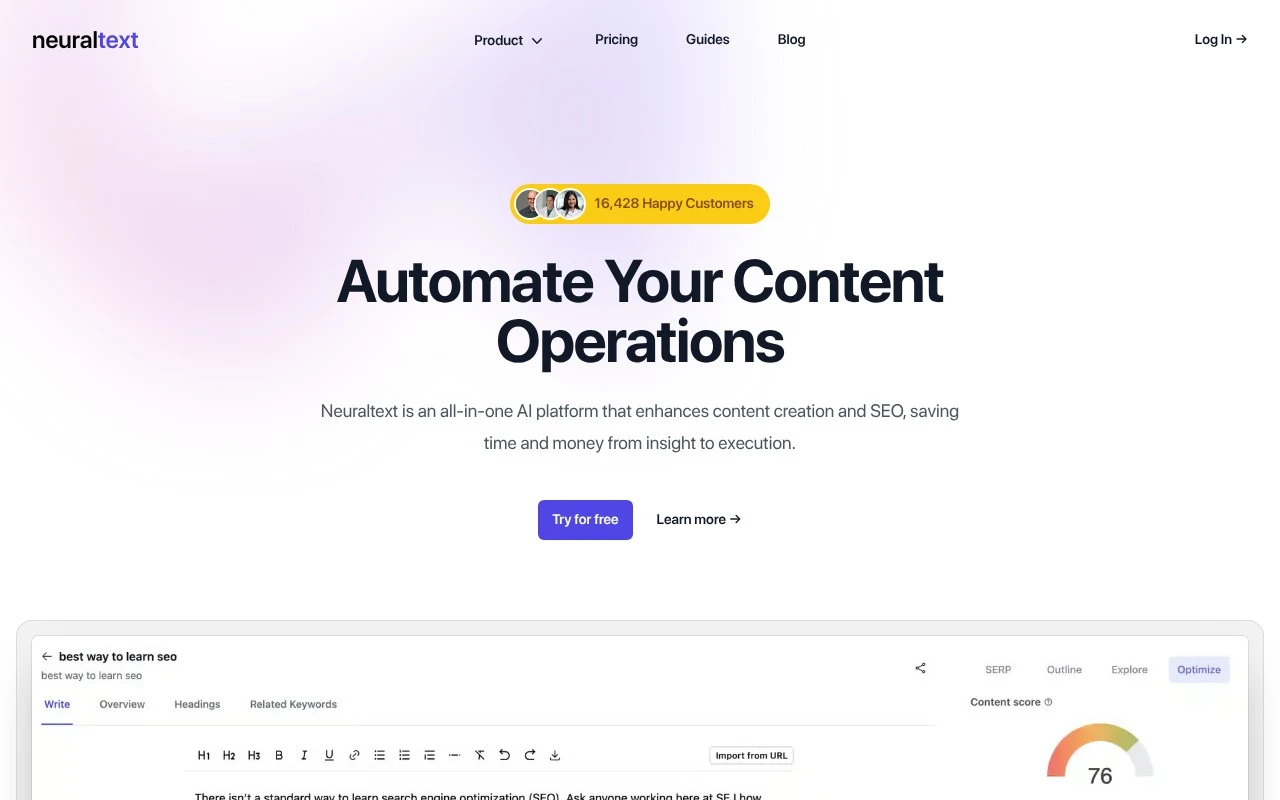
Neuraltext is an AI-assisted content and SEO platform for marketers, writers, agencies, and founders who want to research, plan, write, and optimize search-focused articles in one workspace. Neuraltext is best at turning search data into practical writing guidance, especially for teams that need keyword research, SERP analysis, content briefs, and SEO content optimization without jumping between separate tools. For content teams, the main value is that the platform treats writing as a search-driven workflow rather than a blank-page exercise. Instead of starting with a generic prompt, users can explore topics, understand what competitors are ranking for, and shape an article around real search intent. That makes it useful for blog posts, landing page copy, comparison content, and other long form content creation where structure and topical coverage matter. The workflow begins with discovery. Keyword research and topic clustering help users move from a broad idea to a mapped set of related search opportunities, which is especially useful when building content hubs or planning an editorial calendar. Neuraltext supports content gap analysis by helping teams see which themes, questions, and subtopics are appearing in the SERP, then compare those signals with what their own content has already covered. Search results are central to the product’s character. Live SERP analysis gives writers a view of competing pages, headings, questions, and related terms before they draft, so the brief is grounded in the current ranking landscape. Rather than presenting SEO as a checklist after the article is finished, the tool brings optimization into the planning stage, where decisions about angle, outline, depth, and intent are easier to make. Drafting is where the AI assistant becomes part of the content process. Users can generate outlines, expand sections, write blog post drafts, rewrite content, and refine passages while keeping the SEO brief nearby. This makes Neuraltext less like a standalone AI text generator and more like a guided writing environment for search-oriented content, where the assistant supports research-backed production rather than replacing editorial judgment. Integrated Google Search Console data gives the platform a stronger connection to existing performance. Teams can use their own search data to spot pages that need improvement, identify terms with ranking potential, and prioritize updates based on evidence rather than guesswork. For mature content libraries, this turns optimization into an ongoing cycle of refreshing, expanding, and repositioning pages. Compared with general AI writing tools, the platform is more specialized around SEO content operations. It is not simply designed to produce text quickly, although it can help with drafting. Its stronger role is coordinating the steps around content strategy, from keyword selection and brief creation to article optimization and performance-informed updates. Neuraltext is best suited to users who regularly publish SEO-oriented written content and want a single workspace for research, outlining, drafting, and optimization. It will appeal most to content marketers, SEO specialists, freelance writers, and small teams that need a structured way to create better search content without building a large tool stack. The overall story of Neuraltext is a practical one: it brings AI writing together with search intelligence so content can be planned and improved with clearer evidence.

Use cases

Best for

SEO Content Optimization

Neuraltext scores your draft against target keywords and suggests on page edits using its content optimization guidance.

Keyword Research

Discover keywords and group them into clusters to plan topic coverage and map pages to search intent.

SERP Analysis

Review live SERP data for a query to compare top pages, headings, and common topics before outlining content.

ANALYSIS

Strengths & limitations

Strengths
  • Strong fit for SEO-led content teams because keyword discovery, clustering, SERP analysis, briefs, drafting, and optimization live in one workflow.
  • Useful for writers and editors who need search-informed briefs because live SERP analysis helps turn ranking pages and intent signals into article structure.
  • Helpful for improving existing content because Google Search Console integration connects optimization work to real site query data.

Limitations
  • Less suitable for teams focused on ads, social, email, or brand copy because Neuraltext is centered on search-driven long-form written content.
  • Less useful for brand-new sites with little Search Console history because some optimization opportunities depend on having meaningful search performance data.
  • Can overlap with an existing SEO stack because teams already using separate keyword research, briefing, writing, and optimization tools may duplicate workflows.

Evaluation

FYAI score breakdown

Our structured evaluation across five key criteria

7.7 / 10

Overall score

Based on 71 reviews

  • Ease of use7.8 / 10
  • Features7.6 / 10
  • Pricing8.3 / 10
  • Integrations7.2 / 10
  • Support7.2 / 10

What users say

Findings from public reviews, documentation and community sources.

  • Ease of use

    Capterra shows NeuralText at 4.5/5 from 71 reviews, and G2 review text describes NeuralText as having the “fastest learning time.” NeuralText’s product page describes “content briefs for your writers in a bunch of clicks” and a “Google Docs style editor.”

  • Features

    NeuralText’s product page describes NeuralText as an “all-in-one AI platform” spanning “Plan,” “Research,” “Write,” and “Analyze.” NeuralText’s product page lists keyword clustering, live SERP analysis, content briefs, and Google Search Console-based performance insights.

  • Pricing

    NeuralText’s pricing page lists Starter, Basic, and Pro tiers at $19, $49, and $119 per month, plus a “5-day trial period for free.” NeuralText’s pricing page states usage limits for AI words, content briefs, keyword suggestions, clusters, Search Console properties, and seats, while a Capterra review snippet says some users see “The Pricing $49” as higher than copy-focused tools like Copy.ai or Rytr.

  • Integrations

    NeuralText’s Google Search Console integration page describes Google Search Console as allowing users to access performance metrics, discover keyword opportunities, and send keywords into NeuralText tools. Third-party signals mention Google Docs and WordPress.

  • Support

    Capterra lists NeuralText support options including “Email/Help Desk, FAQ/Forum, and Chat support.” Capterra notes that users have reported support “can be slow.”

Who is this for?

Best for SEO content teams that want planning, research, writing, and analysis in one workflow, NeuralText’s product page describes an “all-in-one AI platform” spanning “Plan,” “Research,” “Write,” and “Analyze.” Less suited to teams that depend on broad native integrations, the clearly documented native integration is Google Search Console, while third-party signals mention Google Docs and WordPress.

PRODUCT PREVIEW

Feature highlights

Live SERP Insights

Analyze top results to match intent and build stronger outlines.

Brief-to-Draft AI

Generate briefs, write drafts, and optimize content in one workspace.

Brief-to-Draft Writing

Turn research into clear briefs and publish-ready drafts in minutes.

COMPARE

Discover curated alternatives worth comparing

Compare similar AI tools based on features, pricing and use cases

8.8/ 10Based on 846 reviews

Yoast SEO

Content & On-pageTechnical & Audit
Optimizes SEO titles, descriptions, and product content
Best for:
SEO teams
Pricing
Freemium

8.1/ 10Based on 1,124 reviews

Yext

SEO MonitoringAI Search / GEO
Publishes verified business data, tracks AI and search discovery
Best for:
SEO teams
Pricing
Paid

7.7/ 10Based on 5,772 reviews

Writesonic

Copy Optimization
Surfaces answer-engine visibility and citation gaps for GEO fixes
Best for:
Marketing teams
Pricing
Freemium

Start creating SEO-ready content that ranks and converts. See why marketers choose Neuraltext to turn keyword research into publishable pages faster.

FAQ

Frequently asked
questions

Everything you need to know about this AI tool,
its features, pricing, use cases, and limitations.

Who is Neuraltext best suited for?
Neuraltext is best suited for SEO teams, content marketers, writers, editors, and site owners who create search-driven written content. It is designed around keyword research, SERP analysis, content briefs, AI-assisted drafting, rewriting, topic clustering, and using Google Search Console data to find optimization opportunities.
Does Neuraltext have a free plan or a free trial?
Neuraltext offers a free trial, but ongoing use is plan-based and subject to usage limits. Buyers should expect quotas around areas such as AI words, content briefs, keyword suggestions, keyword clustering volume, Search Console properties, and seats, so plan fit depends on publishing volume and team size.
How does Neuraltext compare with other SEO content tools?
Neuraltext is strongest when you want keyword research, SERP-based briefs, AI writing, clustering, and Search Console insights in one SEO content workflow. Compared with broader AI writing tools, it is more focused on search optimization. Compared with specialist SEO suites, it may be narrower but more content-production oriented.
How much setup work does Neuraltext require?
Neuraltext is mainly limited by its narrow focus on SEO-focused written content and its quota-based usage model. It is not a general AI workspace for design, video, coding, or broad operations, and teams should evaluate whether its proprietary scoring and optimization guidance match their SEO process.
What should teams check about Neuraltext data privacy and compliance?
Teams using Neuraltext should review how it handles connected Search Console data, uploaded content, user access, retention, and third-party processing. Organizations with regulated data or strict compliance requirements should confirm current security practices, contractual terms, and access controls directly with Neuraltext before connecting sensitive properties or workflows.