Curated ToolThis tool is part of our curated AI directory. We only include tools that meet our standards for relevance, usability and real-world value.

Marketmuse

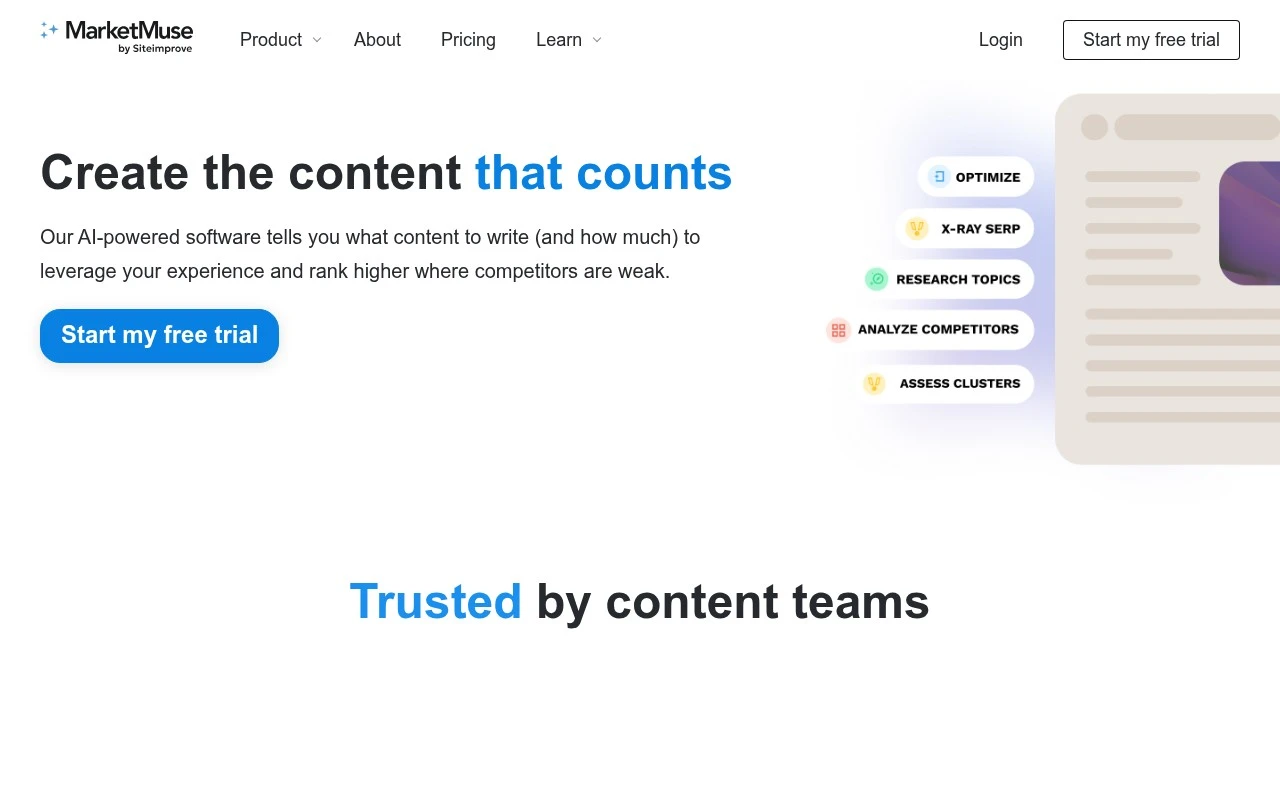
Marketmuse is an AI-powered content strategy and optimization platform that analyzes website content to identify topic gaps, prioritize content opportunities, and generate SEO-focused content briefs. It helps teams plan, update, and optimize pages using topic modeling and content scoring.
Content & On-pageSEO Monitoring

FYAI Score

7.9 / 10

Based on 216 reviews

Pricing:

Freemium

Best for:

SEO and content teams planning and optimizing organic content at scale

Score Breakdown

  • Ease of use8.0 / 10
  • Features8.9 / 10
  • Pricing7.3 / 10
  • Integrations7.1 / 10
  • Support7.6 / 10

PRODUCT PREVIEW

What this AI tool does

Marketmuse is an AI content planning and optimization platform for SEO, content, and editorial teams that depend on organic search performance. Marketmuse is best at turning a website’s existing content, topical authority, and competitive landscape into prioritized decisions about what to create, update, or consolidate. Instead of treating keyword research as a standalone task, the platform looks at topics in relation to a site’s current strengths. It evaluates content inventory, search intent, related concepts, and competitive coverage so teams can move from isolated keyword targets to a more complete SEO strategy planning process. For content leaders, Marketmuse helps answer a practical question: where should effort go next? The tool can surface pages that are underperforming, topics where the site has a realistic chance to grow, and gaps where competitors have stronger coverage. This makes content gap analysis less dependent on guesswork and more tied to the authority a site has already built. A central part of the product story is prioritization. Many SEO tools can show search volume, rankings, or SERP analysis data, but Marketmuse focuses on deciding which opportunities are actually achievable for a specific domain. That makes it especially relevant for teams managing large libraries, where updating the right existing page can be more valuable than publishing another new article. The optimization experience is designed around topic depth and relevance, not just keyword repetition. Writers and editors can use the platform to understand which related concepts a strong page should cover, how comprehensively competitors address the subject, and where a draft may be thin. In that sense, its role in seo content optimization and on page optimization is to guide better editorial decisions rather than replace the writer. Competitive insight is built into the workflow. The platform can highlight where rival pages are strong, where they are weak, and what kind of content structure appears to satisfy the search landscape. This competitor analysis is useful not only for individual pages, but also for building broader topic clustering plans across a content hub or editorial calendar. In practice, Marketmuse is often used by SEO managers, content strategists, editorial teams, agencies, and enterprise marketing teams that need a repeatable way to plan organic content. It is not a CMS, a publishing system, or a done-for-you writing service. The value sits earlier in the workflow, where teams decide what deserves attention and how a piece should be shaped before it goes live. The platform’s character is analytical and strategic. It brings AI into content operations by mapping what a site already knows, what the market expects, and what competitors have failed to cover well. For teams that rely on organic growth, Marketmuse provides a structured way to connect keyword research, topic clustering, content gap analysis, and optimization into a more disciplined content planning process.

Use cases

Best for

SEO Strategy Planning

Marketmuse audits your content inventory and topic landscape to recommend what to create or update based on authority and effort.

Keyword Research

It clusters keywords by topic and estimates content depth needed to compete, using your site coverage and authority signals.

Competitor Analysis

It compares your pages to competitor coverage to surface topic gaps and areas where rivals are weak.

ANALYSIS

Strengths & limitations

Strengths
  • Prioritizes content opportunities against the site’s existing authority, helping SEO and content teams focus on topics they are more likely to win.
  • Combines inventory analysis, topic modeling, briefs, and optimization guidance, giving strategists, editors, and writers a shared planning workflow.
  • Highlights competitor weaknesses and topical gaps, making it useful for teams deciding whether to create new content or refresh existing pages.

Limitations
  • Less suitable for teams that need a CMS or done-for-you content production, because MarketMuse focuses on planning, briefs, and optimization rather than publishing or fully managed writing.
  • Can be heavier than small teams or occasional bloggers need, because its strongest fit is ongoing organic content programs with enough inventory and topics to analyze.
  • The freemium model is best for evaluation and limited use, because teams planning content at scale should expect important capacity and workflow needs to sit in paid usage.

Evaluation

FYAI score breakdown

Our structured evaluation across five key criteria

7.9 / 10

Overall score

Based on 216 reviews

  • Ease of use8.0 / 10
  • Features8.9 / 10
  • Pricing7.3 / 10
  • Integrations7.1 / 10
  • Support7.6 / 10

What users say

Findings from public reviews, documentation and community sources.

  • Ease of use

    G2 lists MarketMuse at 4.6/5 across 216 G2 reviews, and the quoted G2 review describes MarketMuse as “very helpful” for optimizing existing content or writing SEO-optimized content. MarketMuse messaging says users can produce “cluster analyses and content plans in minutes.”

  • Features

    The MarketMuse product page describes SEO/content strategy features including “Topic authority,” “Competitor gaps,” “Personalized difficulty,” and “Content plan.” The MarketMuse product page also references Optimize briefs, link recommendations, quality analysis, content inventory, SERP tools, and proprietary topic modeling.

  • Pricing

    The MarketMuse pricing page lists Free, Optimize, Research, and Strategy tiers with usage limits including “10 queries/month,” “100 tracked topics,” “1000 tracked topics,” and “10K tracked topics.” The MarketMuse pricing page routes pricing access through “Book a demo” rather than visible dollar amounts.

  • Integrations

    MarketMuse’s about page notes a “ChatGPT integration” that lets users connect their ChatGPT account. MarketMuse product pages also reference exports and MarketMuse Connect/linking workflows.

  • Support

    The MarketMuse pricing page provides in-page FAQs explaining Inventory, tracked topics, Personalized Difficulty, Topic Authority, Content Score, queries, and brief types. The MarketMuse pricing page routes plans through “Book a demo.”

Who is this for?

Best for SEO and content teams that need strategy workflows across planning, optimization, and competitive analysis, the MarketMuse product page lists “Topic authority,” “Competitor gaps,” “Personalized difficulty,” and “Content plan.” Less suited to teams that need published dollar pricing before contacting sales, the MarketMuse pricing page routes pricing access through “Book a demo” rather than visible dollar amounts. Less suited to teams prioritizing broad connectivity, MarketMuse’s cited integration facts name a “ChatGPT integration,” exports, and MarketMuse Connect/linking workflows.

PRODUCT PREVIEW

Feature highlights

Content Inventory

Audit pages to spot gaps, overlaps, and update priorities fast.

Topic Opportunity Map

Find achievable topics based on your authority and competitive gaps.

Optimize Existing Pages

Get guidance on depth and coverage to improve rankings and relevance.

COMPARE

Discover curated alternatives worth comparing

Compare similar AI tools based on features, pricing and use cases

8.8/ 10Based on 846 reviews

Yoast SEO

Content & On-pageTechnical & Audit
Optimizes SEO titles, descriptions, and product content
Best for:
SEO teams
Pricing
Freemium

8.1/ 10Based on 1,124 reviews

Yext

SEO MonitoringAI Search / GEO
Publishes verified business data, tracks AI and search discovery
Best for:
SEO teams
Pricing
Paid

7.7/ 10Based on 5,772 reviews

Writesonic

Copy Optimization
Surfaces answer-engine visibility and citation gaps for GEO fixes
Best for:
Marketing teams
Pricing
Freemium

Join teams using Marketmuse to publish content that ranks, covers topics fully, and wins more organic traffic. Start optimizing your strategy today.

FAQ

Frequently asked
questions

Everything you need to know about this AI tool,
its features, pricing, use cases, and limitations.

Who is Marketmuse best for?
Marketmuse is best suited for content and SEO teams that need to prioritize what to create, update, and optimize across a content inventory. It fits brands, publishers, and agencies with established content operations, especially strategists, editors, writers, SEOs, and digital managers working on topic clusters, authority gaps, and content briefs.
Does Marketmuse have a free plan, and what do paid plans add?
Marketmuse uses a freemium pricing model, so teams can evaluate the platform before committing to broader paid usage. Paid access is typically most relevant for teams that need larger-scale content inventory analysis, planning workflows, briefs, optimization recommendations, and competitive gap research. Check marketmuse.com for current plan limits and feature access.
How should I compare Marketmuse with other SEO content optimization tools?
Marketmuse is most useful to compare against tools for SEO strategy planning, content gap analysis, topic clustering, and on-page optimization. Its main distinction is the use of site-specific content inventory and topical authority analysis, rather than focusing only on keyword research or SERP snapshots. The best choice depends on workflow depth, team size, and budget.
How long does it take to set up Marketmuse?
Marketmuse is not a CMS and does not directly manage or publish website content. It also is not primarily a finished-content writing service, although its Optimize application includes a generative AI component. Very small teams that only need basic keyword research may find its broader content strategy workflow more than they need.
What should buyers check about Marketmuse data privacy and compliance?
Buyers should review how Marketmuse handles content inventory data, connected site data, user access, retention, and compliance requirements before rollout. This matters because the platform analyzes existing content and topic coverage to generate plans and recommendations. Teams with regulated data should confirm current security documentation, permissions, and contractual terms directly with Marketmuse.