Curated ToolThis tool is part of our curated AI directory. We only include tools that meet our standards for relevance, usability and real-world value.

LowFruits

LowFruits is an SEO keyword research tool that analyzes SERPs to identify low-competition keywords and weak-ranking opportunities. It also supports topic clustering to help organize related keyword ideas for content planning.
SEO MonitoringKeyword & Research

FYAI Score

7.8 / 10

FYAI rating based on features, pricing and integrations

Pricing:

Freemium

Best for:

SEO writers and site owners targeting low-competition long-tail keywords

Score Breakdown

  • Ease of use7.5 / 10
  • Features7.6 / 10
  • Pricing9.0 / 10
  • Integrations7.0 / 10
  • Support7.8 / 10

PRODUCT PREVIEW

What this AI tool does

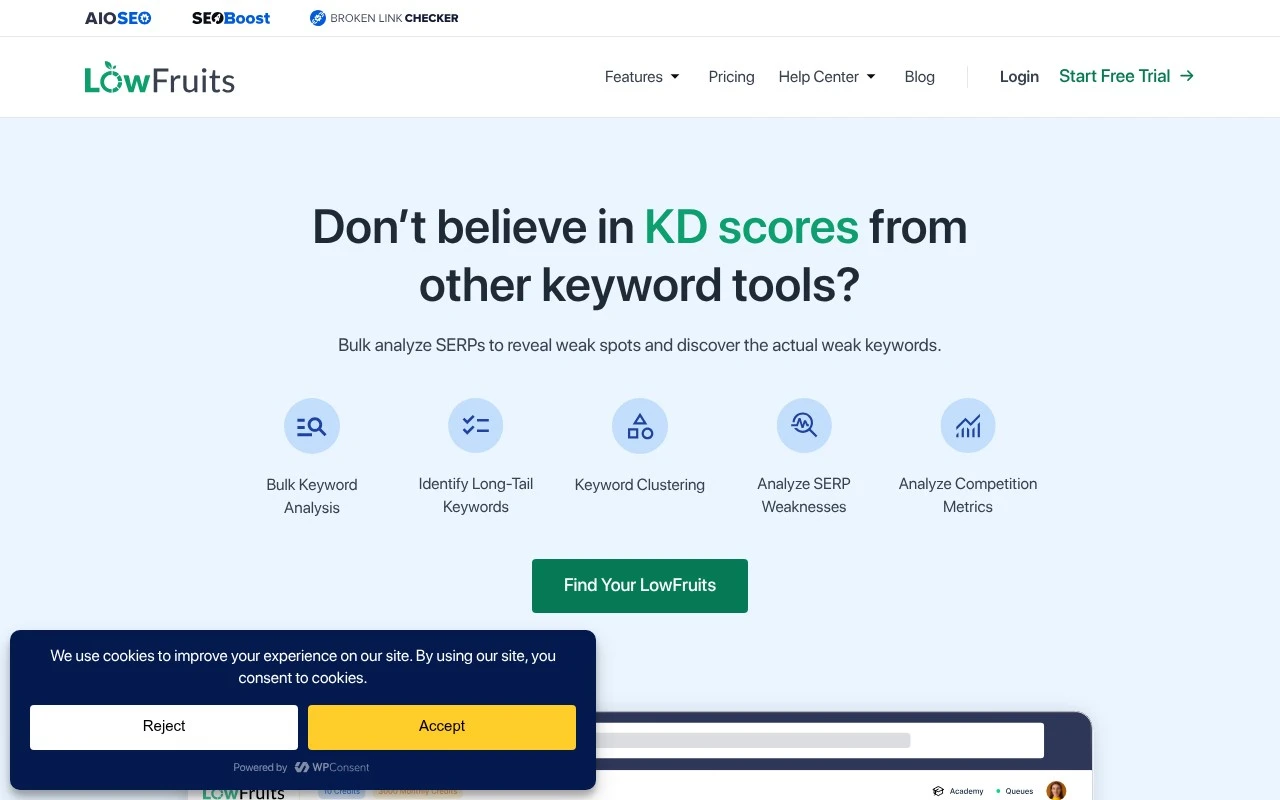
LowFruits is an SEO keyword research and SERP analysis platform for bloggers, niche site owners, affiliate marketers, and small teams that want to find keywords they have a realistic chance of ranking for. LowFruits is best at turning long-tail keyword ideas into practical content opportunities by checking the live Google results for signs of weak competition. For many users, the appeal is that it starts from the search results rather than from an abstract difficulty score. Traditional keyword tools often compress competition into a single metric, while this platform looks at who is actually ranking. That makes it useful when a keyword looks difficult on paper but the SERP contains forums, low-authority sites, thin pages, or results with poorly matched titles. The workflow is built around discovery, validation, and prioritization. Users can generate keyword ideas inside the tool or import lists from other keyword research sources, then analyze them in bulk. Instead of checking search results one by one, the platform surfaces patterns across hundreds or thousands of queries so that content planning becomes more systematic. Topic clustering is one of the ways LowFruits helps turn scattered keyword data into an editorial strategy. Related keywords can be grouped so users can decide whether a query deserves its own article, belongs inside a broader guide, or should support an existing page. This is especially useful for sites trying to build topical authority without publishing overlapping content. Search intent analysis sits underneath much of the product’s value. By showing title relevance, page types, content word count, and the kinds of websites Google is rewarding, the tool helps users understand what a searcher likely expects. A weak competitor is not only a low-authority domain, it may also be a page that does not fully answer the query or is ranking despite limited optimization. In practice, LowFruits is built for people who care less about chasing the highest-volume terms and more about finding winnable openings. A new blog, a small SaaS site, or an affiliate publisher can use it to locate low-competition keywords where the current SERP leaves room for a better article. More experienced SEOs can use the same analysis to expand content hubs, refresh old pages, or identify supporting articles around a core topic. Compared with broad SEO suites, the platform has a narrower and more tactical character. It is not trying to replace every rank tracker, backlink database, or technical audit tool. Its strength is in the moment when a user asks, “Which of these keywords can I actually rank for, and what would I need to create?” Questions about LowFruits pricing usually come up because the tool is often used for bulk checks, where credits and analysis volume matter. A useful LowFruits review should therefore look beyond the interface and consider how much time it saves in manual SERP checking, how clearly it identifies weak spots, and whether its keyword opportunities match the user’s publishing capacity. The result is a focused SEO research tool with a practical point of view. LowFruits does not promise that every low-competition keyword will rank, but it gives users a more grounded way to judge opportunity by looking at the pages already winning in Google. For content teams that want keyword research tied closely to real search results, it offers a clear bridge between data collection and publishable strategy.

Use cases

Best for

SERP Analysis

Runs bulk SERP analysis to flag weak Google results by authority, title match, word count, and site type.

Keyword Research

LowFruits generates or imports long tail keyword lists, then filters and clusters them into content opportunities.

Search Intent Analysis

Evaluates ranking pages for each query to infer intent from page types, titles, and content depth across the SERP.

ANALYSIS

Strengths & limitations

Strengths
  • SERP-based weakness analysis helps SEO teams prioritize keywords by looking at actual ranking pages rather than relying only on generic difficulty scores.
  • Long-tail keyword generation, imports, filtering, and clustering make it well suited to content planning workflows that need organized topic opportunities.
  • Best suited to bloggers, niche site owners, and content marketers because it focuses on practical low-competition keywords that can guide article production.

Limitations
  • Less suitable for teams that need a full SEO platform because its core strength is keyword discovery and SERP analysis rather than technical audits, backlink management, or broad rank tracking.
  • Bulk SERP analysis can create usage-dependent costs under the freemium model, so high-volume agencies and publishers should plan around credit or paid-tier needs.
  • Less suitable for teams focused mainly on non-Google channels or paid search because its opportunity analysis is centered on organic Google search results.

Evaluation

FYAI score breakdown

Our structured evaluation across five key criteria

7.8 / 10

Overall score

FYAI rating based on features, pricing and integrations

  • Ease of use7.5 / 10
  • Features7.6 / 10
  • Pricing9.0 / 10
  • Integrations7.0 / 10
  • Support7.8 / 10

What users say

Findings from public reviews, documentation and community sources.

  • Ease of use

    The LowFruits homepage says users can import your own list of keywords or generate keyword ideas for free, and says the tool highlights SERP weaknesses. The LowFruits homepage also references bulk analysis, while Reddit sentiment describes LowFruits as a tool that finds low competition keywords fast.

  • Features

    The LowFruits pricing page lists bulk keyword analysis, keyword clustering, SERP weakness analysis, and Domain Explorer among LowFruits capabilities. The LowFruits pricing page also references competitor keyword extraction and sitemap extraction.

  • Pricing

    The LowFruits pricing page lists Standard at $29.90/month or $20.75/month billed yearly and Premium at $79.90/month or $62.45/month billed yearly. The LowFruits pricing page lists pay-as-you-go credit packs from $25 for 2,000 credits to $250 for 50,000 credits, says the first analysis is included, credits last one year on PAYG, and offers a 14-day money-back guarantee if fewer than 100 credits are used.

  • Integrations

    The LowFruits homepage emphasizes built-in keyword generation, keyword import, Google Auto Complete keyword ideas, and SERP extraction. The LowFruits homepage also references competitor extraction and sitemap extraction.

  • Support

    The LowFruits homepage surfaces FAQs, an Academy, blog resources, and a contact option.

Who is this for?

Best for SEOs and content teams looking for low-competition keyword opportunities, the LowFruits homepage says users can generate keyword ideas for free, import your own list of keywords, and the tool highlights SERP weaknesses. It is less suited to teams that need a broader integration ecosystem, because the LowFruits homepage emphasizes built-in keyword generation, keyword import, Google Auto Complete keyword ideas, SERP extraction, competitor extraction, and sitemap extraction rather than analytics/search-console connections, CMS plugins, APIs, or reporting connectors.

PRODUCT PREVIEW

Feature highlights

Bulk SERP analysis

Scan Google results to spot weak pages, low authority, and thin content.

Find Easy Wins

Uncovers opportunities by spotting weak pages in real search results.

Bulk Results Audit

Analyzes many result pages at once to surface low-competition targets.

COMPARE

Discover curated alternatives worth comparing

Compare similar AI tools based on features, pricing and use cases

8.8/ 10Based on 846 reviews

Yoast SEO

Content & On-pageTechnical & Audit
Optimizes SEO titles, descriptions, and product content
Best for:
SEO teams
Pricing
Freemium

8.1/ 10Based on 1,124 reviews

Yext

SEO MonitoringAI Search / GEO
Publishes verified business data, tracks AI and search discovery
Best for:
SEO teams
Pricing
Paid

7.7/ 10Based on 5,772 reviews

Writesonic

Copy Optimization
Surfaces answer-engine visibility and citation gaps for GEO fixes
Best for:
Marketing teams
Pricing
Freemium

Find keyword opportunities your competitors miss and grow organic traffic faster. Start uncovering low-competition wins with LowFruits today.

FAQ

Frequently asked
questions

Everything you need to know about this AI tool,
its features, pricing, use cases, and limitations.

Who is LowFruits best suited for?
LowFruits is best suited for SEO professionals, content marketers, bloggers, niche site owners, and businesses looking for lower-competition organic search opportunities. It fits workflows focused on long-tail keyword discovery, SERP weakness analysis, search intent grouping, and content planning rather than broad all-in-one SEO management.
Can I use LowFruits for free, and what do paid plans add?
LowFruits uses a freemium model, with SERP analysis tied to a credit system where each analyzed keyword consumes one credit. Paid or subscription-based access can unlock additional capabilities such as the boosted keyword finder, rank tracker, Domain Explorer, competitor keyword extraction, and sitemap extraction tools.
How does LowFruits compare with other keyword research tools?
LowFruits differs from many keyword research tools by emphasizing real Google SERP weaknesses instead of relying only on generic keyword difficulty scores. It is most useful when users want to find weak competitors, cluster related keyword ideas, and prioritize content opportunities, while broader SEO suites may cover more technical, backlink, or reporting functions.
How much setup is needed to start using LowFruits?
LowFruits is specialized for keyword research, SERP opportunity analysis, and intent-based clustering, not full SEO campaign management. Its credit-based SERP analysis can affect research volume, and some advanced features require a subscription. Teams needing broad technical audits, backlink analysis, or enterprise reporting may need additional tools.
What privacy or compliance checks should teams consider before using LowFruits?
Teams should review LowFruits’ current privacy, data retention, and compliance terms before using it with sensitive business data. Keyword research tools may involve uploading keyword lists, domains, competitor targets, and strategic content ideas, so buyers should confirm access controls, export handling, vendor terms, and internal approval requirements.