Curated ToolThis tool is part of our curated AI directory. We only include tools that meet our standards for relevance, usability and real-world value.

LLMrefs

LLMrefs is a content gap analysis tool that identifies which sources large language models reference for target queries, helping teams compare their AI search visibility with competitors.
Content & On-pageAI Search / GEO

FYAI Score

7.7 / 10

Based on 1 reviews + FYAI product analysis

Pricing:

Freemium

Best for:

SEO agencies and growth teams tracking brand visibility in AI search

Score Breakdown

  • Ease of use7.5 / 10
  • Features7.4 / 10
  • Pricing8.3 / 10
  • Integrations7.6 / 10
  • Support7.8 / 10

PRODUCT PREVIEW

What this AI tool does

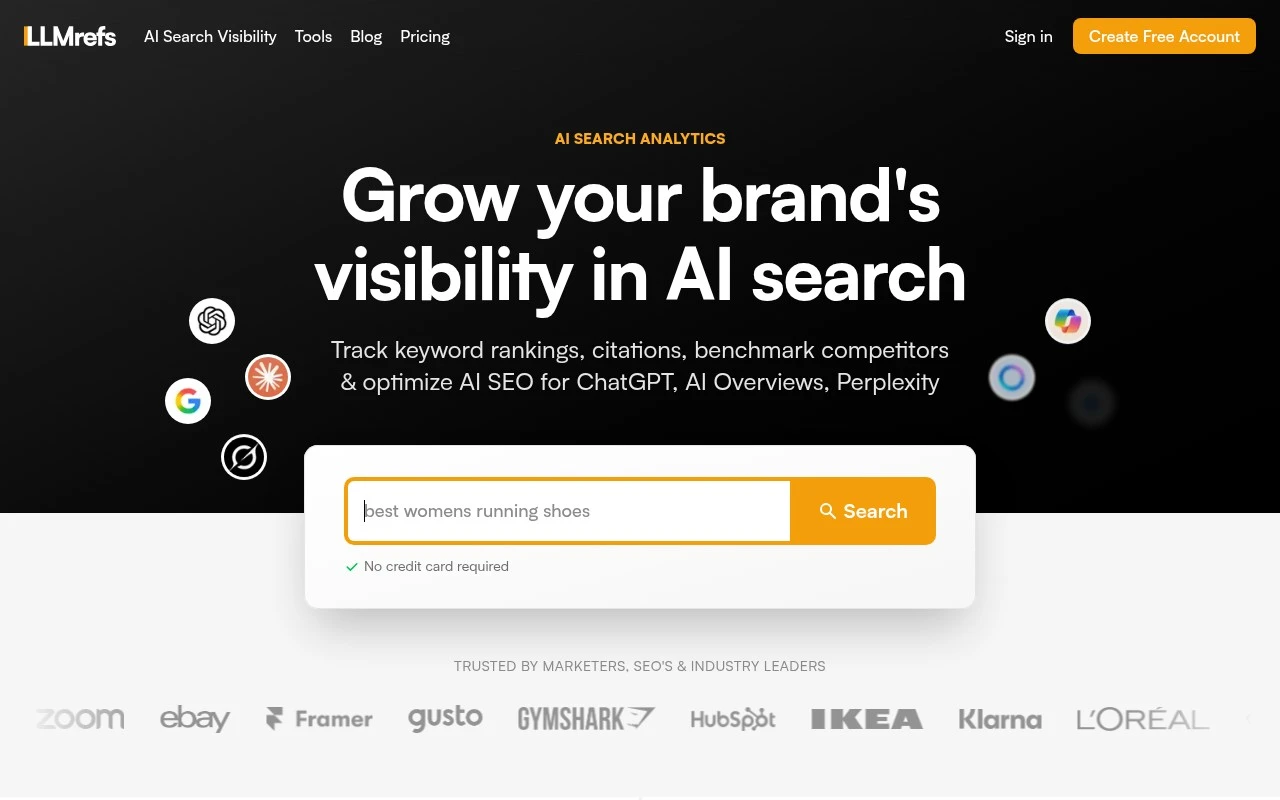
LLMrefs is an AI search visibility tracking platform for marketers, SEOs, agencies, and growth teams that need to understand how brands appear inside generative AI answer engines. It is built for the shift from classic search results to AI-generated answers, where visibility depends not only on rankings, but also on citations, mentions, source selection, and the language models that summarise the web. For many teams, the hard part is not knowing that AI search matters, but finding a repeatable way to measure it. The platform starts from familiar SEO keywords, then generates related prompts that resemble real AI-search-style conversations. This makes the workflow closer to how people actually ask ChatGPT-style and answer-engine questions, without forcing users to manually invent and monitor every prompt one by one. At the core of the product is a measurement layer for brand presence across major AI answer engines. It aggregates responses, citations, brand rankings, share of voice, and source URLs, then makes those results easier to compare by country, language, and engine. LLMrefs helps teams see whether their brand is being mentioned, which competitors are appearing instead, and which web sources are shaping the answers. The tool is especially relevant for AI search visibility tracking at scale. A single brand can use it to understand where it is visible or absent, while an agency can apply the same framework across multiple domains, markets, and clients. LLMrefs is best at turning fragmented AI answer outputs into structured visibility data that can be reported, exported, and compared over time. Content strategy teams can use the platform for content gap analysis in a newer search environment. If a brand does not appear in generated answers for important topics, or if competitors are repeatedly cited from stronger source pages, that absence becomes a planning signal. The resulting insight can guide updates to existing pages, new content priorities, digital PR, and broader authority-building work. Competitor analysis is another important part of the story. Rather than treating AI answer engines as black boxes, the platform shows which brands are being surfaced, how often they appear, and which sources support those appearances. That makes it useful for benchmarking share of voice, identifying category leaders in AI search, and explaining why a client or stakeholder may be losing visibility even when traditional SEO metrics look stable. Reporting and operational fit matter because this category is still emerging. Agencies and growth teams often need CSV exports, client-ready summaries, API access, and the ability to compare performance across engines and regions. Teams evaluating LLMrefs pricing are typically assessing whether they need a lightweight visibility check or a more scalable workflow for multiple markets, competitors, and reporting cycles. What makes LLMrefs distinct is its keyword-to-prompt approach. Traditional rank tracking begins with search queries and search engine result pages, while generative AI monitoring has to account for conversational prompts, synthesized answers, and citation behavior. By bridging SEO keywords with AI-generated prompt sets, the platform gives search professionals a familiar starting point while adapting the analysis to how AI answer engines actually work. In practice, LLMrefs is a measurement and benchmarking system for the next phase of search. It does not simply show whether a website ranks, it helps explain whether a brand is present in AI-generated answers, who else is present, and which sources the engines rely on. For organizations trying to protect or grow visibility as search becomes more conversational, the platform provides a structured way to monitor the change rather than guess at it.

Use cases

Best for

AI Search Visibility Tracking

Track brand visibility in AI answers by entering SEO keywords and viewing aggregated rankings, citations, and sources by engine and locale.

Competitor Analysis

Benchmark competitors by comparing share of voice, brand rankings, and cited source URLs across AI answer engines with country and language filters.

Content Gap Analysis

Use LLMrefs prompt generation from keywords to see which topics trigger citations for rivals but not your domain, then export results to CSV.

ANALYSIS

Strengths & limitations

Strengths
  • Keyword-to-prompt generation reduces manual tracking work, so SEO teams can monitor AI-search visibility at scale from the terms they already care about.
  • Cross-engine reporting on citations, rankings, share of voice, and source URLs gives marketers a practical view of where brands and competitors appear in AI-generated answers.
  • Agency-friendly filtering, exports, API access, and multi-domain workflows make it well suited to teams managing AI search reporting across several clients or markets.

Limitations
  • Less suitable as a standalone SEO suite because it focuses on generative AI search visibility rather than broader tasks such as technical audits, backlink analysis, or traditional SERP tracking.
  • High-volume agencies are likely to outgrow the free tier because reporting, exports, API access, and multi-client workflows are the areas where paid access usually matters most.
  • Less suitable for teams that need fixed, deterministic rankings because AI answer visibility can vary by engine, country, language, prompt phrasing, and response timing.

Evaluation

FYAI score breakdown

Our structured evaluation across five key criteria

7.7 / 10

Overall score

Based on 1 reviews + FYAI product analysis

  • Ease of use7.5 / 10
  • Features7.4 / 10
  • Pricing8.3 / 10
  • Integrations7.6 / 10
  • Support7.8 / 10

What users say

Findings from public reviews, documentation and community sources.

  • Ease of use

    The LLMrefs homepage says users can “Import your SEO keyword lists and view LLM visibility in moments,” and the FAQ says “Within 5 minutes, your dashboard will show LLM visibility insights.”

  • Features

    The LLMrefs homepage lists GEO tracking for brand visibility, keyword rankings, citations, and competitor benchmarking. The LLMrefs homepage says coverage includes ChatGPT, AI Overviews, Perplexity, Gemini, Claude, Grok, Copilot, Meta, DeepSeek and more.

  • Pricing

    The LLMrefs pricing page lists an “All in One” plan for “$79/month” with a “7-day Free Trial,” 500 prompts, all AI search engines, weekly reports, geo-targeting, unlimited team members/projects, CSV export, API access, and priority support.

  • Integrations

    The LLMrefs homepage says users can “Export clean CSVs in seconds” and “Get API access to integrate your data into your workflows.” A Reddit review snippet mentions “integration with traditional rankings” as “genuinely nice.”

  • Support

    The LLMrefs pricing page lists “Priority support & custom feature requests.” The LLMrefs FAQ invites users to “feel free to reach out.”

Who is this for?

Best for SEO and GEO teams that want quick LLM visibility tracking, the LLMrefs FAQ says “Within 5 minutes, your dashboard will show LLM visibility insights.” Best for teams that need exports or workflow access because the homepage says users can “Export clean CSVs in seconds” and “Get API access to integrate your data into your workflows.” Less suited to buyers who need multiple public plan options, the pricing page lists a single “All in One” plan for “$79/month.”

PRODUCT PREVIEW

Feature highlights

Brand visibility

Track rankings, share of voice, citations, and source URLs across engines.

Geo & engine filters

Filter results by country, language, and answer engine for accurate reporting.

AI Prompt Discovery

Auto-generates real chat-style prompts and aggregates answers and citations.

COMPARE

Discover curated alternatives worth comparing

Compare similar AI tools based on features, pricing and use cases

8.8/ 10Based on 846 reviews

Yoast SEO

Content & On-pageTechnical & Audit
Optimizes SEO titles, descriptions, and product content
Best for:
SEO teams
Pricing
Freemium

8.1/ 10Based on 1,124 reviews

Yext

SEO MonitoringAI Search / GEO
Publishes verified business data, tracks AI and search discovery
Best for:
SEO teams
Pricing
Paid

7.7/ 10Based on 5,772 reviews

Writesonic

Copy Optimization
Surfaces answer-engine visibility and citation gaps for GEO fixes
Best for:
Marketing teams
Pricing
Freemium

Start turning scattered references into a clear SEO advantage. See why marketing teams choose LLMrefs to strengthen authority and climb rankings faster.

FAQ

Frequently asked
questions

Everything you need to know about this AI tool,
its features, pricing, use cases, and limitations.

Who is LLMrefs best suited for?
LLMrefs is best suited for SEO, marketing, growth, agency, and brand teams that need to track visibility in AI-generated search answers. It focuses on brand mentions, rankings, citations, share of voice, competitor benchmarks, and content gaps across answer engines such as ChatGPT, Google AI Overviews, Perplexity, Gemini, Claude, and others.
Does LLMrefs have a free plan, and what do paid plans add?
LLMrefs uses a freemium pricing model, so teams can start with some level of free access and upgrade for broader tracking needs. Paid use is most relevant when a team needs ongoing keyword monitoring, multiple projects, team access, client reporting, geo-targeting, CSV exports, API access, and deeper citation or competitor analysis.
How does LLMrefs compare with other AI search visibility tools?
LLMrefs is designed around AI search visibility tracking rather than traditional SEO rank tracking alone. Compared with similar tools, its fit depends on how many answer engines, markets, keywords, competitors, and client dashboards a team needs to monitor. It is strongest when AI-generated recommendations are a core reporting requirement.
How much setup work does LLMrefs require?
LLMrefs is not a full replacement for a traditional SEO suite because its focus is AI search visibility and generative engine optimization. Teams that need crawling, backlink analysis, technical audits, or classic search rank tracking will likely still need other tools. Its AI visibility metrics should also be treated as monitored estimates.
What privacy and compliance checks should buyers make before using LLMrefs?
Buyers should review LLMrefs’ data handling, access controls, retention practices, API terms, and compliance documentation before adding sensitive brand or client data. This is especially important for agencies and enterprise teams that may upload keyword sets, competitor lists, market information, reporting exports, and client-specific visibility data.