Curated ToolThis tool is part of our curated AI directory. We only include tools that meet our standards for relevance, usability and real-world value.

KeySearch

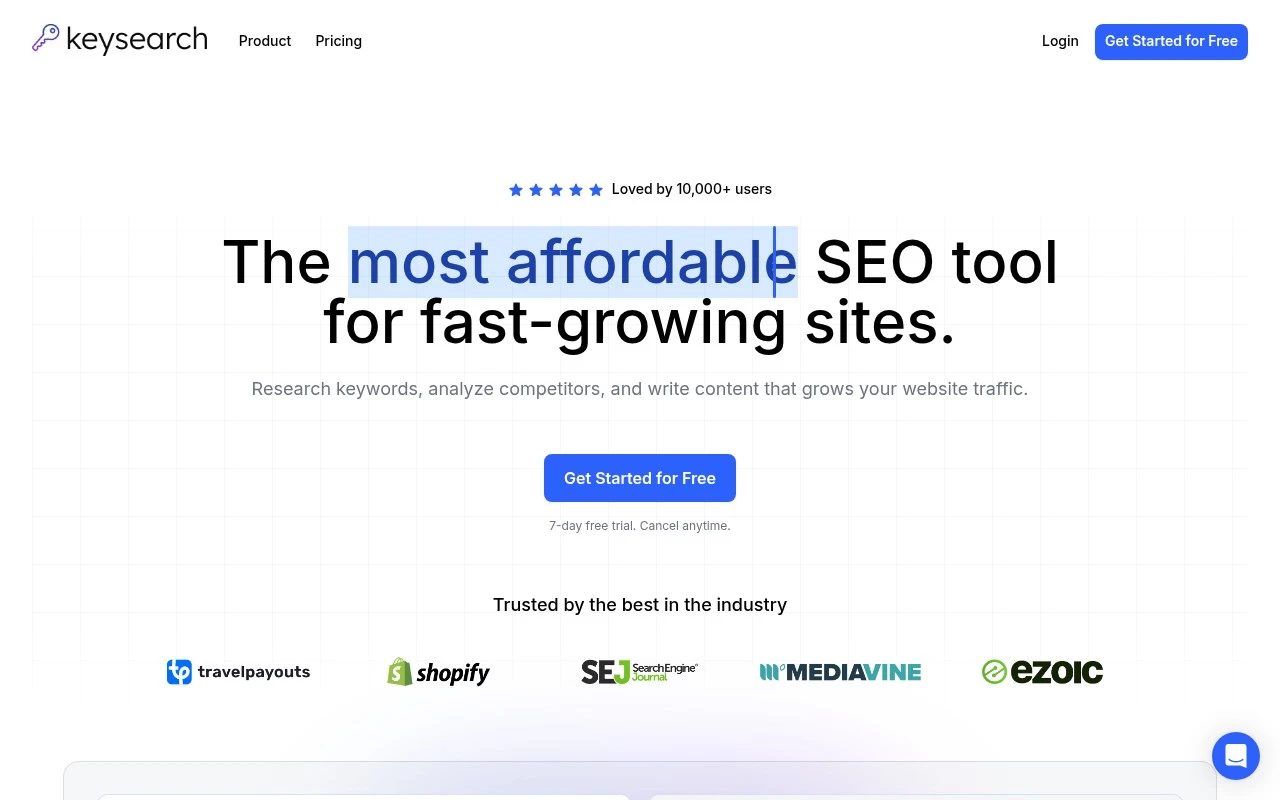
KeySearch is an SEO research platform for keyword research, competitor analysis, rank tracking, backlink checking, and content gap analysis. It helps users identify search opportunities by comparing keywords, SERP competition, and competing domains.
Content & On-pageSEO Monitoring

FYAI Score

7.8 / 10

Based on 27 reviews

Pricing:

Paid

Best for:

Bloggers and small site owners growing organic traffic on a budget

Score Breakdown

  • Ease of use7.8 / 10
  • Features7.3 / 10
  • Pricing9.2 / 10
  • Integrations7.1 / 10
  • Support7.3 / 10

PRODUCT PREVIEW

What this AI tool does

KeySearch is an affordable SEO tool for bloggers, niche site owners, small businesses, and growing publishers that need practical keyword research, competitor analysis, and content planning without enterprise-level complexity. KeySearch is best known for making keyword discovery approachable, combining search volume, difficulty signals, SERP analysis, and competitor insights in a workflow aimed at people who are building organic traffic with limited time or budget. For many users, the platform sits between basic keyword suggestion tools and larger SEO suites. It gives website owners a way to find topics they can realistically compete for, understand why certain pages rank, and decide where new content or updates may have the highest impact. That positioning makes it especially relevant for early-stage SEO teams, solo creators, affiliate marketers, and agencies managing smaller sites. Keyword research is the core of the KeySearch experience, but the value comes from how the tool connects keywords to competitive context. Instead of treating a keyword as a standalone metric, it helps users examine the live search results, compare ranking pages, and judge whether a topic fits their site’s authority. This supports more realistic planning than simply chasing high-volume phrases. Content gap analysis is one of the most useful ways to understand KeySearch as a strategic tool rather than only a keyword database. By comparing a site with competing domains and ranking pages, users can identify topics competitors cover, keywords their own site is missing, and clusters that may deserve new articles or refreshed content. This makes the platform useful for both content expansion and on page optimization decisions. Competitive research also shapes how KeySearch supports SEO decision-making. Users can investigate competitor domains, review ranking keywords, and look at the SERP landscape before committing to a content brief. In practice, this helps answer questions such as whether a result is dominated by high-authority sites, whether weaker pages are ranking, and what kind of content format Google appears to reward. Beyond discovery, the tool includes operational SEO functions that help teams monitor and maintain progress. Rank tracking lets users follow keyword movement over time, while the seo audit features surface technical and on-page issues that may limit performance. These capabilities make it easier to connect strategy with ongoing site maintenance rather than treating research as a one-off task. For content teams, KeySearch also extends into seo content optimization through its editor and AI-supported recommendations. The AI-powered editor is designed to help shape articles around the topics, terms, and structure that search engines already associate with a query. Used carefully, this can turn SERP analysis into a more actionable outline and reduce the guesswork involved in updating or drafting SEO-focused content. Foresight adds a newer layer to the product by making recommendations more specific to the site being analyzed. The feature looks at a website’s niche, current rankings, and authority level, then suggests keyword opportunities and content strategies that are more aligned with what the site may realistically rank for. It can also help reverse-engineer top-ranking pages into outlines and optimization guidance, which is useful when moving from research to execution. YouTube keyword analysis broadens the platform beyond traditional web search. For creators who publish both articles and videos, this gives KeySearch a role in planning topics across channels, especially when a niche depends on search-driven discovery. It reflects the same practical emphasis as the rest of the tool, which is to find attainable opportunities and understand the competition before producing content. Compared with larger SEO platforms, KeySearch is generally positioned around accessibility, affordability, and focused workflows. Readers looking for a KeySearch review often want to know whether it can replace more expensive suites, and the answer depends on the size and sophistication of the SEO operation. For many growing websites, its strength is not being the biggest platform, but offering enough keyword research, rank tracking, seo audit, and competitor analysis capability to support consistent publishing decisions. KeySearch pricing is part of the tool’s broader identity, since affordability is central to why many smaller publishers consider it. The platform is best understood as a practical SEO workspace for people who need to choose better keywords, analyze competing pages, track results, and improve content without building a complex enterprise stack. In that role, KeySearch offers a grounded route from opportunity discovery to content optimization and performance monitoring.

Use cases

Best for

Keyword Research

KeySearch surfaces keyword ideas with search volume and difficulty, plus SERP analysis to judge ranking competition.

Competitor Analysis

It compares competitor pages and SERPs to identify ranking keywords, content gaps, and on page factors to target.

SEO Audit

It runs website audits that flag SEO issues like broken links, missing tags, and crawl errors for prioritized fixes.

ANALYSIS

Strengths & limitations

Strengths
  • Best suited to bloggers, website owners, and small SEO teams because it combines keyword research, competitor analysis, rank tracking, audits, YouTube keyword research, and content optimization in one paid tool.
  • Useful for growing sites because its AI recommendations factor in niche, authority, and current rankings to surface more realistic keyword and content opportunities.
  • Helpful for content-led SEO workflows because it can turn ranking-page analysis into outlines, topic coverage suggestions, and optimization guidance.

Limitations
  • Less suitable for enterprise SEO teams because its positioning is focused on affordable keyword and content workflows rather than large-scale SEO operations, governance, and complex reporting needs.
  • Less suitable for teams that need a free long-term SEO workflow because KeySearch is a paid product.
  • Less suitable for teams seeking fully automated content production because AI-generated outlines, recommendations, and drafts still require human review for accuracy, brand fit, and search intent.

Evaluation

FYAI score breakdown

Our structured evaluation across five key criteria

7.8 / 10

Overall score

Based on 27 reviews

  • Ease of use7.8 / 10
  • Features7.3 / 10
  • Pricing9.2 / 10
  • Integrations7.1 / 10
  • Support7.3 / 10

What users say

Findings from public reviews, documentation and community sources.

  • Ease of use

    A Reddit r/SEO thread includes a user describing KeySearch as having an “Easy to use interface.” KeySearch product positioning emphasizes “fast” keyword discovery and a “7-day trial.”

  • Features

    KeySearch.co lists tools including “Keyword Research,” “Competitor Analysis,” “AI-Powered Editor,” and “YouTube Analysis.”

  • Pricing

    The KeySearch SE Ranking alternatives page says plans start at “just $24/month,” and lists “Starter” with “200 daily searches, 80 tracked keywords, 2,000 site audits, and 5,000 monthly AI credits.” KeySearch’s home page advertises a “7-day free trial” and “Cancel anytime.”

  • Integrations

    The Wordtracker comparison says KeySearch provides “API access on higher plans” for “custom connections and data exports.”

  • Support

    Trustpilot shows KeySearch with a “4-star rating” from “27 reviews.”

Who is this for?

Best for SEO users who want keyword research plus related analysis in one lower-cost tool, KeySearch.co lists “Keyword Research,” “Competitor Analysis,” “AI-Powered Editor,” and “YouTube Analysis,” and the KeySearch SE Ranking alternatives page says plans start at “just $24/month.” Less suited to teams that need a broad native integration ecosystem, the Wordtracker comparison says KeySearch provides “API access on higher plans” for “custom connections and data exports,” so connectivity may require higher-plan API work.

PRODUCT PREVIEW

Feature highlights

Idea Discovery

Find new content opportunities from real-world search behavior.

Performance Tracking

Monitor visibility changes over time with clear, simple reports.

AI Recommendations

Get smart suggestions to improve pages faster with less guesswork.

COMPARE

Discover curated alternatives worth comparing

Compare similar AI tools based on features, pricing and use cases

8.8/ 10Based on 846 reviews

Yoast SEO

Content & On-pageTechnical & Audit
Optimizes SEO titles, descriptions, and product content
Best for:
SEO teams
Pricing
Freemium

8.1/ 10Based on 1,124 reviews

Yext

SEO MonitoringAI Search / GEO
Publishes verified business data, tracks AI and search discovery
Best for:
SEO teams
Pricing
Paid

7.7/ 10Based on 5,772 reviews

Writesonic

Copy Optimization
Surfaces answer-engine visibility and citation gaps for GEO fixes
Best for:
Marketing teams
Pricing
Freemium

Start finding keywords you can actually rank for and turn searches into steady traffic. See why marketers and site owners choose KeySearch to grow faster.

FAQ

Frequently asked
questions

Everything you need to know about this AI tool,
its features, pricing, use cases, and limitations.

Who is KeySearch best suited for?
KeySearch is best suited for website owners, bloggers, content marketers, SEO freelancers, and growing sites that need practical SEO research without an enterprise SEO suite. It focuses on keyword discovery, competitor and SERP analysis, content gap research, rank tracking, audits, and AI-assisted SEO content planning.
Is KeySearch free or paid?
KeySearch is a paid SEO tool. Buyers should evaluate its current plans by checking usage limits for keyword research, rank tracking, audits, competitor analysis, and AI-assisted content features, since those limits can affect whether it fits a solo publisher, freelancer, or growing content team.
How does KeySearch compare with other SEO tools?
KeySearch is positioned as a practical all-in-one SEO workflow tool rather than a broad enterprise SEO platform. It combines keyword research, competitor analysis, SERP review, rank tracking, site audits, and AI content support, so the best comparison depends on budget, data needs, reporting depth, and team size.
How hard is it to get started with KeySearch?
KeySearch’s main trade-off is that its recommendations should be treated as SEO guidance, not guaranteed ranking outcomes. Users should review AI-generated outlines, topic suggestions, and draft content manually, and should also validate keyword opportunities against search intent, site authority, content quality, and real SERP competition.
What should teams check about privacy and compliance before using KeySearch?
Teams should review KeySearch’s current privacy, data handling, and account security policies before connecting sites, tracking keywords, or adding business-sensitive SEO data. Buyers handling regulated or client information should confirm what data is stored, who can access it, retention practices, export options, and any applicable compliance commitments.