Curated ToolThis tool is part of our curated AI directory. We only include tools that meet our standards for relevance, usability and real-world value.

Indexly

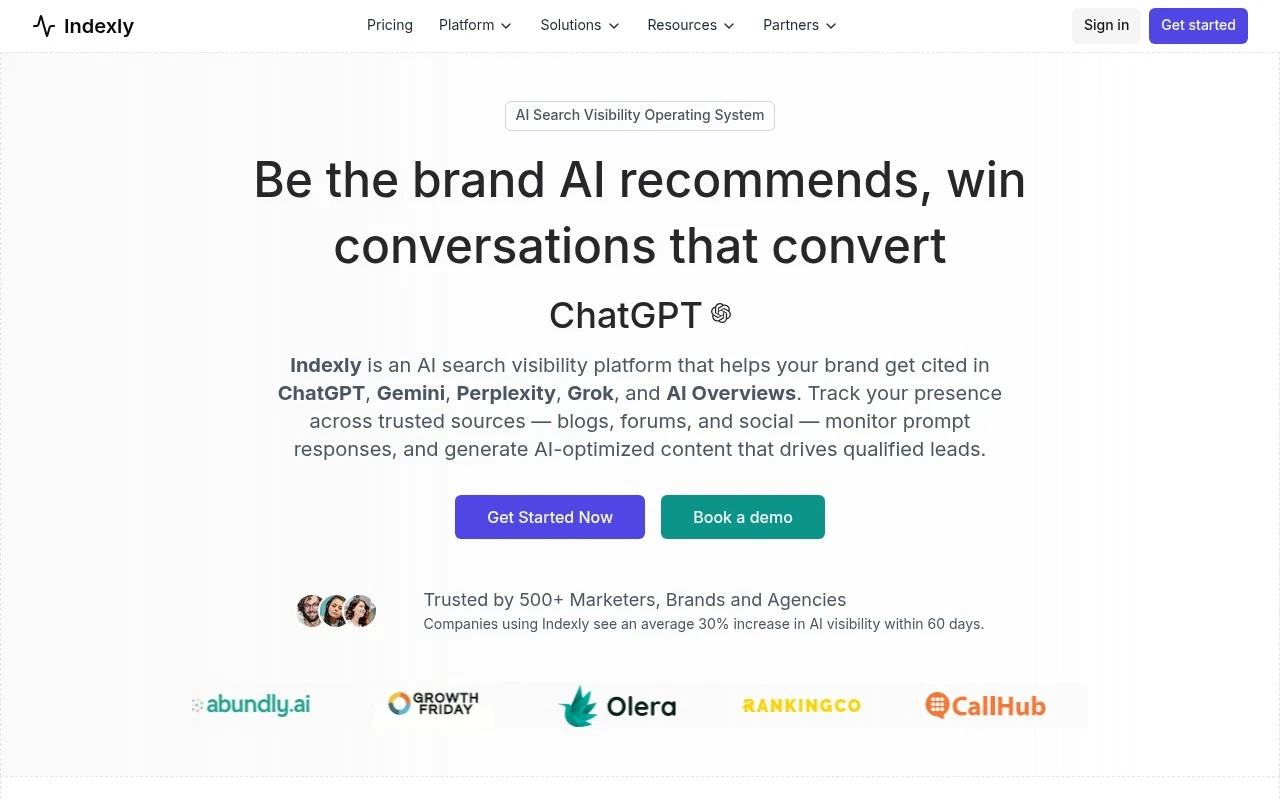
Indexly is an ai search optimization platform that helps websites monitor and improve how their content is discovered, cited, and surfaced in AI answer engines such as ChatGPT, Perplexity, and Google AI Overviews.
Content & On-pageAI Search / GEO

FYAI Score

7.9 / 10

Based on 4 reviews + FYAI product analysis

Pricing:

Free trial

Best for:

SEO and content teams growing visibility in AI search

Score Breakdown

  • Ease of use7.3 / 10
  • Features8.2 / 10
  • Pricing7.9 / 10
  • Integrations8.3 / 10
  • Support7.9 / 10

PRODUCT PREVIEW

What this AI tool does

Indexly is an AI search optimization platform for companies that want to understand, improve, and grow their visibility across AI-powered search engines, answer engines, and generative discovery experiences. It treats AI search as a measurable growth channel rather than a vague brand-awareness problem, bringing together visibility tracking, content optimization, technical diagnostics, and publishing workflows in one place. For marketing teams, the platform answers a new question that traditional SEO tools do not fully cover: how does a brand appear when customers ask AI systems for recommendations, comparisons, explanations, or buying advice? Indexly helps teams see whether their company is mentioned, how it is described, which competitors are cited, and which sources influence those answers. That makes it especially relevant for SEO leaders, growth teams, content marketers, and founders adapting to generative engine optimization. AI search visibility tracking is central to the product story. Instead of only monitoring rankings on search result pages, the tool looks at how brands, products, and topics surface inside AI-generated responses. It can help users identify where they are present, where they are absent, and where the sentiment or framing around the brand needs improvement. Citation and sentiment analysis give the data more practical value. A brand may be mentioned by an AI engine, but that mention can be neutral, positive, inaccurate, outdated, or overshadowed by a competitor. By connecting visibility with source attribution and tone, the platform helps teams decide whether they need better content, stronger authority signals, clearer positioning, or corrections to the web sources that AI systems rely on. Technical AI-readiness checks expand the scope beyond content alone. The platform examines whether a company’s site is structured in a way that AI crawlers and retrieval systems can understand, including signals that affect discoverability, clarity, and machine readability. This positions AI search optimization as a blend of technical SEO, content strategy, entity clarity, and brand governance. Content agents are where Indexly moves from analysis into execution. The platform can generate and publish optimized articles using brand context, images, embeds, and multilingual support, which makes it useful for teams that need to write blog post content at scale without losing consistency. Rather than functioning as a generic AI writer, it is shaped around SEO content optimization and the specific requirements of being cited, summarized, and recommended by AI systems. Traffic analytics for AI engines help close the loop between visibility and business impact. As discovery shifts from classic search results toward AI assistants and answer interfaces, companies need to know whether these systems are sending qualified visitors, influencing demand, or changing the path to conversion. The platform’s analytics layer helps teams connect AI visibility with measurable growth signals. In a crowded field of SEO tools, Indexly is best understood as a generative engine optimization platform built for the AI search era. It does not replace every traditional SEO workflow, but it extends the discipline into the places where customers increasingly ask questions and receive synthesized answers. Its strength is the combination of monitoring, diagnosis, analytics, and content production around one goal: making a brand easier for AI systems to find, understand, cite, and recommend. Indexly is best for organizations that already care about organic growth and want to prepare for a search landscape where visibility depends on more than blue-link rankings. It gives teams a structured way to manage how their brand appears in AI-generated answers, improve the sources that shape those answers, and publish content designed for both human readers and machine interpretation.

Use cases

Best for

AI Search Optimization

Track brand visibility, sentiment, and citations in AI answers, and run AI-readiness checks to fix discoverability issues.

Generative Engine Optimization

Indexly monitors generative engines for where your brand is cited, then maps citations to pages and content gaps to address.

SEO Content Optimization

Use content agents to generate and publish brand-context articles with images, embeds, and multilingual variants for SEO pages.

ANALYSIS

Strengths & limitations

Strengths
  • Best suited to marketing and SEO teams treating AI search as a growth channel because it combines visibility tracking, citation analysis, sentiment analysis, technical checks, traffic analytics, and content generation in one workflow.
  • Useful for brands and agencies managing content at scale because its content agents can generate and publish optimized articles with brand context, images, embeds, and multilingual support.
  • Helps teams connect AI answer visibility to business impact because it pairs citation and content gap monitoring with analytics for AI-engine traffic.

Limitations
  • Less suitable for teams that only need traditional keyword rank tracking because its workflow is centered on AI search visibility, citations, and generative engine optimization.
  • Requires meaningful brand, content, and analytics setup to get full value because sentiment tracking, citation analysis, traffic measurement, and publishing depend on connected context and data.
  • The free-trial model means ongoing use requires budget after evaluation, which can be a constraint for small teams or high-volume content programs.

Evaluation

FYAI score breakdown

Our structured evaluation across five key criteria

7.9 / 10

Overall score

Based on 4 reviews + FYAI product analysis

  • Ease of use7.3 / 10
  • Features8.2 / 10
  • Pricing7.9 / 10
  • Integrations8.3 / 10
  • Support7.9 / 10

What users say

Findings from public reviews, documentation and community sources.

  • Ease of use

    Indexly's website presents self-serve onboarding actions such as “Get Started” and describes an “Auto-Pilot Engine” where users can “set the cadence and let the agent run.”

  • Features

    Indexly's website says AI visibility monitoring covers “ChatGPT, Gemini, Perplexity, Grok, Claude and AI Overviews,” and also lists prompt tracking, citation gap analysis, and AI traffic analytics.

  • Pricing

    Indexly's pricing page lists Starter at “$99/month,” Growth at “$299/month,” and Scale at “$499/month,” plus 50/100/200 tracked prompts and a “17% discount” for annual billing. Indexly's pricing page does not list a public free tier and limits APIs to Scale.

  • Integrations

    Indexly's integrations page lists native publishing/connectivity options including “WordPress.com, WordPress.org, Ghost, Webflow, Zapier and Webhooks,” and says Scale includes “API Access.” Indexly's integrations page says partners can request custom CRM integrations such as Salesforce and HubSpot.

  • Support

    Indexly's pricing page lists Starter support as “Email,” higher tiers with “Priority Support,” and Scale with a “Key Account Manager” plus “Monthly Business Review.”

Who is this for?

Best for teams that want SEO/GEO workflows around AI visibility and indexing, Indexly's website lists AI visibility monitoring across “ChatGPT, Gemini, Perplexity, Grok, Claude and AI Overviews,” prompt tracking, citation gap analysis, and automated indexing. Less suited to users needing a free entry point or API access on lower plans, Indexly's pricing page does not list a public free tier and limits APIs to Scale.

PRODUCT PREVIEW

Feature highlights

AI visibility tracking

Track prompts, rankings, citations, and sentiment across AI engines.

AI-readiness checks

Audit technical signals that affect how AI systems crawl and cite you.

Content agents

Generate and publish brand-safe articles with images and multilingual support.

COMPARE

Discover curated alternatives worth comparing

Compare similar AI tools based on features, pricing and use cases

8.8/ 10Based on 846 reviews

Yoast SEO

Content & On-pageTechnical & Audit
Optimizes SEO titles, descriptions, and product content
Best for:
SEO teams
Pricing
Freemium

8.1/ 10Based on 1,124 reviews

Yext

SEO MonitoringAI Search / GEO
Publishes verified business data, tracks AI and search discovery
Best for:
SEO teams
Pricing
Paid

7.7/ 10Based on 5,772 reviews

Writesonic

Copy Optimization
Surfaces answer-engine visibility and citation gaps for GEO fixes
Best for:
Marketing teams
Pricing
Freemium

Start showing up where nearby customers search. Use indexly to boost local visibility and turn more local searches into calls, visits, and bookings.

FAQ

Frequently asked
questions

Everything you need to know about this AI tool,
its features, pricing, use cases, and limitations.

Who is Indexly best suited for?
Indexly is best suited for marketing, SEO, content, brand, and agency teams that want to track and improve visibility in AI-generated search results. It is particularly relevant for teams monitoring brand mentions, citations, sentiment, share of voice, and AI-driven traffic across tools such as ChatGPT, Gemini, Perplexity, Claude, Grok, and Google AI Overviews.
Does Indexly have a free plan or a paid plan?
Indexly offers a free trial rather than being positioned as a fully free product. Teams evaluating it should use the trial to test prompt tracking, citation monitoring, AI readiness checks, and content workflows before committing. For current plan limits, feature access, and billing terms, check indexly.ai directly.
How does Indexly compare with other AI search visibility tools?
Indexly combines AI search visibility tracking with content workflows, while some similar tools focus mainly on monitoring, analytics, or SEO content optimization. Its fit depends on whether a team needs both measurement and execution, including citation-gap analysis, brand-context content generation, scheduling, and publishing support.
How hard is it to set up Indexly?
Indexly’s main trade-off is that buyers should validate how its visibility scores, prompt tracking, and citation measurements align with their own reporting needs. Pricing details, plan limits, and integration coverage should also be confirmed before purchase. Marketing claims around visibility improvement should be treated as directional rather than guaranteed outcomes.
What should teams check about Indexly’s data privacy and compliance?
Teams should review Indexly’s privacy, data retention, access control, and compliance documentation before sharing brand, content, analytics, or customer-related data. Agencies and regulated businesses should confirm how client data is separated, whether CMS or analytics integrations are protected, and what contractual terms apply to uploaded or generated content.