Curated ToolThis tool is part of our curated AI directory. We only include tools that meet our standards for relevance, usability and real-world value.

Cognitive SEO

Cognitive SEO is an SEO platform for backlink analysis, rank tracking, site audits, and content optimization, including content gap analysis to compare pages with competitors and identify missing topics or keywords.
Content & On-pageKeyword & Research

FYAI Score

7.6 / 10

Based on 74 reviews

Pricing:

Paid

Best for:

SEO practitioners and marketing teams managing content, links, and audits

Score Breakdown

  • Ease of use7.6 / 10
  • Features8.0 / 10
  • Pricing7.6 / 10
  • Integrations7.4 / 10
  • Support7.3 / 10

PRODUCT PREVIEW

What this AI tool does

Cognitive SEO is an SEO toolset for improving and monitoring website search visibility across content, links, rankings, competitors, and site health. It is designed to help teams understand why organic traffic changes, where search opportunities are being missed, and which fixes are likely to have the greatest impact. For SEO practitioners, agencies, and marketing teams, Cognitive SEO is built to turn scattered search signals into a more usable workflow. Instead of treating keyword research, backlink analysis, rank tracking, and technical checks as separate exercises, the platform brings them into a shared view of performance and risk. Content work is one of the clearest parts of the product story. The tool supports seo content optimization by helping users evaluate pages against search intent, topic coverage, and competing results. This makes it useful for content gap analysis, especially when a team needs to see what ranking pages cover that their own pages do not. Technical visibility is another important layer. A site audit can surface issues that affect crawling, indexation, page quality, and on page optimization, giving teams a clearer sense of what may be holding a site back. The value is not only in finding errors, but in helping users prioritize technical SEO analysis alongside content and link decisions. Backlink intelligence gives the platform a risk and authority perspective. Cognitive SEO is best at connecting backlink analysis with broader SEO performance, so users can investigate link growth, unnatural link patterns, competitor link profiles, and possible penalty signals. This is particularly relevant for sites concerned with Google penalty prevention or recovery. Competitive research sits at the center of many day-to-day SEO decisions. Through competitor analysis, keyword research, and serp analysis, the platform helps users compare their visibility with other domains and identify search terms where improvement is realistic. It is especially useful when teams need to understand not just which keywords matter, but why competitors are winning them. Rank tracking adds the monitoring layer that keeps strategy grounded in results. Teams can follow keyword movement over time, connect ranking changes with content updates or technical work, and build reports that show progress without relying on a single metric. For agencies, this reporting angle can help translate detailed SEO findings into client-ready narratives. Compared with lighter keyword tools, the platform is more of a full SEO diagnostic environment. A typical Cognitive SEO review tends to focus on how well it combines content optimization, link analysis, audits, and ranking data into one operational system. Teams comparing Cognitive SEO pricing with alternatives should think less in terms of a single feature and more in terms of whether they need an integrated platform for ongoing search visibility management. The overall character of Cognitive SEO is analytical and practitioner-focused. It is not positioned as a quick writing assistant or a simple rank checker, but as a search intelligence platform for teams that need evidence before making SEO decisions. Its strongest fit is for users who want to investigate traffic problems, find content opportunities, monitor competitors, and reduce SEO risk through a structured view of their site.

Use cases

Best for

Backlink Analysis

Cognitive SEO analyzes your backlink profile to flag toxic links, track new and lost links, and surface anchor text patterns.

Keyword Research

It generates keyword ideas and metrics by analyzing search queries, ranking pages, and SERP data to prioritize targets.

Competitor Analysis

It compares competitors by tracking their rankings, backlink sources, and top pages to identify gaps in your SEO strategy.

ANALYSIS

Strengths & limitations

Strengths
  • Well suited to SEO teams that need one workspace for content optimization, technical audits, backlink analysis, rank tracking, keyword research, competitor analysis and reporting because it covers multiple search visibility workflows together.
  • Useful for content-led SEO work because its AI and NLP workflow helps editors assess search intent, content performance and ranking factors for target keywords.
  • Strong fit for teams investigating traffic drops or link risk because its backlink analysis and Google penalty prevention or recovery features support diagnostic SEO work.

Limitations
  • Less suitable for very small sites or casual publishers because Cognitive SEO is a paid SEO toolset rather than a lightweight free checker.
  • Less suitable for teams that only need one narrow function, such as a standalone rank tracker or content brief tool, because the broader suite can add workflow complexity.
  • Not a replacement for broader marketing analytics or conversion optimization platforms because its core focus is organic search visibility, site health, content and links.

Evaluation

FYAI score breakdown

Our structured evaluation across five key criteria

7.6 / 10

Overall score

Based on 74 reviews

  • Ease of use7.6 / 10
  • Features8.0 / 10
  • Pricing7.6 / 10
  • Integrations7.4 / 10
  • Support7.3 / 10

What users say

Findings from public reviews, documentation and community sources.

  • Ease of use

    G2 summarizes that users praise cognitiveSEO’s comprehensive suite for tools that “simplify SEO tasks,” especially content optimization and backlink analysis. The product page describes audit data as “easy to comprehend and visualize” with an “easy-to-follow recipe” for rankings.

  • Features

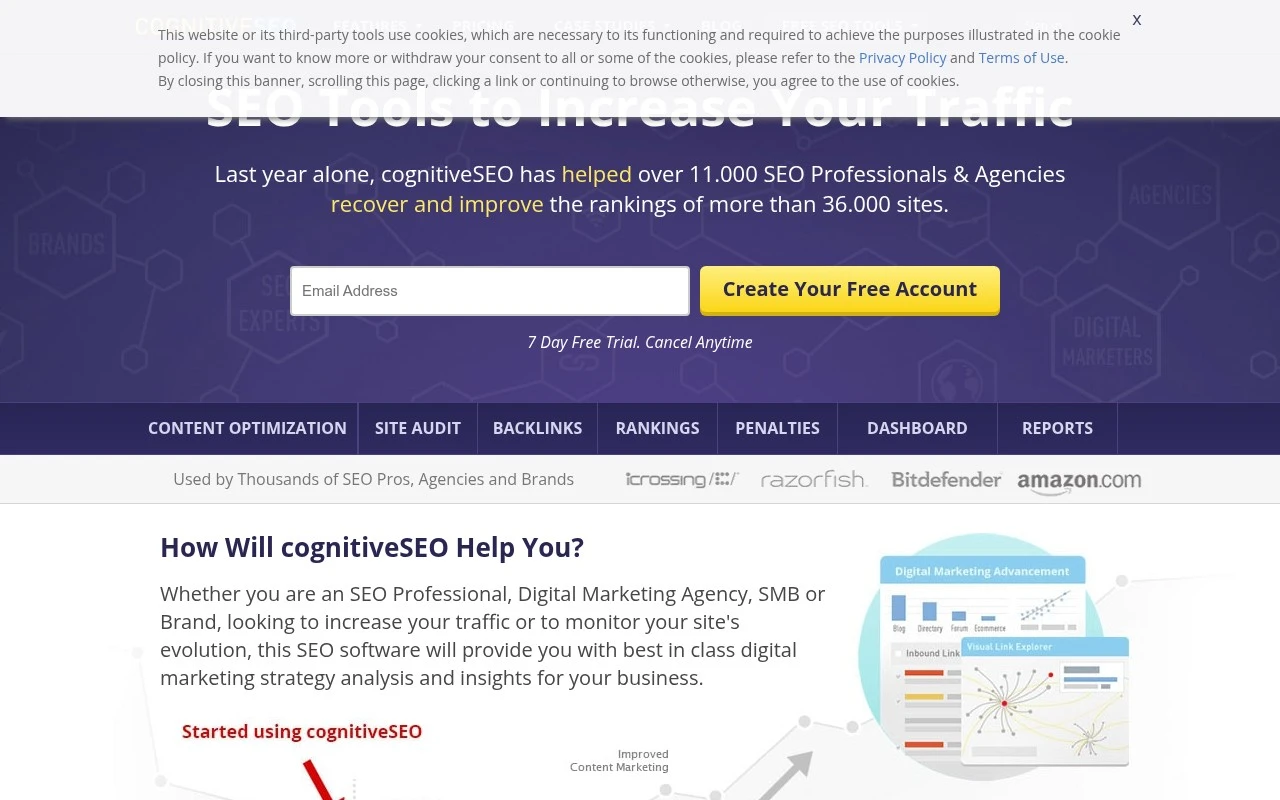
    The product page positions cognitiveSEO as an “all-inclusive” SEO suite covering “Site Audit,” “keywords research & rank tracking,” “content optimization,” and “in-depth backlinks analysis.”

  • Pricing

    The pricing page lists the Starter plan at “$129.99” monthly or “$89” annually, plus Premium and higher tiers. The pricing page advertises a “7 Day Free Trial” with “No Obligations. Cancel Anytime.”

  • Integrations

    The product navigation includes an “SEO API.” Originality.ai states that the “CognitiveSEO API allows users to process SEO-based data, such as rank tracking, and link analysis.”

  • Support

    The product page surfaces self-serve resources such as “Case Studies,” “Blog,” “Free Seo Tools,” and a “Google Webmaster Tools Guide.”

Who is this for?

Best for SEO teams that want one workspace for audits, rankings, content, and backlinks, the product page positions cognitiveSEO as an “all-inclusive” SEO suite covering “Site Audit,” “keywords research & rank tracking,” “content optimization,” and “in-depth backlinks analysis.” Less suited to freelancers or startups seeking a low entry price, the pricing page lists the Starter plan at “$129.99” monthly or “$89” annually.

PRODUCT PREVIEW

Feature highlights

Content Optimizer

Optimize pages with data-driven suggestions to improve search relevance.

Backlink Analysis

Audit link profiles, find risky links, and uncover new opportunities.

Penalty Prevention

Detect unnatural link signals early and support penalty recovery work.

COMPARE

Discover curated alternatives worth comparing

Compare similar AI tools based on features, pricing and use cases

8.8/ 10Based on 846 reviews

Yoast SEO

Content & On-pageTechnical & Audit
Optimizes SEO titles, descriptions, and product content
Best for:
SEO teams
Pricing
Freemium

8.1/ 10Based on 1,124 reviews

Yext

SEO MonitoringAI Search / GEO
Publishes verified business data, tracks AI and search discovery
Best for:
SEO teams
Pricing
Paid

7.7/ 10Based on 5,772 reviews

Writesonic

Copy Optimization
Surfaces answer-engine visibility and citation gaps for GEO fixes
Best for:
Marketing teams
Pricing
Freemium

See what’s holding your rankings back and turn insights into measurable organic growth. Start optimizing with Cognitive SEO today.

FAQ

Frequently asked
questions

Everything you need to know about this AI tool,
its features, pricing, use cases, and limitations.

Who is Cognitive SEO best suited for?
Cognitive SEO is best suited for SEO professionals, agencies, webmasters, SMBs, and brands that need to diagnose and improve organic search performance. It is most useful when teams want one suite for site audits, keyword research, content optimization, backlink analysis, rank tracking, and competitor-focused SEO work.
Is Cognitive SEO free or paid?
Cognitive SEO is a paid SEO software suite rather than a free tool. Buyers should expect to evaluate it as a subscription or commercial SEO platform and check cognitiveseo.com for current plan details, usage limits, trial availability, and feature access across audit, ranking, backlink, and content workflows.
How does Cognitive SEO compare with other SEO tools?
Cognitive SEO compares with broader SEO suites by combining technical audits, rank tracking, backlink analysis, keyword research, and AI/NLP-based content optimization in one platform. The best choice depends on whether a team needs an all-in-one workflow or prefers a simpler tool focused only on keyword tracking, audits, or content scoring.
How much setup work does Cognitive SEO require?
Cognitive SEO’s main trade-off is that its broad feature set may be more than some teams need if they only want a simple keyword tracker or basic site audit. Buyers should also validate ranking, backlink, and traffic-improvement claims in their own environment, especially when relying on the platform for prioritization decisions.
What should buyers check about Cognitive SEO data privacy and compliance?
Buyers should review Cognitive SEO’s current privacy, data retention, access control, and compliance documentation before adding websites, keywords, competitors, or reporting data. Agencies and larger brands should also confirm how user permissions, client data separation, exports, integrations, and any third-party processing fit their internal security and procurement requirements.