Curated ToolThis tool is part of our curated AI directory. We only include tools that meet our standards for relevance, usability and real-world value.

Also Asked

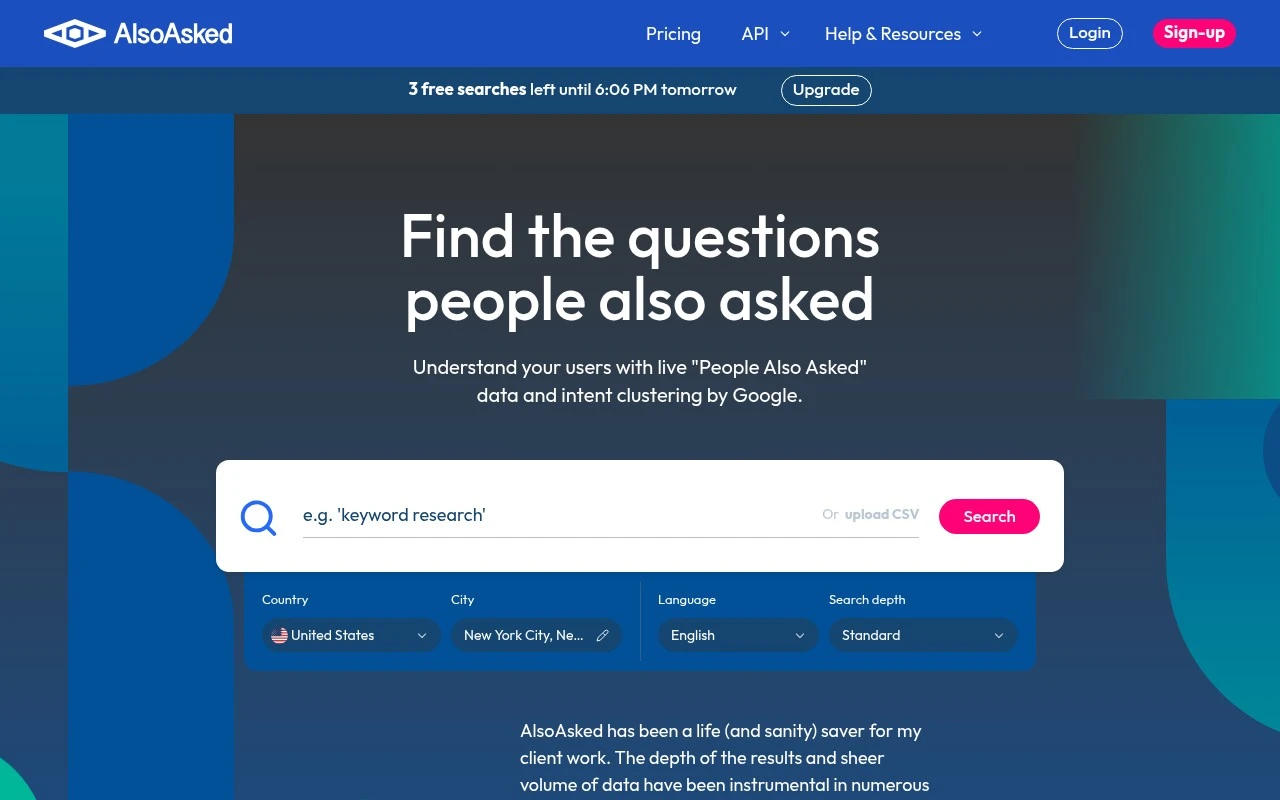
Also Asked is an SEO research tool that visualizes Google People Also Ask data to show related questions and search intent around a topic. It supports content gap analysis by helping teams identify unanswered user questions to address in content planning.
Content & On-pageKeyword & Research

FYAI Score

7.8 / 10

FYAI rating based on features, pricing and integrations

Pricing:

Freemium

Best for:

SEO content strategists building question-led topic clusters

Score Breakdown

  • Ease of use7.6 / 10
  • Features7.6 / 10
  • Pricing9.0 / 10
  • Integrations7.6 / 10
  • Support7.2 / 10

PRODUCT PREVIEW

What this AI tool does

Also Asked is a question-led SEO and content research tool that collects live Google People Also Ask data to help users understand what searchers are really trying to find. Also Asked is for SEO professionals, content strategists, marketers, publishers, and agencies that want search intent analysis based on real user questions rather than only keyword volume or ranking metrics. Its core idea is simple: start with a seed query, choose the country, city, and language that matter, and see the questions Google connects to that topic. The platform turns those relationships into visual graphs, making it easier to understand how broad queries split into subtopics, follow-up questions, and related concerns. This makes it especially useful when a team needs to brief content around intent, not just around a keyword list. For content gap analysis, Also Asked is best at revealing the questions a page, article, or cluster may not yet answer. A marketer can compare what their content covers with the questions appearing in People Also Ask results, then identify missing sections, FAQs, supporting articles, or internal linking opportunities. Instead of treating gaps as abstract keyword opportunities, the tool frames them as real questions that searchers are likely to ask. Search intent is where the product has its strongest character. Many SEO platforms focus on rankings, backlinks, audits, or broad keyword research, while this tool narrows its attention to the question patterns behind a query. That narrower focus is part of its value, because it helps users move from “what keyword should we target?” to “what does the searcher need to understand next?” Visual mapping gives the research a practical shape. Related questions are organised into branching graphs, which can support topic clustering, content outlines, FAQ planning, and editorial prioritisation. The graph format is helpful for explaining research to writers and stakeholders because it shows relationships between questions rather than presenting a flat export of terms. Location and language targeting make the data more relevant for teams working across markets. A query can produce different People Also Ask results depending on geography, so geo-specific research can matter for local SEO, international content planning, and regional campaign work. By supporting country, city, and language settings, the platform helps users avoid assuming that one market’s search intent applies everywhere. Bulk search and deep search extend the tool beyond quick one-off checks. Teams can research many seed terms, explore question networks in more depth, and return to cached search history when they need to revisit earlier findings. Downloads make the output easier to bring into spreadsheets, briefs, content calendars, or wider SEO workflows. For agencies and larger teams, the API adds a more operational layer. Also Asked offers API access with webhook support, which allows People Also Ask data to be pulled into custom dashboards, reporting systems, or automated research pipelines. This is useful when question data needs to support repeatable processes rather than manual exploration alone. Compared with broad SEO suites and also asked alternatives, the platform is more specialised than all-in-one. It is not trying to replace rank tracking, technical auditing, backlink analysis, or full competitive intelligence. Its role is to add a question-first lens to keyword research and content planning, particularly when understanding intent is more important than collecting another large keyword database. The result is a focused research tool with a clear editorial purpose. Also Asked helps turn live search behaviour into content structure, showing what people ask, how those questions connect, and where content can answer more completely. For teams building search-driven pages, topic clusters, and helpful resources, its main value is making the hidden conversation around a query visible.

Use cases

Best for

Search Intent Analysis

Also Asked pulls live, geo-specific Google People Also Ask questions to map search intent for a seed query.

Keyword Research

Use People Also Ask question graphs to expand a seed term into related keyword questions by country, city, and language.

Content Gap Analysis

Compare your page outline to Also Asked question clusters to spot missing subtopics and unanswered user questions.

ANALYSIS

Strengths & limitations

Strengths
  • Best suited to question-led SEO research because it turns live Google People Also Ask data into structured question paths for briefs, FAQs, and topic clusters.
  • Useful for local and international content planning because it supports country, city, and language targeting for search intent research.
  • Good fit for teams that need repeatable workflows because bulk search, deep search, downloads, cached history, and API access help move question research into production processes.

Limitations
  • Less suitable as an all-in-one SEO platform because it focuses on People Also Ask and question research rather than rankings, backlinks, technical audits, or full competitive analytics.
  • Less useful for teams researching non-Google channels because its insights depend on Google People Also Ask data rather than social, forum, marketplace, or internal site-search behavior.
  • High-volume teams should expect the freemium model to affect workflow planning because heavier use cases such as bulk search, deep search, and API access are a better fit for paid usage.

Evaluation

FYAI score breakdown

Our structured evaluation across five key criteria

7.8 / 10

Overall score

FYAI rating based on features, pricing and integrations

  • Ease of use7.6 / 10
  • Features7.6 / 10
  • Pricing9.0 / 10
  • Integrations7.6 / 10
  • Support7.2 / 10

What users say

Findings from public reviews, documentation and community sources.

  • Ease of use

    The AlsoAsked homepage presents a workflow to “Find the questions people also asked” with visual outputs, “PNG image export,” dashboards, and cached search history. The AlsoAsked homepage includes customer quotes describing the product as a “life... saver” and a “new starting point for keyword research.”

  • Features

    The AlsoAsked homepage describes “live, geo-specific” PAA data, “city-level targeting in all languages supported by Google,” visual graphs, and Deep Search averaging “150 questions per query.” The AlsoAsked homepage also references bulk upload, downloads, and a sync/async API with webhooks.

  • Pricing

    The AlsoAsked pricing page lists monthly tiers of Basic at “$12 /month,” Lite at “$23 /month,” and Pro at “$47 /month,” with annual savings of 20%. The AlsoAsked pricing page states monthly credit allowances of 100, 300, and 1,000 credits, plus free monthly search credits for non-registered users, all regions/languages, and unlimited users.

  • Integrations

    The AlsoAsked homepage advertises an “Asynchronous API” with sync/async access and webhook support. The AlsoAsked homepage specifically mentions integrations with “Screaming Frog and ChatGPT.”

  • Support

    The AlsoAsked homepage links to learning content such as “Read how to understand customers and improve SEO with intent data.” The AlsoAsked homepage references dashboard-based access to previous searches and historical downloads.

Who is this for?

Best for SEO and content teams researching People Also Ask intent across locations, the AlsoAsked homepage describes “live, geo-specific” PAA data and “city-level targeting in all languages supported by Google.” Less suited to teams that need many named native integrations, the AlsoAsked homepage specifically mentions integrations with “Screaming Frog and ChatGPT,” while API access and webhooks are available.

PRODUCT PREVIEW

Feature highlights

Live PAA Mining

Pull fresh Google People Also Ask questions from a seed query.

Geo Intent Targeting

See questions by country, city, and language for local intent.

Bulk + API Workflows

Run bulk/deep searches, export data, or automate via API + webhooks.

COMPARE

Discover curated alternatives worth comparing

Compare similar AI tools based on features, pricing and use cases

8.8/ 10Based on 846 reviews

Yoast SEO

Content & On-pageTechnical & Audit
Optimizes SEO titles, descriptions, and product content
Best for:
SEO teams
Pricing
Freemium

8.1/ 10Based on 1,124 reviews

Yext

SEO MonitoringAI Search / GEO
Publishes verified business data, tracks AI and search discovery
Best for:
SEO teams
Pricing
Paid

7.7/ 10Based on 5,772 reviews

Writesonic

Copy Optimization
Surfaces answer-engine visibility and citation gaps for GEO fixes
Best for:
Marketing teams
Pricing
Freemium

Turn real search questions into clear content plans. Start mapping intent and uncovering what your audience asks next with Also Asked.

FAQ

Frequently asked
questions

Everything you need to know about this AI tool,
its features, pricing, use cases, and limitations.

Is Also Asked a good fit for content gap analysis and SEO content briefs?
Also Asked is a good fit when content gap analysis depends on understanding the real questions people ask around a topic. It pulls Google People Also Ask data and turns follow-up questions into visual maps, clusters, and exports that can support briefs, FAQ sections, article outlines, and content refresh planning.
Can I use Also Asked for free, or do I need a paid plan?
Also Asked uses a freemium model, so it can be useful for light research before a team commits to paid access. Paid usage is more relevant when teams need larger workflows such as deep searches, bulk uploads, downloadable datasets, or API-based research across multiple topics, markets, or languages.
How does Also Asked compare with other keyword research tools?
Also Asked is more focused on searcher questions and intent paths than on broad SEO metrics. It is best compared with other question research, topic clustering, and content planning tools, while full SEO suites are usually stronger for backlink analysis, rank tracking, technical audits, and keyword volume reporting.
How long does it take to start using Also Asked for topic research?
The main limitation of Also Asked is that it is centered on Google People Also Ask data rather than the full SEO workflow. It does not replace tools for backlink analysis, rank tracking, audits, or search volume, and question coverage can vary depending on the topic, location, language, and Google’s current results.
What privacy or compliance checks should teams make before using Also Asked?
Teams should treat queries, uploads, exports, and API usage in Also Asked as business research data and review the tool’s current privacy, security, and data retention terms. Agencies and regulated teams should avoid entering sensitive client information unless their internal policies allow it and access controls are understood.