Curated ToolThis tool is part of our curated AI directory. We only include tools that meet our standards for relevance, usability and real-world value.

Wudpecker

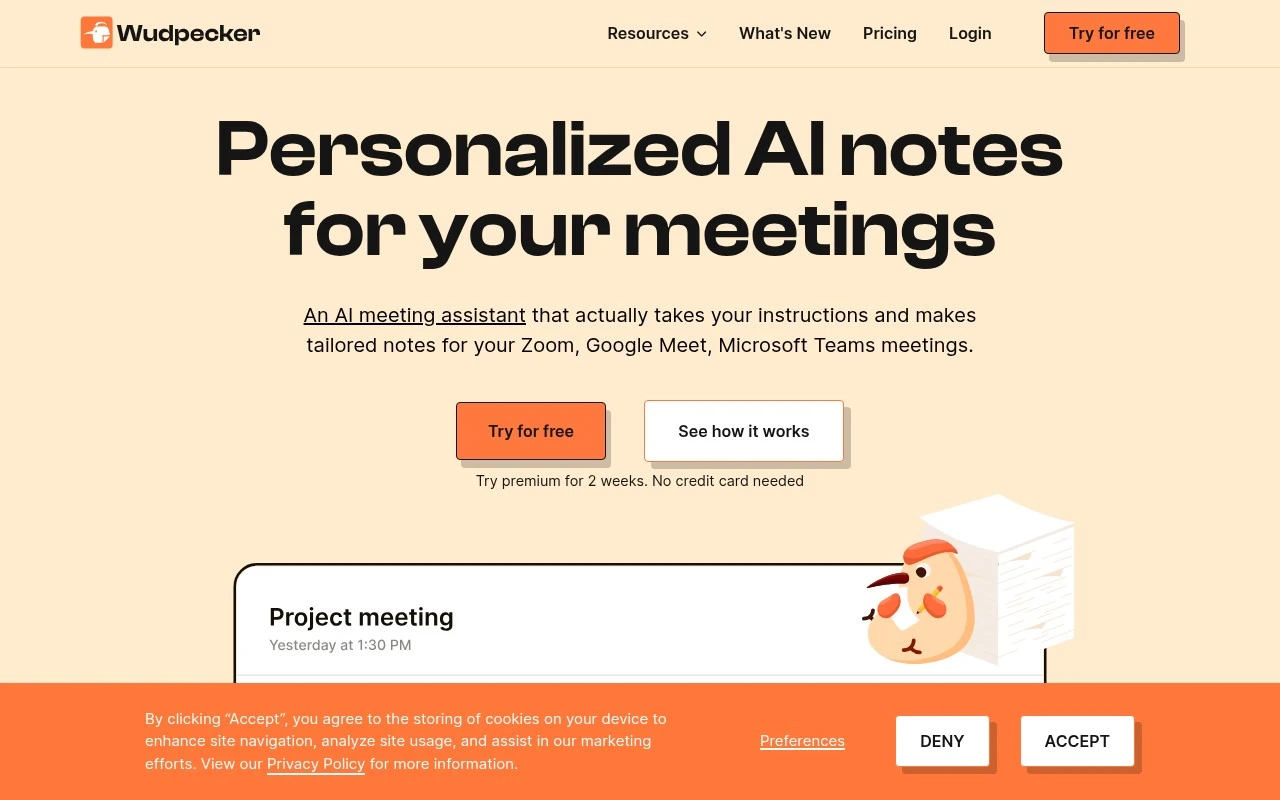
Wudpecker is an AI meeting assistant that records and transcribes calls, then generates meeting notes, summaries, and action items for tools like Zoom, Google Meet, and Microsoft Teams.
Meeting NotesSummarization

FYAI Score

7.8 / 10

Based on 31 reviews

Pricing:

Freemium

Best for:

Sales and customer teams who need accurate meeting notes fast

Score Breakdown

  • Ease of use7.9 / 10
  • Features7.4 / 10
  • Pricing8.5 / 10
  • Integrations7.4 / 10
  • Support7.9 / 10

PRODUCT PREVIEW

What this AI tool does

Wudpecker is an AI meeting assistant that turns online conversations into personalized meeting notes for professionals and teams using Zoom, Google Meet, and Microsoft Teams. It is built for people who need a reliable record of what was said, what mattered, and what should happen next, without dividing their attention between listening and manual note-taking. For customer-facing teams, researchers, managers, consultants, and founders, the value is not just transcription. Wudpecker is best at converting meeting context into notes that match the way a user actually works, including preferred structure, language, vocabulary, level of detail, and even table formatting. That makes it useful when meetings are not interchangeable, and when the right summary depends on the role, objective, or audience. Instead of producing one generic recap for every call, the platform is designed around instruction-led note generation. A sales team might ask it to capture pain points, objections, buying signals, and next steps, while a product team might focus on feature requests, user language, and recurring themes. This makes the meeting notes more usable as working documents rather than passive summaries that need to be rewritten later. Meeting coverage is centered on the major video platforms where modern work happens. Wudpecker can join or process meetings from Zoom, Google Meet, and Microsoft Teams, then use the conversation as source material for structured notes and audio summarization. The experience is aimed at reducing the administrative burden around calls while preserving the details that are easy to miss in live discussion. Ask Wudpecker extends the product beyond note creation into meeting intelligence. Users can ask questions about meeting context, extract ideas, find answers, or revisit specific points after the call. This is especially useful when a team needs to understand what customers, candidates, partners, or stakeholders actually said without replaying recordings or scanning long transcripts. In practice, Wudpecker fits teams that care about understanding people better. It helps capture the nuance of customer interviews, sales calls, internal planning sessions, and recurring team meetings, while leaving room for each user to define what good notes should look like. The tool is less about replacing human judgment and more about making the raw material of meetings easier to organize, search, and act on. The broader story of Wudpecker is a shift from simple meeting recording to personalized meeting memory. By combining meeting notes, audio summarization, and an assistant that can answer questions from meeting context, it turns conversations into a more useful knowledge source for teams that rely on accurate follow-up and shared understanding.

Use cases

Best for

Meeting Notes

Wudpecker joins Zoom, Meet, or Teams and generates structured meeting notes using your instructions for format, language, and details.

Audio Summarization

Summarize recorded meeting audio by extracting key points and action items from the meeting context with Ask Wudpecker.

ANALYSIS

Strengths & limitations

Strengths
  • Best suited to teams that want highly tailored meeting outputs because notes can follow user instructions for structure, language, vocabulary, captured details, and table formatting.
  • Useful for organizations standardized on Zoom, Google Meet, and Microsoft Teams because Wudpecker fits into the main online meeting platforms many teams already use.
  • Strong fit for customer-facing and research-heavy teams because Ask Wudpecker can extract answers and ideas from meeting context for follow-up and knowledge sharing.

Limitations
  • Less suitable for teams that need documentation across many unsupported meeting channels because Wudpecker is centered on Zoom, Google Meet, and Microsoft Teams workflows.
  • Less suitable as an all-in-one productivity suite because its core value is meeting documentation, summaries, action items, and contextual Q&A rather than project management or task execution.
  • The freemium model can become a constraint for high-volume teams because broader usage, team rollout, or advanced needs may require moving beyond the free plan.

Evaluation

FYAI score breakdown

Our structured evaluation across five key criteria

7.8 / 10

Overall score

Based on 31 reviews

  • Ease of use7.9 / 10
  • Features7.4 / 10
  • Pricing8.5 / 10
  • Integrations7.4 / 10
  • Support7.9 / 10

What users say

Findings from public reviews, documentation and community sources.

  • Ease of use

    G2 summarizes that users “consistently praise the ease of use and AI summary functionality,” while Product Hunt notes some new users struggle to find features like Ask Wudpecker or templates.

  • Features

    Wudpecker lists tailored note structures, Ask Wudpecker, 35-language notes, custom vocabulary, and bot recording for Zoom/Google Meet/Microsoft Teams.

  • Pricing

    The Wudpecker pricing page lists a Free plan at $0 including 10 notetaker-bot meetings/month, Plus at $19/month for 30 bot meetings and unlimited Ask AI, and Pro at $32/month for 100 bot meetings. The Wudpecker pricing page also offers a 2-week premium trial with no credit card and states a no-refund policy after cancellation.

  • Integrations

    Wudpecker integration docs document Google Meet, Zoom, and Microsoft Teams, and the Wudpecker pricing page lists Notion, Slack, and HubSpot on Plus.

  • Support

    The Wudpecker pricing page includes an FAQ covering upgrades, limits, refunds, calendars, languages, speaker identification, processing time, accuracy, and privacy. The Wudpecker pricing page references contacting support for data-privacy questions.

Who is this for?

Best for teams that want AI meeting notes across common video-call platforms. Wudpecker supports bot recording for Zoom/Google Meet/Microsoft Teams and offers 35-language notes. Less suited to users who need many bot-recorded meetings on lower tiers, the Free plan includes 10 notetaker-bot meetings/month and Plus includes 30 bot meetings.

PRODUCT PREVIEW

Feature highlights

Meeting capture

Works with Zoom, Meet, and Teams to capture meeting context.

Custom note templates

Personalized notes by your structure, language, and detail level.

Ask Wudpecker

Query past meetings to pull answers, ideas, and next steps.

COMPARE

Discover curated alternatives worth comparing

Compare similar AI tools based on features, pricing and use cases

9.0/ 10Based on 1,589 reviews

Toggl Track

Time & Habit Tracking
Tracks time, automates activity capture, and reports team data
Best for:
Operations teams
Pricing
Freemium

8.5/ 10Based on 2,648 reviews

Todoist

Task & Project Management
Captures tasks, organizes schedules, and clarifies action plans
Best for:
Knowledge workers
Pricing
Freemium

8.1/ 10Based on 524 reviews

tl;dv

Meeting NotesKnowledge Search
Transcribes meetings, writes notes, and updates your CRM
Best for:
Sales teams
Pricing
Freemium

Turn every meeting into clear notes and accountable next steps. Start using Wudpecker today and keep your team aligned without the busywork.

FAQ

Frequently asked
questions

Everything you need to know about this AI tool,
its features, pricing, use cases, and limitations.

Who is Wudpecker best for?
Wudpecker is best for teams that run recurring Zoom, Google Meet, or Microsoft Teams meetings and need structured notes without manual note-taking. It fits product managers, sales teams, customer success, partnerships, marketing, recruiting, and other roles that need summaries, action items, and searchable meeting context.
Does Wudpecker have a free plan?
Wudpecker uses a freemium pricing model, so users can start free and upgrade for more capability as needed. Teams evaluating it should check the current plan details on wudpecker.io, especially limits around recording volume, summaries, seats, retention, integrations, and access to advanced customization.
How does Wudpecker compare with other AI meeting note tools?
Wudpecker is most differentiated by configurable meeting notes, including preferred structures, vocabulary, languages, detail-capture instructions, and table-based outputs. Like other AI meeting assistants, it records and summarizes calls, but the best choice depends on meeting volume, workflow needs, budget, integrations, and how much note customization your team requires.
How much work does it take to set up Wudpecker for meetings?
Wudpecker’s main trade-off is that its value depends on capturing meetings and giving it clear instructions for the notes you want. It is focused on meeting documentation, summaries, action items, and contextual Q&A, not on replacing a full project management system or general-purpose knowledge base.
Is Wudpecker secure enough for customer or internal meetings?
Wudpecker states that it supports GDPR compliance, AES-256 encryption at rest, HTTPS encryption in transit, and EU-based data storage. Teams handling sensitive conversations should still review its current security documentation, retention controls, access permissions, and data processing terms before using it for confidential customer, employee, or strategic meetings.