Curated ToolThis tool is part of our curated AI directory. We only include tools that meet our standards for relevance, usability and real-world value.

tl;dv

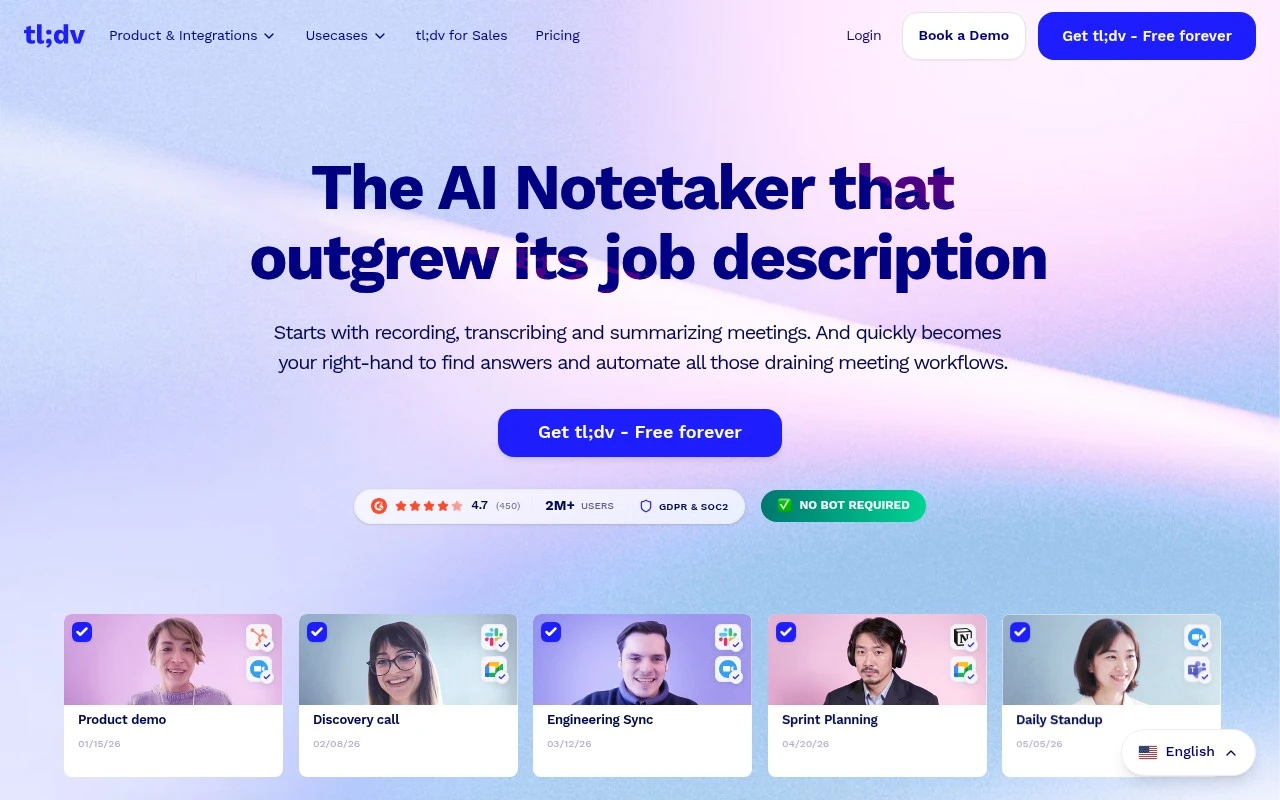
tl;dv is an AI meeting recorder that joins Zoom, Google Meet, and Microsoft Teams calls to record meetings, transcribe audio, and generate searchable summaries with key moments and action items.
Meeting NotesKnowledge Search

FYAI Score

8.1 / 10

Based on 524 reviews

Pricing:

Freemium

Best for:

Sales and customer-facing teams that run lots of calls

Score Breakdown

  • Ease of use8.4 / 10
  • Features8.6 / 10
  • Pricing8.4 / 10
  • Integrations7.3 / 10
  • Support7.5 / 10

PRODUCT PREVIEW

What this AI tool does

tl;dv is an AI-powered meeting notetaker for teams that records calls, generates transcripts, meeting notes, summaries, and action items, and turns conversations into searchable business knowledge. It is built for organizations that spend a large part of their workday in meetings and need a reliable way to capture decisions, customer signals, next steps, and recurring themes without relying on manual notes. For busy teams, the core value is continuity. The platform can transcribe audio from meetings, preserve the recording, and produce concise outputs that help people catch up quickly or revisit what was actually said. This makes it useful not only for absent teammates, but also for managers, customer-facing teams, and cross-functional groups that need a shared record of conversations. Instead of treating transcription as the final product, the tool positions meeting data as something teams can search, summarize, and act on. Users can ask questions across past calls, pull out highlights, identify patterns, and generate reports from multiple conversations rather than opening recordings one by one. In that sense, tl;dv is best at turning scattered meeting content into an internal search layer for company knowledge. Sales organizations are one of its clearest audiences. The platform supports sales enablement by helping reps and managers review customer calls, surface objections, inspect discovery quality, and capture insights that can improve coaching. It can also reduce administrative work through CRM automation, helping teams move call outcomes, notes, and follow-ups into the systems where sales work is tracked. Workflow automation is part of the broader story. Meeting summaries and action items can feed into everyday tools, making it easier to turn a conversation into a task, a customer update, a coaching moment, or context for email writing. This matters because the most valuable parts of a meeting often disappear after the call unless they are connected to the team’s actual workflow. Across international teams, multilingual transcription and translation make the platform more useful than a single-language meeting recorder. Colleagues can review conversations in different languages, share summaries with global stakeholders, and reduce the friction of working across regions. For distributed companies, this helps meetings become more accessible and less dependent on who was present live. Security and governance are also part of the product’s positioning. Meeting recordings and transcripts often contain customer details, commercial plans, hiring discussions, and internal decisions, so the value of an AI meeting assistant depends on how responsibly it handles that data. tl;dv is presented as a tool for professional teams, not just individuals, which means its usefulness is tied to trust, permissions, and controlled access as much as to summarization quality. In the wider market of AI meeting assistants, tl;dv sits above basic record-and-transcribe tools and closer to a meeting intelligence platform. Readers comparing tl;dv alternatives or looking for a tl;dv review are usually evaluating whether they need simple notes or a system that can connect meetings to sales, operations, reporting, and knowledge management. Pricing will matter by team size and use case, but the larger question is whether meeting content is a passive archive or an active source of business insight. Ultimately, tl;dv is strongest for teams that want fewer lost details after meetings and more structured intelligence from the conversations they already have. It helps convert live discussions into searchable records, practical summaries, CRM-ready updates, and cross-meeting insights, giving organizations a clearer way to learn from their calls over time.

Use cases

Best for

Meeting Notes

tl;dv records meetings and generates searchable transcripts, summaries, and action items you can share with your team.

Transcribe Audio

Upload or capture meeting audio to get an AI transcript with speaker labels, timestamps, and multilingual translation.

Email Writing

Turn meeting summaries and action items into follow-up emails by copying tl;dv notes into your email draft.

ANALYSIS

Strengths & limitations

Strengths
  • Best suited to sales and customer-facing teams because it turns calls into summaries, action items, follow-ups, CRM updates, and coaching insights.
  • Useful for teams with high meeting volume because searchable transcripts and AI reports can surface themes across many conversations without replaying every recording.
  • Strong fit for distributed or multilingual teams because transcription and translation help share meeting knowledge across languages and time zones.

Limitations
  • Less suitable for teams that prohibit meeting recording or bot participants because tl;dv’s core value depends on capturing and storing conversation content.
  • Teams with strict compliance, consent, or data residency rules need governance before rollout because recorded customer and internal meetings can contain sensitive information.
  • Less compelling for individuals or small teams that only need basic transcripts because its broader CRM updates, cross-meeting reports, and coaching workflows add more process than they may need.

Evaluation

FYAI score breakdown

Our structured evaluation across five key criteria

8.1 / 10

Overall score

Based on 524 reviews

  • Ease of use8.4 / 10
  • Features8.6 / 10
  • Pricing8.4 / 10
  • Integrations7.3 / 10
  • Support7.5 / 10

What users say

Findings from public reviews, documentation and community sources.

  • Ease of use

    G2 lists tl;dv at 4.7/5 from 524 reviews, and a sample G2 review says tl;dv helps users be “more present in meetings” while keeping documentation accessible afterward. Reddit sentiment includes some reliability concerns.

  • Features

    The tl;dv features page describes AI-generated summaries, customizable notes, CRM outcome logging, and drafted follow-up emails. The tl;dv features page also references translation/summarization in “30+ languages.”

  • Pricing

    The tl;dv pricing page says users can “begin recording, transcribing, taking notes, and getting insights” for free. The tl;dv pricing page notes “40% off on every annual plan.”

  • Integrations

    The tl;dv homepage says meeting insights can be “instantly sent to your favourite apps.” The tl;dv homepage also says tl;dv can “automatically log call notes and CRM outcomes.”

  • Support

    The tl;dv homepage includes a FAQ-style section framed as “Your note-taking questions, explained.” G2 lists tl;dv at 4.7/5 from 524 reviews.

Who is this for?

Best for teams that want meeting capture to feed follow-up work, the tl;dv features page describes AI-generated summaries, CRM outcome logging, and drafted follow-up emails, so meeting notes can turn into CRM records and email drafts. Less suited to buyers who need a fully detailed integration catalog before purchase, the tl;dv homepage facts mention insights sent to “your favourite apps” and automatic CRM outcome logging rather than a separately detailed integration catalog.

PRODUCT PREVIEW

Feature highlights

AI meeting notes

Auto-record, transcribe, summarize, and capture action items.

Search across calls

Find answers and summarize insights across all conversations.

CRM & workflow sync

Push notes and updates into your CRM and team workflows.

COMPARE

Discover curated alternatives worth comparing

Compare similar AI tools based on features, pricing and use cases

7.8/ 10Based on 31 reviews

Wudpecker

Meeting NotesSummarization
Turns recordings into notes, summaries, action items, and Q&A
Best for:
Knowledge workers
Pricing
Freemium

9.0/ 10Based on 1,589 reviews

Toggl Track

Time & Habit Tracking
Tracks time, automates activity capture, and reports team data
Best for:
Operations teams
Pricing
Freemium

8.5/ 10Based on 2,648 reviews

Todoist

Task & Project Management
Captures tasks, organizes schedules, and clarifies action plans
Best for:
Knowledge workers
Pricing
Freemium

Turn every meeting into clear takeaways in minutes. Start using tl;dv to keep everyone aligned and never miss an action item again.

FAQ

Frequently asked
questions

Everything you need to know about this AI tool,
its features, pricing, use cases, and limitations.

Who is tl;dv best for?
tl;dv is best suited to teams that rely on recorded meetings, customer calls, and internal discussions. Sales, customer success, product, and management teams can use it to create transcripts, summaries, action items, follow-ups, CRM updates, and searchable meeting insights across individual calls or collections of meetings.
Is tl;dv free, and what do paid plans usually add?
tl;dv uses a freemium pricing model, so teams can start with a free option and upgrade when they need more advanced or team-oriented capabilities. Buyers should review current plan limits for recording, transcription, AI summaries, integrations, CRM workflows, reporting, and collaboration features on tldv.io.
How does tl;dv compare with other AI meeting notetakers?
tl;dv is a better fit than basic transcription tools when teams need meeting intelligence and workflow automation, not just a written transcript. It combines meeting notes, summaries, action items, shareable highlights, CRM updates, reports, and coaching insights, while the right alternative depends on budget, meeting volume, and integration needs.
How hard is it to set up tl;dv for a team?
tl;dv is less useful for teams that do not run many recorded meetings or customer calls. Its strongest workflows depend on integrations, CRM processes, and consistent team usage, so buyers should evaluate transcription accuracy, integration fit, setup effort, and whether automated summaries match their review and compliance needs.
How does tl;dv handle privacy and compliance?
tl;dv states that it supports GDPR, SOC 2, EU hosting, encryption, and does not use recordings or transcripts to train AI. Teams handling sensitive meeting data should still confirm current retention settings, access controls, admin permissions, consent workflows, and regional data requirements before rolling it out broadly.