Curated ToolThis tool is part of our curated AI directory. We only include tools that meet our standards for relevance, usability and real-world value.

Supernormal

Supernormal is an AI meeting assistant that records, transcribes, and summarizes meetings in tools like Zoom, Google Meet, and Microsoft Teams, producing notes, action items, and follow-up email writing drafts.
Meeting NotesEmail Assistant

FYAI Score

8.2 / 10

Based on 185 reviews

Pricing:

Freemium

Best for:

Remote teams that want automatic meeting notes without bots

Score Breakdown

  • Ease of use8.7 / 10
  • Features7.8 / 10
  • Pricing8.0 / 10
  • Integrations9.1 / 10
  • Support7.5 / 10

PRODUCT PREVIEW

What this AI tool does

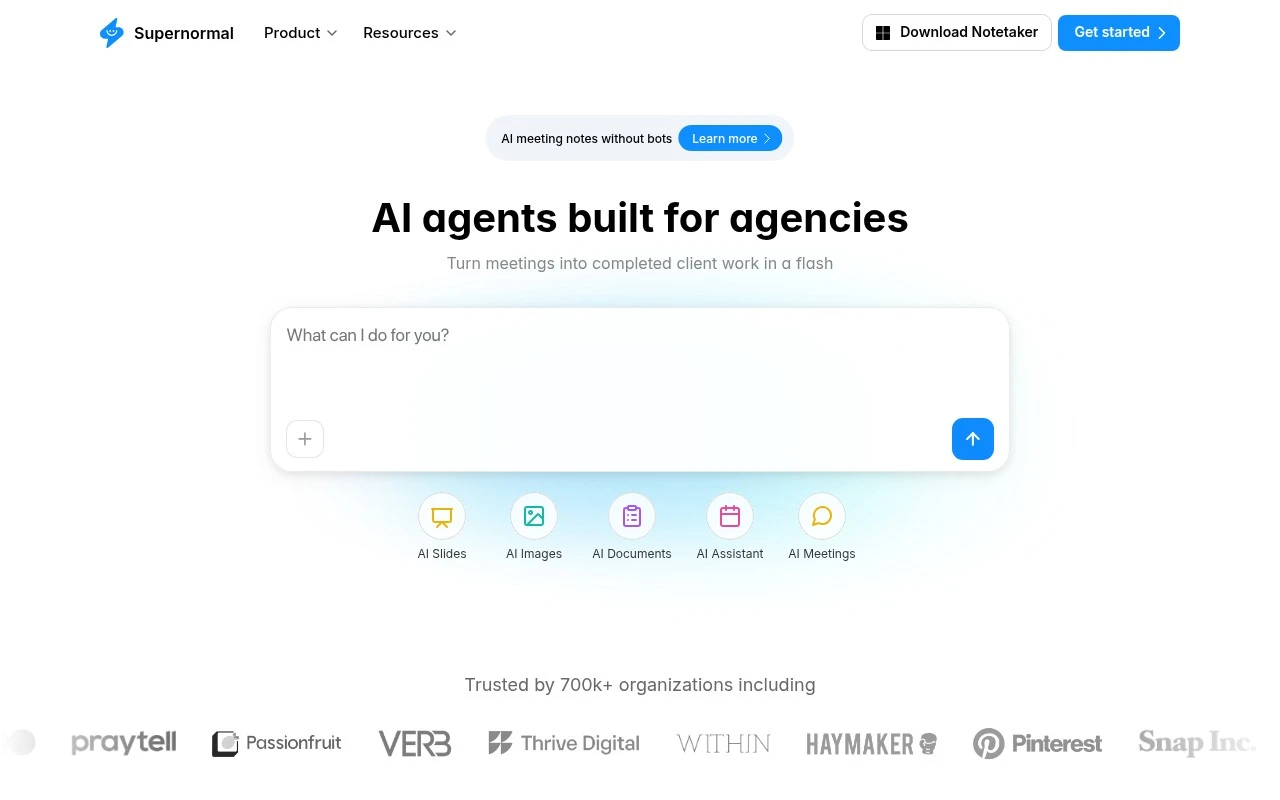
Supernormal is a desktop AI meeting notetaker for professionals and teams that want automatic meeting notes without inviting a recording bot into every call. It runs on the user’s computer, connects to calendar and audio permissions during setup, and begins capturing meetings as they start. Its central idea is simple: useful meeting memory should be quiet, automatic, and ready to turn into work after the conversation ends. Instead of joining a meeting as a visible participant, the tool captures audio locally through the desktop app. That bot-free approach makes Supernormal different from many AI meeting assistants, especially for users who dislike crowded attendee lists or need a less intrusive way to document calls. The experience is closer to having a personal notetaker on the machine than a separate service sitting inside the meeting room. For teams that treat meetings as raw material for action, Supernormal turns conversations into structured meeting notes and next steps. The platform is designed for people who move quickly between sales calls, internal standups, customer interviews, recruiting screens, and project reviews. Supernormal is especially useful for knowledge workers who need accurate audio summarization but do not want to spend the rest of the day rewriting what was said. The practical value shows up after the call, when users can prompt Supernormal’s agents to produce usable outputs from the discussion. A meeting can become a concise summary, a follow-up message, a project document, a slide outline, or a calendar invite. This makes the tool relevant not only for meeting notes, but also for email writing, documentation generation, presentation generation, and calendar automation connected to real conversations. Because it starts from the calendar and runs in the background, the workflow is built around reducing manual effort. Users do not have to remember to invite a bot, paste a meeting link, or start a separate recording process each time. Once configured, the app watches for meetings, captures the relevant audio, and gives the user a workspace for turning the transcript and notes into next actions. Privacy-conscious users may appreciate that the product story emphasizes capture from the user’s own computer rather than a third-party attendee joining the call. This does not remove the need for consent, company policy, or legal awareness around recording, but it changes the meeting experience. In environments where bot presence can feel awkward, Supernormal offers a more discreet pattern for AI-assisted note-taking. Compared with traditional transcription tools, the platform is positioned around outcomes rather than transcripts alone. The transcript matters, but the more important layer is the agentic workflow that helps convert the conversation into deliverables. Supernormal is best at bridging the gap between meeting capture and the practical writing that follows, so a discussion can become a customer recap, internal brief, task plan, or stakeholder update. Supernormal is best suited for busy operators, founders, managers, customer-facing teams, and cross-functional contributors who spend a large part of their week in calls. It is less about replacing collaboration tools and more about filling the gap between spoken decisions and written follow-through. For people whose work depends on remembering details, sending timely follow-ups, and keeping projects documented, the tool acts as a persistent layer of meeting memory. Buyers comparing Supernormal alternatives will likely focus on its desktop-first, bot-free capture model and its ability to generate post-meeting assets, not just its note summaries. A Supernormal review should consider how well that model fits a team’s meeting culture, consent requirements, and preferred workflow for turning calls into action. Supernormal pricing may matter for adoption, but the core question is whether the tool saves enough time after every meeting to become part of the daily operating system.

Use cases

Best for

Meeting Notes

Supernormal runs on your computer and auto-captures meeting notes when a scheduled meeting starts, without a bot joining the call.

Email Writing

After a meeting, you can prompt Supernormal to draft follow-up emails from the captured discussion notes and action items.

Audio Summarization

Supernormal summarizes meeting audio into a concise recap and key decisions using its on-device meeting capture workflow.

ANALYSIS

Strengths & limitations

Strengths
  • Bot-free meeting capture is well suited to professionals who want AI notes without adding a visible assistant participant to every call.
  • Automatic desktop capture is useful for meeting-heavy users because notes can start from calendar and audio activity instead of manual note-taking.
  • Agent-generated follow-ups make Supernormal useful beyond summaries because meetings can be turned into emails, documents, slides, tasks, and calendar invites.
Limitations
  • Less suitable for teams with locked-down devices or browser-only workflows because the notetaker depends on a desktop app with calendar and audio permissions.
  • Less suitable for organisations that require a visible in-call bot as part of their disclosure or meeting governance process because Supernormal is designed around bot-free capture.
  • Freemium access can limit heavy team adoption because higher-volume meeting capture and more advanced workflows are likely to require a paid plan.

Evaluation

FYAI score breakdown

Our structured evaluation across five key criteria

8.2 / 10

Overall score

Based on 185 reviews

  • Ease of use8.7 / 10
  • Features7.8 / 10
  • Pricing8.0 / 10
  • Integrations9.1 / 10
  • Support7.5 / 10

What users say

Findings from public reviews, documentation and community sources.

  • Ease of use

    Supernormal’s desktop app page says users can “Sign in with Google or your work email,” connect calendar, audio, and language settings, and complete setup because “the whole process takes less than two minutes.” Supernormal’s desktop app page also says the app “runs quietly in the background” and takes notes automatically without a bot joining the call.

  • Features

    Supernormal’s desktop app page says Supernormal takes meeting notes from the computer and uses meeting context to generate “slides, follow-up emails, documents, calendar invites, and more.” Supernormal’s desktop app page also highlights bot-free capture and agents for post-meeting work.

  • Pricing

    Supernormal’s pricing page lists a Free plan at “$0,” Team at “$20,” and Business at “$40,” plus enterprise-grade security.

  • Integrations

    Supernormal’s integrations page lists native connections to “Slack, Gmail, Google Calendar, Outlook, Drive, Linear, and more,” and Zapier lists Supernormal as connecting with “9000 other apps.” Supernormal’s integrations page also mentions using “Supernormal's MCP to connect your meetings to other work tools.”

  • Support

    Supernormal’s desktop app page surfaces support resources including “Help Center,” “Templates,” “Blog,” security pages, and “Report vulnerability.” G2 shows Supernormal at 4.4/5 from 19 reviews.

Who is this for?

Best for teams that want meeting notes without adding a bot to calls, Supernormal’s desktop app page says the app “runs quietly in the background” and takes notes automatically without a bot joining the call. Less suited to teams that need public support responsiveness benchmarks before buying, the cited support facts are resource pages such as “Help Center,” “Templates,” “Blog,” security pages, and “Report vulnerability,” plus G2 showing 4.4/5 from 19 reviews.

PRODUCT PREVIEW

Feature highlights

Bot-free capture

Desktop app listens locally so no meeting bot has to join.

Auto-start notes

Connect your calendar and it starts taking notes when meetings begin.

Agents to outputs

Prompt agents for summaries, emails, docs, slides, and invites.

COMPARE

Discover curated alternatives worth comparing

Compare similar AI tools based on features, pricing and use cases

7.8/ 10Based on 31 reviews

Wudpecker

Meeting NotesSummarization
Turns recordings into notes, summaries, action items, and Q&A
Best for:
Knowledge workers
Pricing
Freemium

9.0/ 10Based on 1,589 reviews

Toggl Track

Time & Habit Tracking
Tracks time, automates activity capture, and reports team data
Best for:
Operations teams
Pricing
Freemium

8.5/ 10Based on 2,648 reviews

Todoist

Task & Project Management
Captures tasks, organizes schedules, and clarifies action plans
Best for:
Knowledge workers
Pricing
Freemium

Turn every meeting into clear notes and accountable next steps. Start using Supernormal today and keep projects moving without the manual follow-up.

FAQ

Frequently asked
questions

Everything you need to know about this AI tool,
its features, pricing, use cases, and limitations.

Who is Supernormal best for, and can it help with follow-up emails after meetings?
Supernormal is best for professionals and teams that spend a lot of time in meetings and want notes, summaries, tasks, and follow-up drafts without adding a bot to calls. It is especially relevant when meeting context needs to become emails, documents, slides, or calendar invites after the discussion.
Is Supernormal free, or do teams need a paid plan?
Supernormal uses a freemium pricing model, so users can typically start with a free option and upgrade for broader usage or team needs. Buyers should review Supernormal’s current pricing page to compare plan limits, collaboration features, and any usage restrictions before rolling it out across a team.
How does Supernormal compare with other AI meeting note tools?
Supernormal’s main difference is its bot-free desktop notetaker, which captures meeting audio from the user’s computer instead of joining the call as a visible participant. Many similar tools focus on transcription and summaries, while Supernormal also emphasizes post-meeting deliverables such as follow-up emails, documents, slides, and calendar invites.
How hard is it to set up Supernormal for meeting notes?
Supernormal is most useful for meeting-based workflows, not as a general document or presentation generator detached from meeting context. Its desktop app also has specific operating system requirements, and teams should verify that their preferred meeting platforms and internal workflows are compatible before relying on it for company-wide note taking.
What should teams consider about privacy and compliance before using Supernormal?
Supernormal avoids placing a visible AI bot in the meeting, which can reduce friction in calls, but teams should still review how meeting audio, notes, calendar data, and generated follow-ups are handled. Organisations with compliance requirements should confirm current security controls, retention settings, permissions, and data processing terms directly with Supernormal.