Curated ToolThis tool is part of our curated AI directory. We only include tools that meet our standards for relevance, usability and real-world value.

Scribe

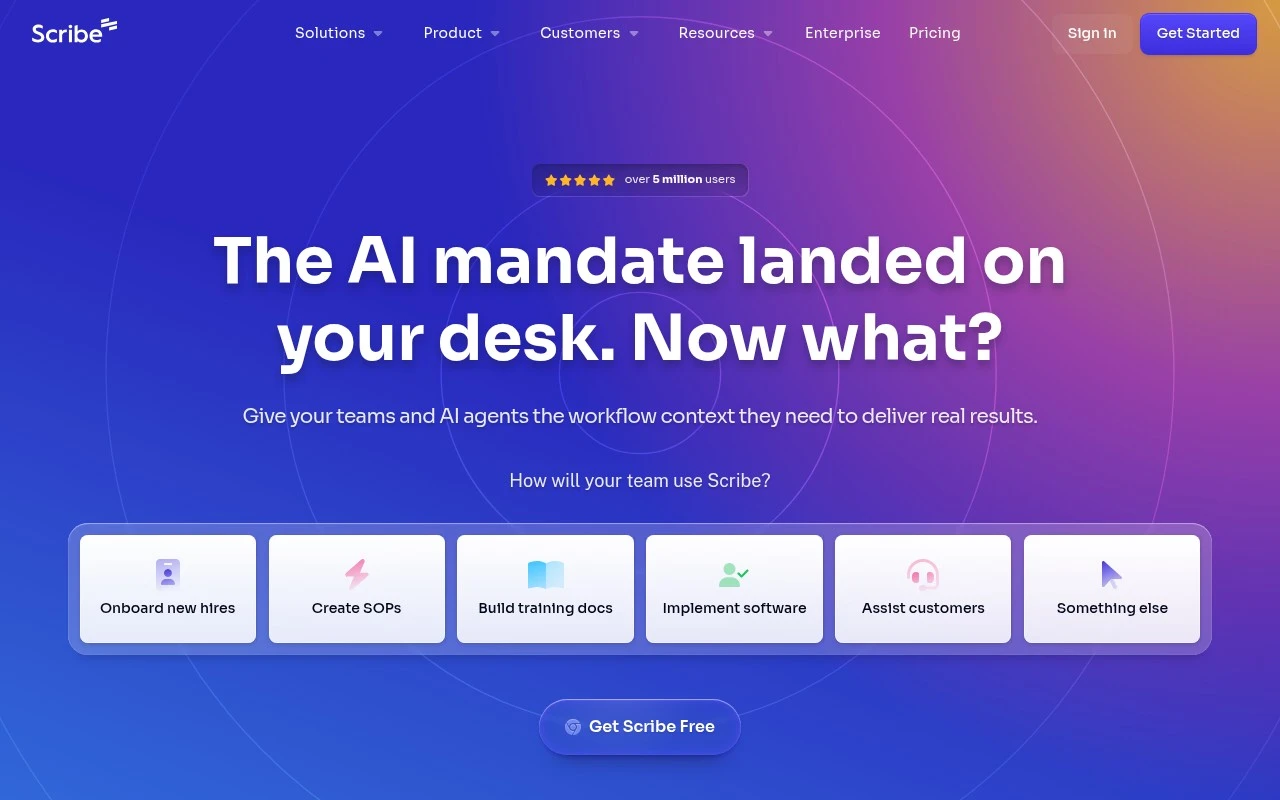
Scribe is a documentation tool that captures a user’s on-screen workflow and automatically turns it into step-by-step guides with screenshots and instructions. Teams use it to create SOPs, training materials, and process documentation.
Productivity

FYAI Score

8.8 / 10

Based on 895 reviews

Pricing:

Freemium

Best for:

Ops and enablement teams documenting processes and onboarding at scale

Score Breakdown

  • Ease of use9.4 / 10
  • Features8.6 / 10
  • Pricing9.0 / 10
  • Integrations8.2 / 10
  • Support8.5 / 10

PRODUCT PREVIEW

What this AI tool does

Scribe is a workflow documentation and workflow intelligence platform for teams that need to capture how work gets done and turn that knowledge into reusable process guides. Scribe is built for organizations where important procedures live in scattered documents, chat threads, individual memory, or repeated screen-sharing sessions. Its core role is to make everyday work observable, documentable, and easier to transfer across people, systems, and teams. For operations, enablement, support, IT, HR, and customer-facing teams, the platform turns routine activity into structured knowledge. Instead of asking a subject-matter expert to manually write every step, it records a workflow as someone performs it and converts the activity into a guide with steps, screenshots, and instructions. That makes documentation generation feel closer to doing the work once than writing a manual from scratch. Automatic capture is the center of the product experience, but the larger value is consistency. A process that might otherwise be explained differently by every trainer can become a standard guide that new hires, teammates, customers, or contractors can follow. Scribe is best at preserving institutional knowledge from real work and making it easier to reuse in onboarding, training, handoffs, and standard operating procedures. As workflow data accumulates, the platform becomes more than a library of how-to documents. It creates a clearer view of how teams actually operate, where processes are repeated, where steps are confusing, and where knowledge gaps slow people down. This is why Scribe is positioned not only as a documentation tool, but as a workflow intelligence layer for understanding and improving operational execution. In practice, teams use it to reduce repetitive explanations and shorten the time between learning a process and performing it correctly. A support team might document account troubleshooting, an HR team might capture onboarding tasks, an IT team might standardize software setup, and a revenue operations team might preserve CRM procedures. The common thread is that the work happens inside software, and the platform helps translate that activity into clear guidance. The AI relevance comes from the quality of the captured workflow context. AI agents and automation systems need more than abstract goals, they need accurate process knowledge, examples of real actions, and instructions grounded in how an organization actually works. Scribe helps create that foundation by turning human workflows into structured, shareable context that can support training, process improvement, and future agent-driven execution. Rather than acting like a traditional document editor, the tool starts from lived process and works backward into documentation. That gives it a practical character: it is less about creating polished knowledge bases from a blank page and more about capturing the operational truth of a task while it is being performed. Scribe is especially useful for teams that know they need better process documentation but do not have time to manually maintain it at the pace their work changes. The result is a platform that sits between documentation, training, operations, and AI readiness. It helps organizations make invisible work visible, convert expert habits into durable assets, and build a repeatable knowledge layer around the software processes that run the business.

Use cases

Best for

Workflow to Sops

Scribe records your on screen steps as you work and converts them into step by step SOPs with screenshots and text.

Onboarding and Training Docs

Create shareable procedure guides from captured workflows so employees can follow consistent steps during onboarding or software rollouts.

Workflow Analysis Context

Review captured workflows to spot redundant steps and share the documented process as context for AI tools or agents.

ANALYSIS

Strengths & limitations

Strengths
  • Strong fit for teams that document recurring software workflows because it turns captured work into reusable step-by-step process guides.
  • Useful for onboarding and training teams because institutional knowledge can be standardized into shareable guides instead of staying with individual employees.
  • Helpful for operations, automation, and AI-transformation teams because captured workflow data can reveal process patterns and provide context for improvement or automation work.

Limitations
  • Less suitable for teams focused mainly on narrative policy documents or long-form knowledge bases because its strength is capturing task-based workflows rather than authoring broad documentation from scratch.
  • Requires consistent adoption by process owners because guides and workflow intelligence are only as useful as the workflows teams capture and keep current.
  • Freemium pricing can limit larger rollouts because teams that need advanced collaboration, governance, or organization-wide usage should expect to evaluate paid plan requirements.

Evaluation

FYAI score breakdown

Our structured evaluation across five key criteria

8.8 / 10

Overall score

Based on 895 reviews

  • Ease of use9.4 / 10
  • Features8.6 / 10
  • Pricing9.0 / 10
  • Integrations8.2 / 10
  • Support8.5 / 10

What users say

Findings from public reviews, documentation and community sources.

  • Ease of use

    G2’s 895-review product page rates Scribe 4.8/5 and says users “most consistently highlight how easy it is to use.” G2’s product page cites “simple setup and automatic screenshot capture that documents processes as the work happens.”

  • Features

    Scribe’s pricing page lists “AI-powered automatic capture,” on-screen walkthroughs, desktop/web capture, and exports to PDF/HTML/Markdown/Word.

  • Pricing

    Scribe’s pricing page lists a Free Basic plan, Pro Personal at “$35” monthly or “$25 per seat per month” yearly, Pro Team at “$17” monthly or “$13 per seat per month” yearly starting at 5 seats, and custom Enterprise.

  • Integrations

    Scribe’s pricing page lists “Confluence integration,” “Enterprise search API,” “Slack bot integration,” and “Custom AI assistants integration.”

  • Support

    Scribe’s pricing page includes “Customer support” and “Customer success,” and the site surfaces “Support” and “Help Center.”

Who is this for?

Best for teams that need to turn live workflows into documentation, G2’s 895-review product page cites “simple setup and automatic screenshot capture that documents processes as the work happens.” Less suited to solo buyers who want the team plan without a seat minimum, Scribe’s pricing page says Pro Team starts at 5 seats.

PRODUCT PREVIEW

Feature highlights

Auto process capture

Record workflows and instantly generate step-by-step documentation.

Reusable SOP library

Organize guides into a shared knowledge base anyone can follow.

Workflow intelligence

Use workflow data to spot gaps, improve ops, and support AI agents.

COMPARE

Discover curated alternatives worth comparing

Compare similar AI tools based on features, pricing and use cases

7.8/ 10Based on 31 reviews

Wudpecker

Meeting NotesSummarization
Turns recordings into notes, summaries, action items, and Q&A
Best for:
Knowledge workers
Pricing
Freemium

9.0/ 10Based on 1,589 reviews

Toggl Track

Time & Habit Tracking
Tracks time, automates activity capture, and reports team data
Best for:
Operations teams
Pricing
Freemium

8.5/ 10Based on 2,648 reviews

Todoist

Task & Project Management
Captures tasks, organizes schedules, and clarifies action plans
Best for:
Knowledge workers
Pricing
Freemium

Turn any workflow into clear, shareable guides in minutes. Join teams using Scribe to capture knowledge fast and keep everyone aligned.

FAQ

Frequently asked
questions

Everything you need to know about this AI tool,
its features, pricing, use cases, and limitations.

Who is Scribe best suited for?
Scribe is best suited for teams that need to turn repeatable business workflows into step-by-step process documentation without writing every procedure manually. It is especially relevant for operations, IT, HR, training, finance, automation, and AI-transformation teams that need SOPs, onboarding material, software rollout guides, or workflow context for AI tools.
Does Scribe have a free plan, and when would a team need a paid plan?
Scribe uses a freemium pricing model, so users can start for free and upgrade when they need broader team or business capabilities. Paid plans are most relevant for organizations documenting workflows at scale, managing shared process knowledge, supporting onboarding, or applying stronger administrative, security, and collaboration controls.
How does Scribe compare with other documentation generation tools?
Scribe is strongest when the priority is capturing real workflows as people perform them and converting them into SOPs, training guides, and reusable process knowledge. Other documentation tools may be better for general knowledge management, long-form writing, or manual content creation, so the right choice depends on workflow complexity, team size, and governance needs.
How hard is it to set up Scribe for a team?
Scribe’s main trade-off is that it is most valuable for repeatable workflows that can be captured and maintained accurately. It is not primarily a general-purpose writing, note-taking, or knowledge-base platform. Teams should also validate how well its workflow analysis and AI-agent context features fit their specific processes before relying on them broadly.
Is Scribe secure enough for regulated or enterprise workflows?
Scribe positions itself for enterprise and regulated environments with automatic redaction and compliance standards including SOC 2 Type II, HIPAA, GDPR, CCPA, and FERPA. Buyers handling sensitive workflows should still review permissions, redaction settings, retention policies, user access controls, and current compliance documentation before deploying it across business-critical teams.