Curated ToolThis tool is part of our curated AI directory. We only include tools that meet our standards for relevance, usability and real-world value.

Sana AI

Chat and search across company knowledge and meeting notes

Knowledge Search
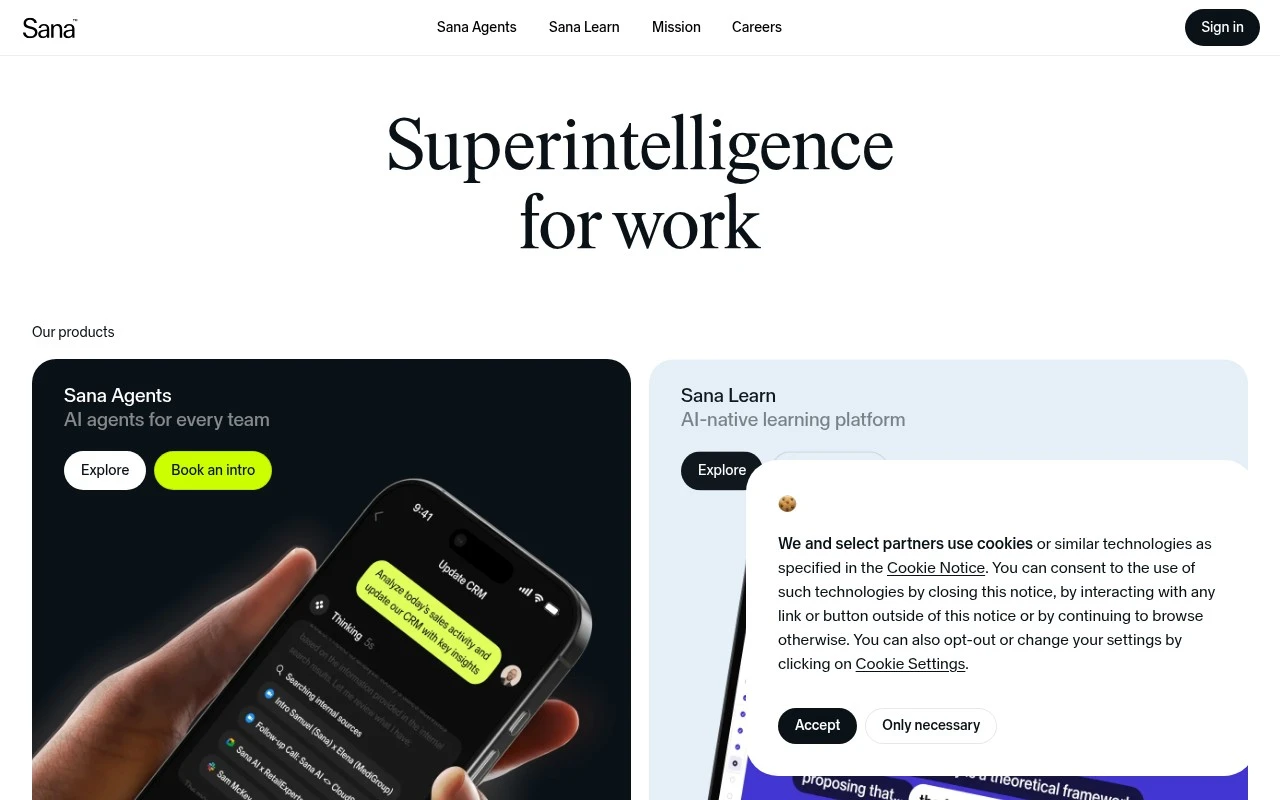
Sana AI appears to be an AI knowledge agent for chat-based search and interaction across a user’s or organization’s knowledge, including meetings. The official page text is brief, so the description should stay focused on knowledge chat, search, and meeting interaction rather than assuming broader platform capabilities.

FYAI Score

7.9 / 10

Based on 106 reviews

Pricing:

Paid

Best for:

Organizations needing chat-based search across internal knowledge and meetings

Score Breakdown

  • Ease of use8.7 / 10
  • Features7.2 / 10
  • Pricing8.0 / 10
  • Integrations8.0 / 10
  • Support7.2 / 10

PRODUCT PREVIEW

What this AI tool does

Sana AI is an AI tool page entry intended to help readers understand what the product is and how it might be used. Because the introductory details and main use case are not provided, this description focuses on setting expectations and explaining the kind of information users typically look for when evaluating an AI tool. On a typical tool page, you would expect to find a plain-language overview of sana-ai, the problem it aims to solve, and the type of workflow it supports. Clear details such as who it is for, what inputs it needs, what outputs it produces, and any setup or access requirements help readers decide whether it fits their needs. If you share a short intro or the primary use case, this description can be refined to match the actual purpose of the tool and provide more specific, accurate context for informational searches.

Use cases

Best for

Internal Search

Use Sana AI to chat with your company knowledge and meeting notes to answer internal questions with sourced results.

Knowledge Base Search

Search a knowledge base by asking questions in chat and retrieving relevant docs and meeting context from your workspace.

ANALYSIS

Strengths & limitations

Strengths
  • Directly positioned around chat and search over existing knowledge.
  • Explicitly includes meetings as part of the knowledge users can interact with.
  • Offers account creation from the official site, suggesting it is accessible as a hosted product.
Limitations
  • The available official page text provides very limited detail about supported data sources, integrations, or deployment options.
  • Security, admin, compliance, and pricing details are not established from the provided source.
  • Specific workflow automation or learning-platform capabilities should not be assumed from the available description.

Evaluation

FYAI score breakdown

Our structured evaluation across five key criteria

7.9 / 10

Overall score

Based on 106 reviews

  • Ease of use8.7 / 10
  • Features7.2 / 10
  • Pricing8.0 / 10
  • Integrations8.0 / 10
  • Support7.2 / 10

What users say

Findings from public reviews, documentation and community sources.

  • Ease of use

    G2’s review signal highlights that “Sana Learn makes onboarding easy and intuitive,” including for a “non-technical person,” and describes it as “fast, efficient, and easy to follow.”

  • Features

    G2’s product-review summary says users praise Sana Learn for simplifying “course creation” and enhancing “collaboration.” Reddit discussion frames Sana as AI agents working inside Workday and across the tech stack.

  • Pricing

    Sana’s pricing page lists a free entry point at “$0/month” and a Team-style paid tier at “$30 per user / month,” alongside enterprise-grade plans with custom pricing.

  • Integrations

    Sana’s support collection says Sana can connect “documents, apps, databases, and content,” and names integration guides such as Asana and Azure Blob.

  • Support

    G2’s review signal highlights onboarding and interface comments, and the G2 product-review summary references course creation and collaboration.

Who is this for?

Best for teams that want AI-assisted onboarding and learning workflows, G2’s review signal says Sana Learn makes onboarding easy and intuitive for a “non-technical person,” and G2’s product-review summary says users praise “course creation” and “collaboration.” Less suited to buyers that need fully published enterprise pricing, Sana’s pricing page lists “$0/month” and “$30 per user / month,” while enterprise pricing remains custom.

PRODUCT PREVIEW

Feature highlights

Knowledge chat

Ask questions in chat and get answers from your org’s knowledge.

Unified search

Search across internal content to quickly find the right info.

Meeting Q&A

Interact with meeting knowledge to recap decisions and next steps.

COMPARE

Discover curated alternatives worth comparing

Compare similar AI tools based on features, pricing and use cases

7.8/ 10Based on 31 reviews

Wudpecker

Meeting NotesSummarization
Turns meeting recordings into notes, summaries, and action items
Best for:
Knowledge workers
Pricing
Freemium

9.0/ 10Based on 1.589 reviews

Toggl Track

Time & Habit Tracking
Tracks time with automatic activity detection and reporting.
Best for:
Operations teams
Pricing
Freemium

8.5/ 10Based on 2.648 reviews

Todoist

Task & Project Management
Organize, schedule, and share tasks with AI-assisted planning
Best for:
Knowledge workers
Pricing
Freemium

Turn onboarding into confident performance. Request a Sana AI demo and see how personalized learning helps every new hire ramp faster from day one.

FAQ

Frequently asked
questions

Everything you need to know about this AI tool,
its features, pricing, use cases, and limitations.

What types of teams and training programs is Sana AI a good fit for?
Sana AI fits organizations that need repeatable onboarding, role-based enablement, and ongoing internal training across many employees. It’s especially useful when content changes often and you want a single place to deliver learning and capture knowledge. If your training is mostly hands-on (e.g., equipment operation) or highly instructor-led, you may still need in-person sessions alongside it.
Does Sana AI have a free plan, and what are the typical limitations compared to paid tiers?
Sana AI is primarily positioned for business use, so access is typically via paid plans rather than a broad, fully featured free tier. If a trial is available, it’s usually time-limited and may restrict advanced analytics, admin controls, integrations, or user volume. Confirm pricing based on your seat count and required features like reporting and knowledge management.
How does Sana AI compare to an LMS like Docebo or a knowledge base like Notion/Confluence?
Compared with traditional LMS platforms (e.g., Docebo), Sana AI tends to emphasize personalized learning flows and faster content delivery rather than deep compliance-centric course administration. Versus Notion or Confluence, Sana AI is more training- and onboarding-oriented, with built-in learning experiences and progress insights rather than being a general documentation workspace. If you need heavy SCORM compliance workflows or complex certification management, an LMS-first tool may be a better match.
How quickly can a company get Sana AI running, and what onboarding effort should you plan for?
Sana AI can reduce manual onboarding work, but it still requires upfront content creation and periodic maintenance to keep materials accurate. Some learners may prefer more human interaction, so you may need a blended approach for sensitive topics or coaching-heavy roles. For highly regulated training, verify whether its reporting and certification features match your audit requirements.
What should we check about data privacy, security, and compliance when evaluating Sana AI?
Review what employee data and internal documents Sana AI processes, where data is stored, and whether you can control retention and access via roles and SSO. Ask for details on encryption, audit logs, and whether the vendor supports your required standards (e.g., SOC 2, ISO 27001, GDPR) and a DPA. If you plan to upload confidential knowledge, confirm how it’s used for model improvement and what opt-out controls exist.