Curated ToolThis tool is part of our curated AI directory. We only include tools that meet our standards for relevance, usability and real-world value.

Read.ai

Transcribes meetings, summarizes, and extracts action items.

Meeting NotesKnowledge Search
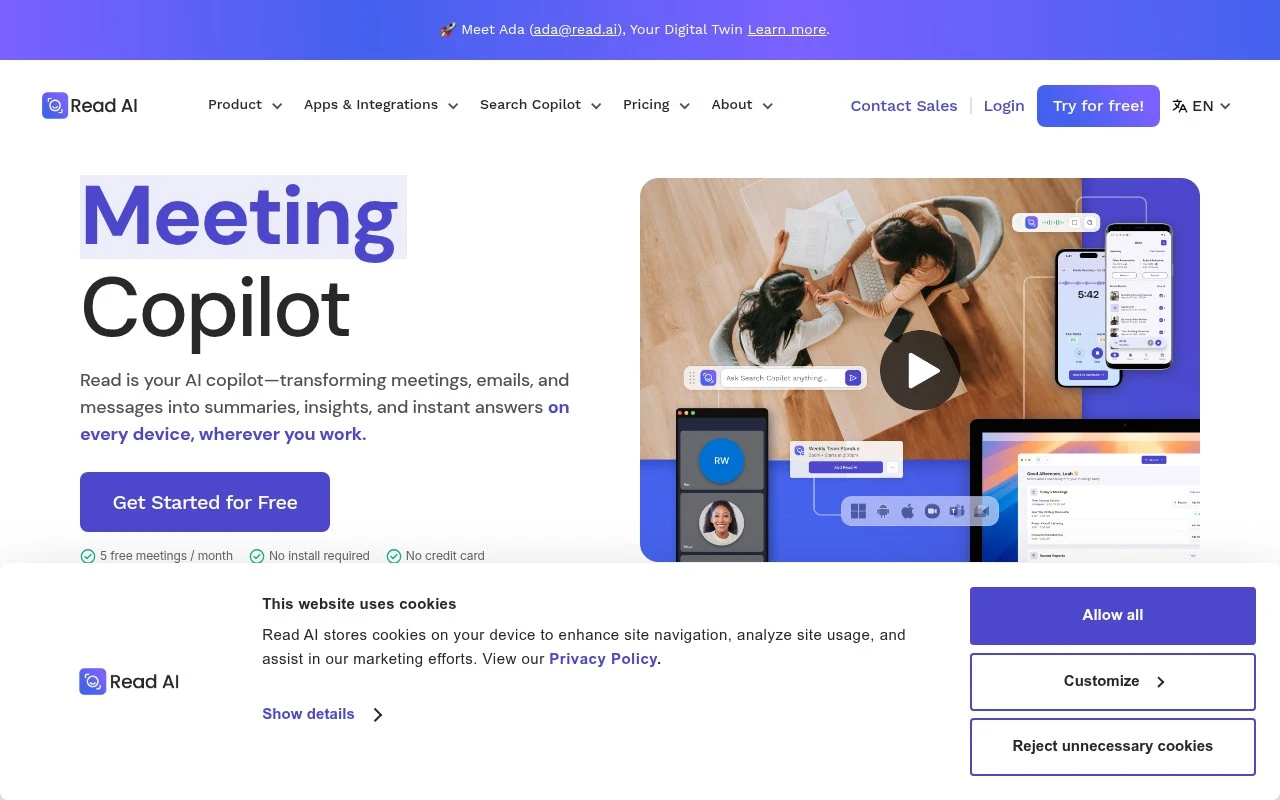
Read.ai is an AI meeting agent and workplace assistant for turning meetings and communications into structured notes, summaries, action items, and searchable knowledge. It works with major meeting platforms such as Zoom, Google Meet, and Microsoft Teams, and also connects to email, messaging, browser, desktop, and mobile workflows. Its distinctive focus is combining meeting capture with cross-tool search through Ask Read, so users can retrieve context from conversations, emails, and messages rather than treating meeting notes as isolated documents.

FYAI Score

7.9 / 10

Based on 103 reviews

Pricing:

Freemium

Best for:

Knowledge workers who run frequent meetings and need searchable context

Score Breakdown

  • Ease of use7.1 / 10
  • Features7.8 / 10
  • Pricing8.5 / 10
  • Integrations8.7 / 10
  • Support7.5 / 10

PRODUCT PREVIEW

What this AI tool does

Read.ai is an AI tool designed to help users work with written content more efficiently. It can be used in situations where you need assistance understanding, drafting, or refining text, such as reviewing documents, summarizing material, or improving clarity and tone. Because the exact workflow depends on how you choose to use it, readai fits a range of informational tasks—from turning rough notes into readable copy to helping you interpret and reorganize longer passages. It’s best suited for people who want a straightforward way to support everyday writing and reading without replacing their own judgment. In practice, you provide the text or prompt you’re working with, and the tool returns a response you can edit and adapt. This makes it useful for iterative work where you want to compare versions, check phrasing, or quickly explore alternative wording before finalizing your content.

Use cases

Best for

Meeting Notes

Read.ai joins Zoom, Google Meet, or Teams calls to generate structured meeting notes with summaries and action items.

Transcribe Audio

It transcribes meeting audio into searchable text and timestamps key moments for quick review.

Internal Search

Use Ask Read to search across meeting transcripts, emails, and messages to retrieve context from past conversations.

ANALYSIS

Strengths & limitations

Strengths
  • Supports automatic meeting recording, transcription, summaries, highlights, playback, and action items.
  • Works across multiple environments, including Zoom, Google Meet, Teams, Gmail, Outlook, Slack, Chrome, desktop, mobile, and other integrations.
  • Includes cross-conversation search and question answering across meetings, emails, messages, documents, and notes.
Limitations
  • The free plan described on the site is limited to 5 free meetings per month.
  • The tool depends on access to meetings and connected workplace accounts, which may require privacy and permissions review before team-wide adoption.
  • The official page makes broad claims about Ada as a digital twin and workflow assistant, but provides less concrete detail on those capabilities than it does for meeting notes, summaries, and search.

Evaluation

FYAI score breakdown

Our structured evaluation across five key criteria

7.9 / 10

Overall score

Based on 103 reviews

  • Ease of use7.1 / 10
  • Features7.8 / 10
  • Pricing8.5 / 10
  • Integrations8.7 / 10
  • Support7.5 / 10

What users say

Findings from public reviews, documentation and community sources.

  • Ease of use

    Read.ai's site includes "Get Started for Free," "5 free meetings / month," "No install required," and "No credit card," plus desktop, mobile, and Chrome apps. A Reddit r/sysadmin thread states that it is "very difficult to sign up with an e-mail account directly in order to view the notes."

  • Features

    Read.ai lists AI meeting notes, transcripts, action items, and Ask Read search across "meetings, emails, and messages." Read.ai also lists apps across Windows, MacOS, Android, iOS, and Chrome.

  • Pricing

    The Read.ai pricing page lists a Free plan at "$0" with "5 meeting transcripts per month," plus "$15" Pro, "$22.50" Enterprise, and "$29.75" Enterprise+ per user/month when billed annually. The Read.ai pricing page lists limits such as meeting length, file-upload minutes, and support levels.

  • Integrations

    The Read.ai pricing page lists integrations including Zoom, Teams, Meet, and webhooks. The Read.ai site footer references ChatGPT, Claude, MCP, and API.

  • Support

    The Read.ai pricing page says "Support requests from users on the Enterprise and Enterprise+ Plans are prioritized," and Enterprise+ includes "Workspace Onboarding." A Reddit r/sysadmin discussion covers Read.ai removal/access and permissions.

Who is this for?

Best for teams that want meeting capture and cross-workspace retrieval without installation, Read.ai advertises "No install required" and Ask Read search across "meetings, emails, and messages." Less suited to organizations that need smooth direct email-account access or admin removal workflows, a Reddit r/sysadmin thread says it is "very difficult to sign up with an e-mail account directly in order to view the notes," and a Reddit r/sysadmin discussion covers Read.ai removal/access and permissions.

PRODUCT PREVIEW

Feature highlights

Meeting capture

Auto notes, summaries, and action items from live meetings.

Ask Read search

Search across meetings, emails, and messages for instant context.

Shareable recaps

Send structured recaps so everyone stays aligned after calls.

COMPARE

Discover curated alternatives worth comparing

Compare similar AI tools based on features, pricing and use cases

7.8/ 10Based on 31 reviews

Wudpecker

Meeting NotesSummarization
Turns meeting recordings into notes, summaries, and action items
Best for:
Knowledge workers
Pricing
Freemium

9.0/ 10Based on 1.589 reviews

Toggl Track

Time & Habit Tracking
Tracks time with automatic activity detection and reporting.
Best for:
Operations teams
Pricing
Freemium

8.5/ 10Based on 2.648 reviews

Todoist

Task & Project Management
Organize, schedule, and share tasks with AI-assisted planning
Best for:
Knowledge workers
Pricing
Freemium

Turn every meeting into clear decisions and next steps. See why teams choose Read.ai to stay aligned, accountable, and moving faster.

FAQ

Frequently asked
questions

Everything you need to know about this AI tool,
its features, pricing, use cases, and limitations.

What types of teams and meetings is Read.ai a good fit for?
Read.ai fits teams that run frequent internal meetings and want automatic notes, summaries, and action-item follow-up without assigning a dedicated note-taker. It’s especially useful for recurring standups, project check-ins, and cross-functional syncs where consistent documentation matters. If your meetings are highly technical or depend on nuanced context, you may want to validate summaries more carefully.
Does Read.ai have a free plan, and what are the practical limitations compared to paid tiers?
Read.ai typically offers a free option with tighter caps (such as limited meeting volume, features, or retention) compared with paid plans. Paid tiers generally unlock higher usage limits and more robust team workflows like expanded integrations and admin controls. When comparing tools, check whether the free tier covers your weekly meeting load and whether exports/sharing are restricted.
How does Read.ai compare with Otter, Fireflies.ai, or Fathom for meeting notes?
Read.ai is often evaluated alongside Otter, Fireflies.ai, and Fathom for transcription and summaries, but the best choice depends on your workflow: some competitors emphasize searchable transcripts, while others focus on lightweight sharing and CRM handoffs. Read.ai’s value tends to be strongest when you want consistent post-meeting documentation and action tracking across a team. If you need highly accurate domain-specific transcription or deep sales-stack automation, compare accuracy and integrations side by side.
How quickly can a team set up Read.ai, and what onboarding effort should you expect?
Read.ai can mis-summarize complex or fast-moving discussions, so teams may need a quick review step before distributing notes. Costs can scale noticeably with larger groups or heavy meeting volume. It also works best when meetings follow clear agendas and speakers are identifiable, which isn’t always true in ad-hoc calls.
What should we check about Read.ai’s data handling, privacy, and compliance before rollout?
Confirm what Read.ai stores (audio, transcripts, summaries), how long data is retained, and whether you can delete or export records on demand. Review where data is processed, what encryption and access controls are available, and whether your plan supports enterprise requirements (e.g., SSO, audit logs, or a DPA). Also align internally on consent rules for recording and whether external participants must be notified.