Curated ToolThis tool is part of our curated AI directory. We only include tools that meet our standards for relevance, usability and real-world value.

Motion

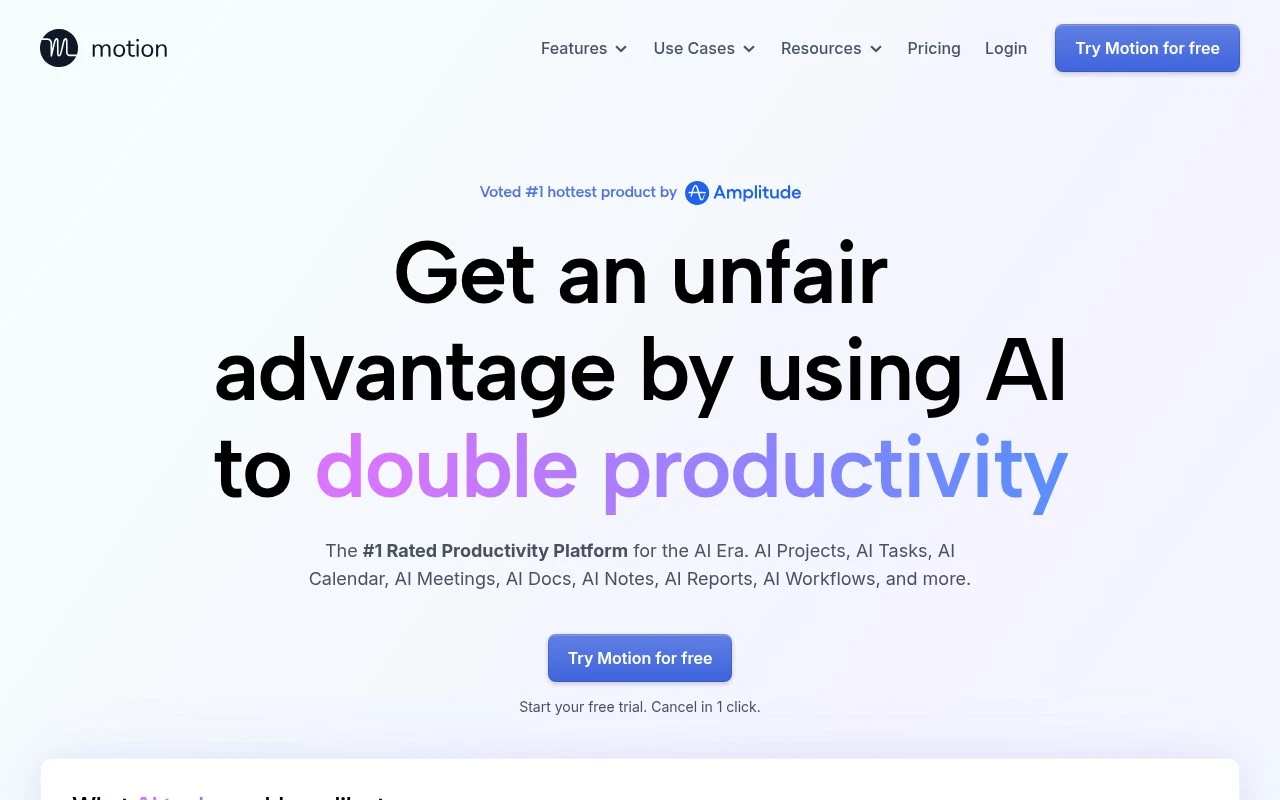
AI schedules tasks, plans projects, and drafts meeting notes

Meeting NotesScheduling & Calendar
Motion is an AI productivity and work-management app for individuals and teams. It centers on an AI planner that turns tasks, projects, meetings, deadlines, and priorities into an automatically updated work schedule. The official site also describes AI project generation, meeting recording and summaries, action-item assignment, docs assistance, search across work items, and workflow creation from SOPs.

FYAI Score

7.9 / 10

Based on 573 reviews

Pricing:

Free trial

Best for:

Busy professionals and teams juggling tasks, meetings, and deadlines

Score Breakdown

  • Ease of use7.3 / 10
  • Features8.8 / 10
  • Pricing7.7 / 10
  • Integrations7.7 / 10
  • Support7.7 / 10

PRODUCT PREVIEW

What this AI tool does

Motion is an AI tool designed to help users work with movement-related content and timing in a more structured way. It can support common workflows where understanding or generating motion patterns matters, such as preparing short animations, refining transitions, or organizing sequences that depend on consistent pacing. The tool is intended for informational use cases where you want clearer control over how movement is represented, adjusted, or interpreted. Depending on your workflow, it may assist with tasks like aligning motion to a timeline, exploring variations, or turning rough ideas into more coherent motion behavior. Because projects and inputs vary, results typically improve when you provide specific context such as the type of motion you want, any constraints, and the desired output format. This makes it easier to evaluate the output and iterate toward a version that fits your needs.

Use cases

Best for

Schedule Planning

Motion auto-schedules tasks, meetings, and deadlines into a live calendar that updates when priorities or timing change.

Project Management

Generate projects from prompts, track deadlines and dependencies, and assign action items from meeting summaries in one workspace.

Task Management

Capture tasks with priorities and due dates, then let the AI planner place each task into your schedule and reshuffle as needed.

ANALYSIS

Strengths & limitations

Strengths
  • Connects calendar planning, tasks, projects, docs, and meeting notes instead of treating them as separate tools.
  • Uses task metadata such as deadlines, durations, priorities, dependencies, and availability to automatically build and update plans.
  • Meeting summaries and action items can become Motion docs and tasks, keeping follow-up work tied to projects and calendars.
Limitations
  • The product appears most useful when teams adopt Motion as a central workspace, which may be heavier than needed for simple to-do lists or standalone note-taking.
  • AI-generated projects, schedules, notes, and follow-ups still require review, especially for important client work or ambiguous meetings.
  • The provided official page is marketing-focused and does not establish detailed limits around pricing, security, compliance, integrations, or implementation effort.

Evaluation

FYAI score breakdown

Our structured evaluation across five key criteria

7.9 / 10

Overall score

Based on 573 reviews

  • Ease of use7.3 / 10
  • Features8.8 / 10
  • Pricing7.7 / 10
  • Integrations7.7 / 10
  • Support7.7 / 10

What users say

Findings from public reviews, documentation and community sources.

  • Ease of use

    Motion says its AI “plans your day for you” and “optimizes itself hundreds of times a day,” and Motion says users can “Start your free trial. Cancel in 1 click.” G2 shows Motion at 4.1/5 from 158 reviews.

  • Features

    Motion's product page lists “AI Projects,” “AI Tasks,” “AI Calendar,” and “AI Workflows.” Motion's product page also describes AI task prioritization, project generation, meeting notes, and workflow building.

  • Pricing

    Motion's pricing page lists Pro AI at “$19 /seat /mo” with 7,500 credits and Business AI at “$29 /seat /mo” with 15,000 credits. Motion's pricing page says Business AI includes capacity planning, dashboards, Gantt charts, and time tracking.

  • Integrations

    Motion's product page says tasks can be created by forwarding Gmail/Outlook/iCloud emails, from Zoom/Meet/Teams meetings, from Slack/Teams messages, or via Siri voice command. Motion's pricing page also includes “Integrations.”

  • Support

    Motion's pricing page includes “Priority Support” on the Business AI tier. Trustpilot shows Motion at 3.8/5, and G2 shows Motion at 4.1/5.

Who is this for?

Best for teams that want AI-managed planning across tasks, calendars, meetings, and projects, Motion says its AI “plans your day for you” and “optimizes itself hundreds of times a day.” Less suited to users who only need a basic productivity app at the lowest cost, Motion's pricing page lists Pro AI at “$19 /seat /mo” and Business AI at “$29 /seat /mo.” Less suited to teams that need priority support without moving to a higher tier, Motion's pricing page includes “Priority Support” on the Business AI tier.

PRODUCT PREVIEW

Feature highlights

AI Auto-Scheduling

Turns tasks and deadlines into a living schedule that updates itself.

Meeting Summaries

Record meetings, get summaries, and assign action items automatically.

Projects from SOPs

Generate projects and workflows from SOPs to standardize execution.

COMPARE

Discover curated alternatives worth comparing

Compare similar AI tools based on features, pricing and use cases

7.8/ 10Based on 31 reviews

Wudpecker

Meeting NotesSummarization
Turns meeting recordings into notes, summaries, and action items
Best for:
Knowledge workers
Pricing
Freemium

9.0/ 10Based on 1.589 reviews

Toggl Track

Time & Habit Tracking
Tracks time with automatic activity detection and reporting.
Best for:
Operations teams
Pricing
Freemium

8.5/ 10Based on 2.648 reviews

Todoist

Task & Project Management
Organize, schedule, and share tasks with AI-assisted planning
Best for:
Knowledge workers
Pricing
Freemium

Take control of your day with Motion. Let your schedule run itself so you can ship projects faster and finish work on time.

FAQ

Frequently asked
questions

Everything you need to know about this AI tool,
its features, pricing, use cases, and limitations.

What types of teams and workflows is Motion a good fit for?
Motion tends to work best for teams that live in their calendars and want tasks automatically scheduled around meetings and deadlines. It’s a strong fit for managers juggling many priorities, recurring work, and shifting timelines. If your team needs highly customized boards or complex dependency planning, you may find other project tools more flexible.
Does Motion have a free plan, and what are the main limitations compared to paid?
Motion is generally positioned as a paid product, with access tied to a subscription rather than a full-featured free tier. If a trial is available, it’s mainly for evaluation and may limit duration or features. When comparing costs, check whether you need individual seats, team features, and integrations for your workflow.
How does Motion compare with tools like Asana, ClickUp, or Monday.com?
Motion’s differentiator is automatic scheduling and daily planning, whereas Asana/ClickUp/Monday.com emphasize configurable project views, reporting, and workflow customization. If your main pain point is “what should I work on next” and calendar conflicts, Motion can be more direct. If you need deep dashboards, custom fields, and multiple view types for stakeholders, the others may be a better match.
How quickly can a team get Motion running, and what onboarding effort should you expect?
Motion can feel restrictive if you prefer manual control over your day or need highly customized task views. Automated scheduling is only as good as the accuracy of priorities, estimates, and deadlines your team enters. Pricing can also be a deciding factor for smaller teams compared with lighter-weight task apps.
What should I verify about Motion’s data handling, privacy, and compliance before adopting it?
Confirm what Motion accesses from connected services (e.g., calendar event details) and whether it stores content or metadata from those integrations. Review its security documentation for encryption, data retention, and any admin controls relevant to your organization. If you have compliance requirements (SOC 2, GDPR, HIPAA, etc.), validate current certifications and contractual options directly with Motion before rollout.