Curated ToolThis tool is part of our curated AI directory. We only include tools that meet our standards for relevance, usability and real-world value.

Meetgeek

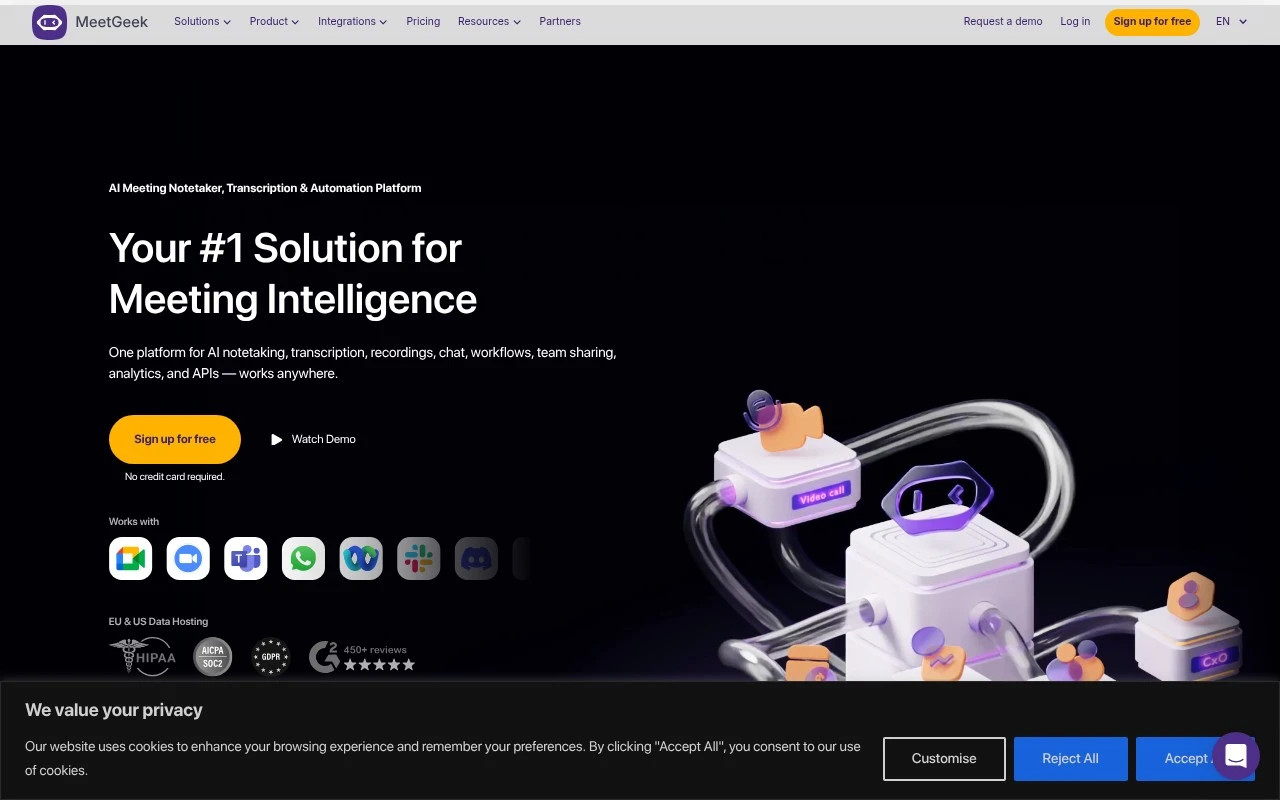
Meetgeek is an AI meeting assistant that records online meetings, can transcribe audio, and generates searchable transcripts, summaries, highlights, and action items for teams.
Meeting NotesSummarization

FYAI Score

8.5 / 10

Based on 490 reviews

Pricing:

Freemium

Best for:

Business teams that want meetings turned into notes and actions

Score Breakdown

  • Ease of use8.8 / 10
  • Features8.8 / 10
  • Pricing7.4 / 10
  • Integrations9.3 / 10
  • Support8.4 / 10

PRODUCT PREVIEW

What this AI tool does

Meetgeek is an AI meeting assistant for business teams that need to transcribe audio, capture conversations, and turn meetings into structured notes, summaries, and follow-up actions. It sits between the meeting itself and the tools where work continues, converting spoken discussion into meeting notes, searchable records, and next steps that can be shared across a team. For sales, customer success, recruiting, product, operations, and leadership teams, the value is not just transcription, but continuity. Meetgeek is designed for organisations that want decisions, blockers, action items, and customer feedback to be available after the call without relying on manual note-taking or fragmented recordings. Capture is one of the platform’s defining strengths because it is not limited to a single meeting setup. It can join online meetings through an automatic meeting agent, record offline conversations from mobile, capture browser-based meetings without a bot, process uploaded recordings, and connect through dialer or API-based workflows. This flexibility makes it useful for teams whose conversations happen across video calls, phone calls, field meetings, and previously recorded audio. Once a conversation is captured, the platform uses AI transcription and audio summarization to create a structured version of what happened. Instead of leaving users with a raw transcript alone, it produces summaries, topics, highlights, action items, and follow-up material that are easier to review and distribute. Meetgeek is best at turning meeting content into usable business memory rather than simply storing recordings. Searchable meeting history gives the tool a broader role than a one-off note generator. Teams can revisit past discussions, find references to specific customers, projects, objections, decisions, or tasks, and trace what was said across multiple calls. This is especially useful when meeting knowledge needs to survive handoffs, absences, account transitions, or long sales cycles. Workflow automation is central to how the platform fits into existing business systems. Summaries and action items can be pushed into collaboration, CRM, project management, and productivity tools, reducing the gap between a conversation and the next piece of work. The practical aim is to make meeting notes actionable in the places where teams already manage customers, tasks, and internal communication. Team sharing features position it as a shared knowledge layer rather than a private recorder. Managers can review calls, colleagues can catch up without attending every meeting, and distributed teams can stay aligned through consistent records of what was discussed. Analytics add another layer by helping teams understand meeting patterns, participation, and topics over time. API access makes the product relevant for companies that want to connect meeting intelligence with internal systems or custom workflows. This matters for more technical teams or larger organisations that want meeting data to feed reporting, coaching, documentation, or customer intelligence processes beyond the default integrations. When people compare meetgeek alternatives or read a meetgeek review, the main distinction to look for is the breadth of capture methods combined with the emphasis on workflow-ready outputs. Meetgeek pricing may be part of the evaluation, but the bigger question is whether the platform can reliably collect conversations from the team’s real meeting environments and convert them into records that people will actually use. Overall, the product is best understood as an AI meeting memory platform. It records, transcribes, summarizes, organizes, and routes meeting knowledge so teams can spend less time reconstructing conversations and more time acting on them.

Use cases

Best for

Meeting Notes

Meetgeek joins meetings to capture recordings, generate structured notes, and share action items to your team workspace.

Transcribe Audio

Transcribe uploaded recordings or live calls into searchable text using Meetgeek’s meeting agent, mobile recorder, or no-bot capture.

Audio Summarization

Generate concise meeting summaries from transcripts, with key decisions and next steps saved to your searchable meeting history.

ANALYSIS

Strengths & limitations

Strengths
  • Strong fit for meeting-heavy teams because it combines transcripts, recordings, summaries, action items, searchable history, and team sharing in one workspace.
  • Useful across online and offline conversations because it supports an automatic meeting agent, no-bot browser recording, mobile recording, uploaded files, dialer connections, and API capture.
  • Good for teams that want follow-through from meetings because structured insights, workflow automation, analytics, and integrations can turn discussions into shared actions across existing tools.

Limitations
  • Less suitable for individuals or very small teams that only need occasional raw transcription because its collaboration, automation, analytics, and knowledge-base features add unnecessary workflow overhead.
  • The freemium model is best for evaluation because teams with regular meeting volume, longer retention, deeper collaboration, or automation needs should expect to move onto a paid subscription.
  • Teams in regulated or client-sensitive environments need clear consent, access-control, and retention policies because MeetGeek centralizes recordings, transcripts, and searchable conversation history.

Evaluation

FYAI score breakdown

Our structured evaluation across five key criteria

8.5 / 10

Overall score

Based on 490 reviews

  • Ease of use8.8 / 10
  • Features8.8 / 10
  • Pricing7.4 / 10
  • Integrations9.3 / 10
  • Support8.4 / 10

What users say

Findings from public reviews, documentation and community sources.

  • Ease of use

    G2’s 490-review signal says users “consistently praise the product for its time-saving capabilities and ease of use.” The MeetGeek product page reinforces low-friction onboarding with “Sign up for free” and “No credit card required,” while Product Hunt mentions room for improvement in speaker/accent recognition.

  • Features

    MeetGeek describes “one platform for AI notetaking, transcription, recordings, chat, workflows, team sharing, analytics, and APIs.” MeetGeek also lists bot/no-bot capture, mobile/offline recording, uploaded recordings, and customizable templates.

  • Pricing

    The MeetGeek pricing page highlights “Sign up for free” and “No credit card required.”

  • Integrations

    MeetGeek lists native/workflow connectivity with “Slack, Notion, HubSpot, ClickUp” and no-code automation through “Make, Zapier, or n8n” with “20,000+ Apps.” MeetGeek also lists “REST API and webhooks” and AI connections to “ChatGPT, Claude & others.”

  • Support

    MeetGeek surfaces support-enablement paths including “Resources,” “Request a demo,” and “View API Docs.” MeetGeek also lists security/compliance request options including “Request report” and “Request BAA.”

Who is this for?

Best for teams that want meeting notes tied to recordings and workflows. MeetGeek describes “one platform for AI notetaking, transcription, recordings, chat, workflows, team sharing, analytics, and APIs.” Best for teams with automation needs. MeetGeek lists “REST API and webhooks” plus no-code automation through “Make, Zapier, or n8n” with “20,000+ Apps.” Less suited to buyers who need concrete plan prices, limits, or tier details before evaluating, the captured pricing page highlights “Sign up for free” and “No credit card required” but presents a product overview rather than plan specifics.

PRODUCT PREVIEW

Feature highlights

AI meeting notes

Auto-transcribe and summarize meetings into structured notes and takeaways.

Searchable history

Find decisions, topics, and action items across all past meetings fast.

Workflow automation

Share notes and push follow-ups into your tools with automations and API.

COMPARE

Discover curated alternatives worth comparing

Compare similar AI tools based on features, pricing and use cases

7.8/ 10Based on 31 reviews

Wudpecker

Meeting NotesSummarization
Turns recordings into notes, summaries, action items, and Q&A
Best for:
Knowledge workers
Pricing
Freemium

9.0/ 10Based on 1,589 reviews

Toggl Track

Time & Habit Tracking
Tracks time, automates activity capture, and reports team data
Best for:
Operations teams
Pricing
Freemium

8.5/ 10Based on 2,648 reviews

Todoist

Task & Project Management
Captures tasks, organizes schedules, and clarifies action plans
Best for:
Knowledge workers
Pricing
Freemium

Turn every meeting into clear outcomes. Start using Meetgeek today and keep your team aligned, accountable, and moving faster after every call.

FAQ

Frequently asked
questions

Everything you need to know about this AI tool,
its features, pricing, use cases, and limitations.

Who is Meetgeek best suited for?
Meetgeek is best suited for business teams that need meetings and recorded conversations turned into shared notes, transcripts, summaries, action items, and searchable knowledge. It fits sales, HR, customer success, marketing, leadership, and operations teams that rely on calls, interviews, internal meetings, and follow-up workflows.
Does Meetgeek have a free plan, and what do paid plans add?
Meetgeek uses a freemium pricing model, so teams can start with a free option and upgrade for broader usage or more advanced needs. Paid plans typically matter when teams need higher recording capacity, expanded collaboration, more automation, integrations, or workflow features. Check Meetgeek’s pricing page for current plan limits.
How does Meetgeek compare with other AI meeting note tools?
Meetgeek stands out for supporting multiple capture methods, including meeting bot recording, browser recording, mobile offline recording, uploads, and API-connected conversations. Compared with similar tools, the right choice depends on whether a team prioritizes transcription accuracy, workflow automation, integrations, searchable knowledge, pricing, or support for in-person conversations.
How quickly can a team get started with Meetgeek?
Meetgeek is focused on meeting intelligence, not replacing a full CRM, project management system, or knowledge management platform by itself. Its strongest value comes from conversations, transcripts, summaries, and follow-up outputs. Some workflow benefits also depend on connecting external tools, and the desktop no-bot recording app is listed as coming soon.
What should teams consider about privacy and compliance before using Meetgeek?
Teams should review Meetgeek’s current privacy, security, retention, and compliance documentation before recording sensitive meetings or customer calls. Important checks include consent requirements, where recordings and transcripts are stored, who can access shared meeting knowledge, integration permissions, data retention controls, and whether the tool fits internal policies for regulated or confidential conversations.