Curated ToolThis tool is part of our curated AI directory. We only include tools that meet our standards for relevance, usability and real-world value.

Laxis

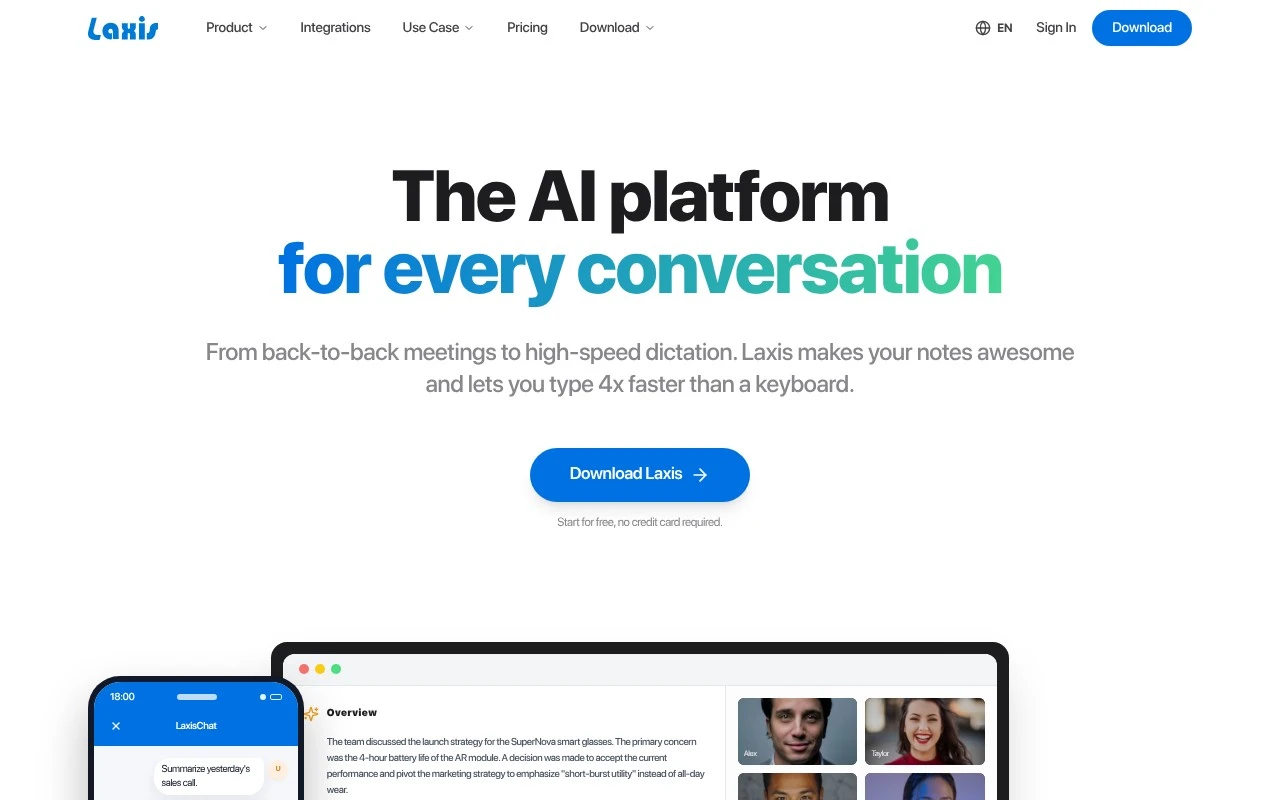
Laxis is an AI meeting assistant that can transcribe audio from meetings, interviews, and calls, then organize the transcript into notes, summaries, and follow-up items. It is used to capture and analyze conversations across tools such as Zoom and Google Meet.
Meeting NotesKnowledge Search

FYAI Score

8.4 / 10

Based on 33 reviews

Pricing:

Freemium

Best for:

Sales and customer-facing teams capturing meetings and follow-ups

Score Breakdown

  • Ease of use8.2 / 10
  • Features7.9 / 10
  • Pricing9.1 / 10
  • Integrations9.0 / 10
  • Support8.1 / 10

PRODUCT PREVIEW

What this AI tool does

Laxis is an AI conversation intelligence platform for professionals who need to capture meetings, transcribe audio, summarize discussions, and turn spoken information into usable work outputs. It is built for teams that rely on calls, interviews, demos, internal meetings, and voice notes, especially when the real value of a conversation appears after the call in the form of decisions, follow-ups, reports, and searchable knowledge. At its core, the platform acts as an AI meeting assistant that can record and process conversations with either bot-based or bot-free capture, depending on the meeting context. Instead of treating transcription as the final product, it uses the transcript as raw material for structured meeting notes, action items, highlights, and summaries that are easier to review than a full call recording. For sales, customer success, recruiting, research, consulting, and management teams, Laxis is best at converting live conversations into organized follow-through. A sales call can become CRM-ready notes, a user interview can become a research summary, and a team discussion can become a list of responsibilities and next steps without requiring someone to manually reconstruct the meeting afterward. The AI layer is designed around retrieval as much as summarization. Users can chat with their meeting history, ask questions across past conversations, and use internal search to find what was said, who said it, and which themes are recurring. This makes the platform useful not only for remembering a single meeting, but also for building a working knowledge base from many conversations over time. Audio summarization and video summarization sit naturally within that workflow. The platform can condense spoken content into concise recap formats while preserving the practical details that teams usually need, such as decisions, objections, requirements, deadlines, and assigned tasks. This positions it between a transcription service and a broader productivity system, because the output is meant to be acted on rather than simply archived. Report generation is another important part of the Laxis story. Instead of forcing users to copy notes into separate documents, the platform can generate reports from templates, helping teams standardize how they summarize sales calls, interviews, client updates, or internal reviews. That template-driven approach is especially useful for repeatable workflows where every conversation needs to produce a consistent deliverable. Workflow and CRM syncing extend the platform beyond the meeting itself. When conversation outputs can be routed into the systems a team already uses, meeting intelligence becomes part of the operating process rather than a separate inbox of transcripts. This is particularly valuable for roles where missed follow-up or incomplete documentation can directly affect revenue, client service, or project execution. Voice input gives the tool a second identity outside scheduled meetings. Its voice keyboard lets users speak into everyday apps and rewrite content from rough speech into cleaner, structured, professional text. That makes it useful for people who think faster by talking than typing, or who want to dictate emails, notes, updates, and messages without sending unpolished voice-to-text output. Compared with simple transcription tools, Laxis is more focused on the full lifecycle of spoken work: capture, understanding, summarization, search, reporting, and handoff. It also differs from generic AI chat tools because it is grounded in a user’s own conversations and designed around recurring meeting-based workflows. A fair Laxis review should therefore assess not only transcript accuracy, but also how well the platform turns conversations into decisions, documents, and next actions. Teams evaluating Laxis pricing will likely be weighing the value of time saved after meetings against the need for accurate capture and dependable workflow integration. The strongest fit is for users who have frequent conversations that contain business-critical details and who want those details to become searchable, summarized, and reusable without manual note-taking. Laxis is ultimately a productivity layer for spoken information, combining meeting intelligence with practical voice-to-text assistance. It is for individuals and teams who want conversations to become structured knowledge, polished writing, and operational follow-up, rather than disappearing into recordings, scattered notes, or memory.

Use cases

Best for

Meeting Notes

Laxis captures meetings with or without a bot, then generates summaries and action items you can sync to CRM workflows.

Transcribe Audio

Use Laxis to record voice or meetings and produce a transcript-style summary with key points and action items.

Internal Search

Ask questions in Laxis chat to search across your meeting history and pull answers from past transcripts and summaries.

ANALYSIS

Strengths & limitations

Strengths
  • Flexible capture options fit teams with different meeting norms because Laxis supports both bot-free and bot-based meeting capture.
  • Strong for conversation-heavy workflows because it turns meetings and calls into summaries, action items, decisions, searchable history, and template-based reports.
  • Useful beyond scheduled meetings because its voice keyboard converts rough spoken dictation into polished text across everyday apps.

Limitations
  • Less suitable for teams that only need a simple recorder because Laxis combines capture, AI analysis, reporting, and workflow syncing in a broader productivity system.
  • Teams with strict recording or data-governance rules need clear internal policies because Laxis works by capturing and processing conversation content.
  • The freemium model is better for evaluation than scaled use because high meeting volume, advanced reporting, or workflow syncing will typically push teams toward paid usage.

Evaluation

FYAI score breakdown

Our structured evaluation across five key criteria

8.4 / 10

Overall score

Based on 33 reviews

  • Ease of use8.2 / 10
  • Features7.9 / 10
  • Pricing9.1 / 10
  • Integrations9.0 / 10
  • Support8.1 / 10

What users say

Findings from public reviews, documentation and community sources.

  • Ease of use

    G2 describes Laxis setup as “super simple with no technical knowledge required” and “plug and play.” Capterra calls Laxis “very good, easy to use software.”

  • Features

    The Laxis page lists an AI meeting assistant, voice keyboard, AI sales agent, and bot-free capture. The Laxis page also lists 50+ report templates, CRM sync, and 100,000+ professionals using it.

  • Pricing

    The Laxis pricing page lists Basic at $0 with 300 transcription minutes/month, Premium at $15.99/month with 2,000 minutes and AI Chat, and Business at $29.99/month with unlimited transcription, CRM automation, 7,000+ app integrations, team admin, and priority support. G2 characterizes Laxis pricing as “exceptionally good.”

  • Integrations

    The Laxis integrations page names Zoom, HubSpot, Salesforce, Google Meet, Microsoft Teams, Slack, and Notion, and lists “7,000+ apps via Zapier.” The Laxis pricing page lists “Full API & SSO Integration” for Enterprise.

  • Support

    The Laxis pricing page lists “Priority Support” on Business and “Dedicated Account Manager” and “Onboarding & Training” on Enterprise. The Laxis pricing page also links to “Help Center” and “Contact Support.”

Who is this for?

Best for teams that want meeting transcription tied into CRM and workflow automation. Business includes unlimited transcription, CRM automation, 7,000+ app integrations, team admin, and priority support. Less suited to teams that require dedicated onboarding on a lower tier, the pricing page places “Dedicated Account Manager” and “Onboarding & Training” on Enterprise.

PRODUCT PREVIEW

Feature highlights

Meeting capture

Record with or without a bot and keep every detail in one place.

Summaries & actions

Auto-generate structured notes and action items you can share fast.

CRM workflow sync

Push meeting insights into templates, reports, and your CRM.

COMPARE

Discover curated alternatives worth comparing

Compare similar AI tools based on features, pricing and use cases

7.8/ 10Based on 31 reviews

Wudpecker

Meeting NotesSummarization
Turns recordings into notes, summaries, action items, and Q&A
Best for:
Knowledge workers
Pricing
Freemium

9.0/ 10Based on 1,589 reviews

Toggl Track

Time & Habit Tracking
Tracks time, automates activity capture, and reports team data
Best for:
Operations teams
Pricing
Freemium

8.5/ 10Based on 2,648 reviews

Todoist

Task & Project Management
Captures tasks, organizes schedules, and clarifies action plans
Best for:
Knowledge workers
Pricing
Freemium

Turn every meeting into clear notes and accountable next steps. See why teams choose Laxis to stay aligned and move work forward—starting today.

FAQ

Frequently asked
questions

Everything you need to know about this AI tool,
its features, pricing, use cases, and limitations.

Who is Laxis best suited for?
Laxis is best suited for professionals and teams that need to turn conversations and spoken input into usable notes, tasks, reports, and polished text. It fits meeting-heavy roles, sales teams, interviewers, customer-facing teams, and people who want AI support for capturing discussions, summarizing audio or video, and dictating content across apps.
Does Laxis have a free plan, and what do paid plans add?
Laxis uses a freemium pricing model, so users can start with a free option and upgrade for broader usage or capabilities. Teams comparing free and paid plans should check laxis.com for current limits on recording, transcription, AI summaries, reporting, uploads, integrations, and voice keyboard features.
How does Laxis compare with other meeting transcription and note-taking tools?
Laxis competes with AI meeting assistants and transcription tools, but its broader value is combining meeting capture, summaries, action items, report generation, searchable meeting history, and a voice keyboard. The best choice depends on whether a team mainly needs basic transcripts, CRM-ready meeting outputs, internal search, or cross-app dictation support.
How quickly can a team get started with Laxis?
The main trade-offs with Laxis are that buyers should validate detailed integration coverage, confirm how the AI sales agent fits their workflow, and test accuracy for their languages, accents, and meeting types. Marketing claims such as support for many languages or faster typing should be checked against real team usage.
What should teams consider about privacy and compliance before using Laxis?
Teams should review how Laxis handles recordings, transcripts, summaries, meeting history, and dictated text before using it with sensitive conversations. Important checks include consent requirements, data retention controls, access permissions, export options, security practices, and current compliance documentation, especially for regulated industries or customer-facing calls.