Curated ToolThis tool is part of our curated AI directory. We only include tools that meet our standards for relevance, usability and real-world value.

Jamie AI

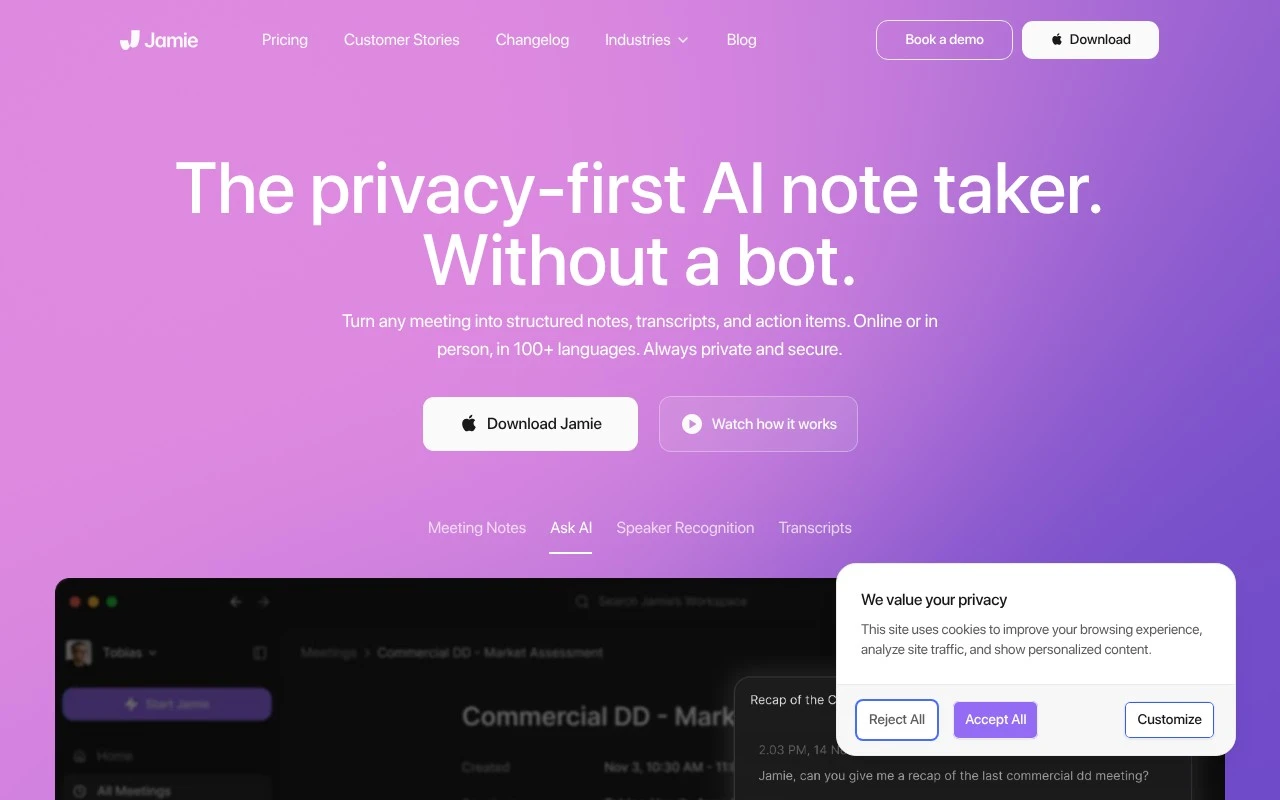
Jamie AI is an AI meeting assistant that can transcribe audio from online and in-person meetings and generate structured summaries, notes, and action items without requiring a meeting bot to join.
Meeting NotesSummarization

FYAI Score

8.7 / 10

Based on 27 reviews

Pricing:

Freemium

Best for:

Privacy-conscious teams that run frequent meetings and need reliable notes

Score Breakdown

  • Ease of use8.7 / 10
  • Features8.6 / 10
  • Pricing8.5 / 10
  • Integrations9.0 / 10
  • Support8.6 / 10

PRODUCT PREVIEW

What this AI tool does

Jamie AI is a privacy-focused AI note taker that transcribes audio from meetings, conversations, and interviews, then turns it into human-like meeting notes, summaries, speaker labels, and action items. Jamie AI is built for professionals and teams that need accurate records of discussions without inviting a visible bot into every call. Jamie AI is best at capturing the substance of a meeting across online platforms and offline settings while keeping data protection central to the product experience. Rather than appearing as another participant in a video call, the tool works quietly from the user’s device and can support common meeting environments as well as in-person conversations. This makes it useful for teams that move between Zoom, Teams, Google Meet, phone calls, and physical rooms. The product story is less about replacing the meeting itself and more about removing the manual work that follows it. For managers, consultants, sales teams, founders, researchers, and knowledge workers, the value is in preserving context that is usually lost after a discussion ends. A user can stay present in the conversation instead of typing notes, then return to a structured record that separates key points from follow-ups. Jamie AI helps turn spoken work into written knowledge that can be shared, searched, and acted on. Privacy is one of the defining parts of the platform’s positioning. The service emphasizes EU hosting, GDPR compliance, encrypted data handling, and deletion of audio after transcription. It also states that customer data is not used to train AI models, which makes the tool especially relevant for organizations that handle confidential client work, internal strategy, legal topics, hiring discussions, or sensitive operational details. The output is designed to read less like a raw machine transcript and more like a useful account of what happened. Transcripts and speaker labels provide traceability, while audio summarization condenses long discussions into decisions, open questions, and action items. Instead of forcing users to scan pages of dialogue, the platform aims to deliver meeting notes that resemble what a careful human assistant would have prepared. Across languages and meeting types, Jamie AI is positioned as a practical layer for documentation rather than a single-platform add-on. Multilingual support matters for international teams, customer calls, and organizations where meetings do not always happen in English. The ability to handle both online and offline conversations also gives it a broader role than many meeting assistants that depend on joining a calendar invite or video room. In day-to-day use, the tool can become part of a team’s institutional memory. Past conversations can feed internal search, helping people recover what was agreed, who was responsible, and why a decision was made. This is especially important for distributed teams, where information is often scattered across chat messages, recordings, documents, and personal notes. For buyers reading a Jamie AI review or comparing Jamie AI pricing with other AI meeting tools, the main distinction is the combination of discretion, privacy, and cross-context capture. Many AI note takers focus on call bots and automated recap emails, while this platform focuses on recording meetings without visibly entering the call and on protecting the audio and transcript lifecycle. That makes it a strong fit for teams that want AI-generated documentation but do not want the meeting experience to feel monitored or exposed. The broader character of Jamie AI is that of a meeting memory system with a strong privacy posture. It does not simply transcribe audio for storage, and it does not treat summaries as a generic afterthought. Its purpose is to make conversations easier to trust, revisit, and act on, while reducing the administrative burden that usually sits between a meeting and meaningful follow-through.

Use cases

Best for

Meeting Notes

Jamie AI records meetings without joining as a bot and generates summaries, speaker labels, and action items.

Transcribe Audio

It transcribes online calls or offline conversations into text with speaker labels, then deletes audio after transcription.

Internal Search

It creates searchable meeting transcripts and summaries so teams can find decisions and action items across past conversations.

ANALYSIS

Strengths & limitations

Strengths
  • Bot-free capture suits teams that do not want an AI attendee joining calls, while still covering online meetings and offline conversations.
  • Strong privacy positioning fits organizations handling sensitive discussions because Jamie AI emphasizes EU hosting, GDPR compliance, encryption, deleted audio after transcription, and no training on customer data.
  • Multilingual summaries, transcripts, speaker labels, and action items help international teams turn recurring meetings into searchable documentation without manual note taking.

Limitations
  • Less suitable for teams that cannot record meeting audio because Jamie AI still needs captured conversation data to generate notes and transcripts.
  • Less suitable for organizations that want a visible in-meeting bot for attendance, disclosure, or live participant workflows because Jamie AI is designed around bot-free capture.
  • The freemium model is less suitable for high-volume meeting teams because heavier usage and advanced needs are likely to require a paid plan.

Evaluation

FYAI score breakdown

Our structured evaluation across five key criteria

8.7 / 10

Overall score

Based on 27 reviews

  • Ease of use8.7 / 10
  • Features8.6 / 10
  • Pricing8.5 / 10
  • Integrations9.0 / 10
  • Support8.6 / 10

What users say

Findings from public reviews, documentation and community sources.

  • Ease of use

    G2’s product-review signal says users “consistently praise Jamie for its ease of use and accurate meeting notes,” and Jamie’s bot-free workflow reduces meeting-join friction versus many AI note takers.

  • Features

    Jamie’s pricing page lists AI note-taking features including Ask AI, speaker recognition and memory, in-person/offline meetings, and 99+ languages.

  • Pricing

    Jamie’s pricing page lists five tiers, starting with a Free plan at €0 for 10 meetings/month and ending with Enterprise custom.

  • Integrations

    Jamie’s pricing page lists integrations including Google Docs, Notion, Salesforce, and Microsoft Dynamics 365, plus API & Webhook and MCP for Claude, ChatGPT, and Cursor. Jamie’s pricing page states support for all online meeting platforms.

  • Support

    Jamie’s pricing page shows support options that scale by tier, including Priority support and a Dedicated account manager on higher plans. Jamie’s site footer links to an FAQ & Help Center, Status page, Support, and demo booking.

Who is this for?

Best for teams that want bot-free notes across varied meeting formats, Jamie’s pricing page lists in-person/offline meetings and support for all online meeting platforms. Less suited to users who need unlimited meetings at no cost, Jamie’s pricing page lists a Free plan at €0 for 10 meetings/month, while Pro is €39/month annually for unlimited meetings.

PRODUCT PREVIEW

Feature highlights

Bot-free capture

Works across online calls and offline chats without joining as a bot

Human-like summaries

Creates transcripts, speaker labels, and action items automatically

EU privacy by design

EU hosting, GDPR-ready, encrypted, and no training on your data

COMPARE

Discover curated alternatives worth comparing

Compare similar AI tools based on features, pricing and use cases

7.8/ 10Based on 31 reviews

Wudpecker

Meeting NotesSummarization
Turns recordings into notes, summaries, action items, and Q&A
Best for:
Knowledge workers
Pricing
Freemium

9.0/ 10Based on 1,589 reviews

Toggl Track

Time & Habit Tracking
Tracks time, automates activity capture, and reports team data
Best for:
Operations teams
Pricing
Freemium

8.5/ 10Based on 2,648 reviews

Todoist

Task & Project Management
Captures tasks, organizes schedules, and clarifies action plans
Best for:
Knowledge workers
Pricing
Freemium

Turn every meeting into clear outcomes. Start using Jamie AI today to keep your team aligned, accountable, and moving faster.

FAQ

Frequently asked
questions

Everything you need to know about this AI tool,
its features, pricing, use cases, and limitations.

Who is Jamie AI best suited for?
Jamie AI is best suited for professionals and teams that run frequent meetings and need reliable notes without adding a meeting bot. It is especially relevant for leaders, sales teams, customer-facing teams, and organizations that want transcripts, speaker-labeled summaries, action items, and searchable records from online, hybrid, or in-person meetings.
Does Jamie AI have a free plan, and when would a team need to upgrade?
Jamie AI uses a freemium pricing model, so users can start with a free option and upgrade when their needs exceed the free plan. Teams should review the current plan details on meetjamie.ai, especially if they need higher usage, collaboration features, integrations, or administrative controls.
How does Jamie AI compare with other AI meeting note takers?
Jamie AI mainly stands out from many AI meeting note takers by recording without adding a meeting bot to the call. That can make it a better fit for teams that want less intrusive capture across online, hybrid, and offline meetings, while bot-based tools may suit teams that prefer visible in-meeting recording.
How much setup does Jamie AI require before it can take meeting notes?
Jamie AI’s main limitation is that it focuses on meeting documentation rather than full project management or task execution. It can generate notes, transcripts, summaries, speaker labels, and action items, but teams may still need separate tools to manage projects, assign work, and track execution. Some enterprise administration features, such as SCIM provisioning, are still pending.
How does Jamie AI handle privacy and meeting data?
Jamie AI is positioned for privacy-sensitive meeting documentation, with EU data residency, encryption, GDPR compliance, deletion of meeting audio after transcription, and no customer-data model training. This makes it relevant for organizations that want searchable meeting notes and transcripts while limiting long-term exposure of raw meeting recordings.