Curated ToolThis tool is part of our curated AI directory. We only include tools that meet our standards for relevance, usability and real-world value.

Grain

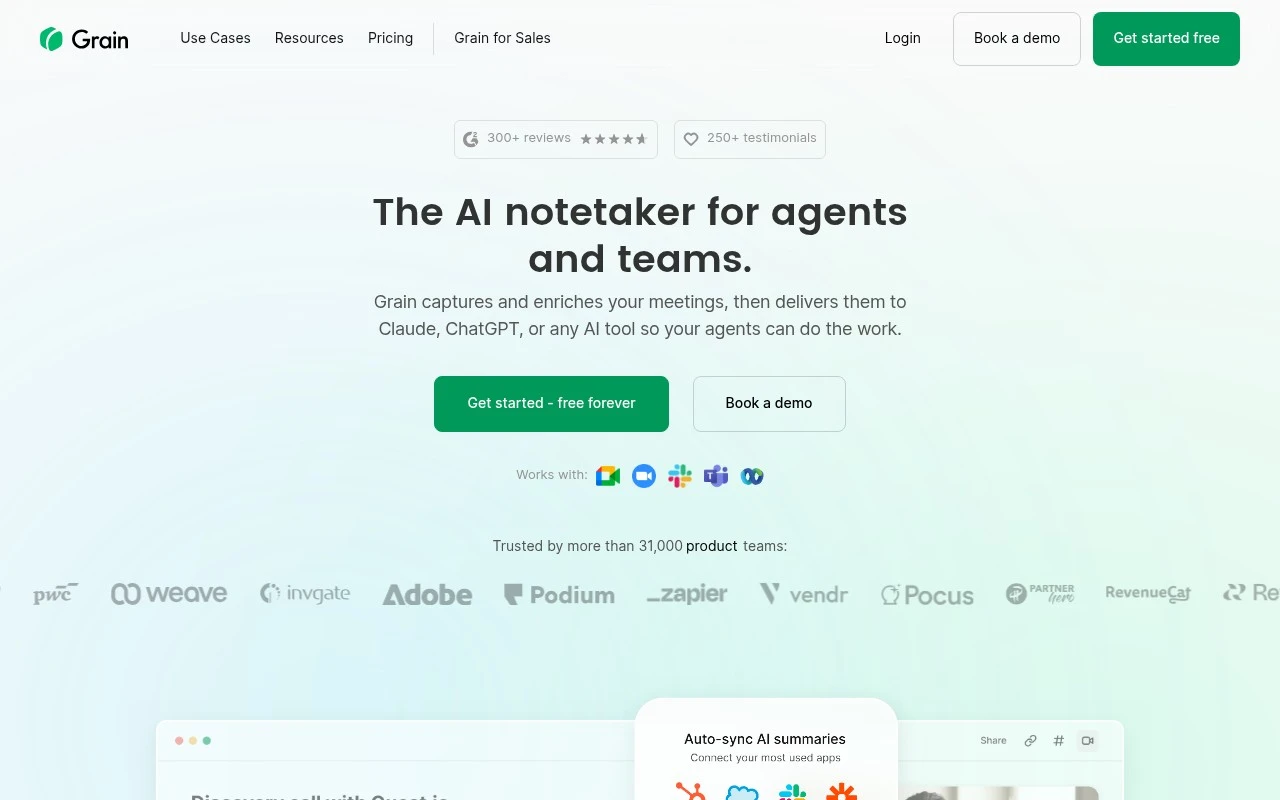
Grain is an AI meeting assistant that records, transcribes, and summarizes video meetings. It helps teams capture key moments, create shareable clips, and sync meeting insights to tools such as Salesforce, HubSpot, and Slack.
Meeting NotesSummarization

FYAI Score

8.5 / 10

Based on 309 reviews

Pricing:

Freemium

Best for:

Teams that run lots of meetings and need reliable notes and follow-ups

Score Breakdown

  • Ease of use9.2 / 10
  • Features8.3 / 10
  • Pricing8.1 / 10
  • Integrations9.0 / 10
  • Support7.8 / 10

PRODUCT PREVIEW

What this AI tool does

Grain is an AI notetaker for teams that records meetings, transcribes conversations in 100+ languages, and turns shared discussions into searchable notes, summaries, clips, and action items. Grain is built for organizations that want meeting knowledge to become usable context, not just a transcript stored after a call. For teams that run on customer calls, internal standups, interviews, demos, and strategy sessions, the tool acts as a memory layer across recurring conversations. It captures what was said, identifies important moments, and helps people revisit decisions without watching an entire recording or relying on scattered manual notes. The platform’s core value is not only that it can transcribe audio, but that it structures the output into formats teams can act on. Meeting notes, highlights, follow-ups, and shareable clips make the conversation easier to distribute to people who were not present, while summaries give participants a faster way to confirm what happened. A key part of Grain’s current positioning is AI-ready meeting context. Instead of treating recordings as isolated files, it helps convert meetings into enriched Markdown transcripts and structured data that can be used inside Grain or passed into external AI systems through an MCP server or API. Meeting notes become more valuable when they connect to the work that follows. Sales teams can preserve customer language, product teams can surface recurring feedback, recruiters can review interview evidence, and leadership teams can track decisions across a history of discussions. In each case, the tool is designed to reduce the gap between conversation and execution. In practice, audio summarization is only one layer of the experience. Users can create clips from important moments, add context around highlights, and package meeting evidence in a way that is easier to share with teammates, stakeholders, or downstream tools. This makes the platform useful for both immediate recap and longer-term knowledge management. For AI workflows, Grain is especially relevant because meeting history often contains the context agents need to answer questions accurately. By making transcripts exportable and queryable, the platform lets teams ask about past decisions, customer objections, project updates, or action items without manually searching through call recordings. Rather than positioning itself as a simple recorder, the product is closer to a meeting intelligence system. It sits between live collaboration and organizational memory, capturing the raw conversation, enriching it with notes and summaries, then making that information available to humans and AI agents. Grain is best suited for teams that have many conversations and need those conversations to remain useful after the meeting ends. Its strength is the combination of multilingual transcription, practical meeting documentation, shareable video evidence, and AI-accessible context that can support both day-to-day collaboration and more advanced automation.

Use cases

Best for

Meeting Notes

Grain records meetings and generates shareable notes with highlights, action items, and searchable transcripts.

Transcribe Audio

Upload or record audio in Grain to get a time stamped transcript in over 100 languages for search and export.

Audio Summarization

Grain summarizes recorded meetings into key points and action items, and lets you export enriched Markdown for AI workflows.

ANALYSIS

Strengths & limitations

Strengths
  • Best suited to meeting-heavy teams because it turns calls into transcripts, summaries, action items, clips, and searchable context in one workflow.
  • Strong fit for multilingual teams because it transcribes meetings in 100+ languages and keeps meeting records usable across regions.
  • Useful for AI-forward teams because enriched Markdown exports, an MCP server, and an API let agents and external tools query meeting history.

Limitations
  • Less suitable for teams that do not rely heavily on live meetings because its value is centered on recorded conversations rather than broader project knowledge management.
  • Less suitable for teams without technical or operations support because MCP, API, and AI-agent workflows require setup, governance, and integration decisions.
  • Freemium pricing can limit growing teams because higher-volume meeting capture, team workflows, or advanced usage are likely to require paid plans.

Evaluation

FYAI score breakdown

Our structured evaluation across five key criteria

8.5 / 10

Overall score

Based on 309 reviews

  • Ease of use9.2 / 10
  • Features8.3 / 10
  • Pricing8.1 / 10
  • Integrations9.0 / 10
  • Support7.8 / 10

What users say

Findings from public reviews, documentation and community sources.

  • Ease of use

    G2’s 309-review signal says users “consistently praise Grain for its ease of use and accurate transcriptions.” Grain’s own page says “Start recording in minutes,” “Bots optional,” and “No credit card required.”

  • Features

    Grain’s site lists “Bot-less transcription,” “Video recording with bots,” “Transcripts… in 100+ languages,” and AI notes/action items.

  • Pricing

    Grain’s pricing page shows a free option at “$0 per seat/month,” a paid price shown as “$19 per seat/month,” a “14-day free trial,” “Free and paid seats,” and “Cancel anytime.”

  • Integrations

    Grain’s integrations page lists native integrations for Webex, Microsoft Teams, Google Meet, Zoom, HubSpot, Salesforce, Aircall, Slack, Productboard, and Zapier. Grain’s home page also mentions Claude, ChatGPT, and “MCP Server & API.”

  • Support

    Grain’s pricing page offers “Book a Demo” and asks “Want help onboarding your team?” Grain’s site includes FAQ sections covering billing, sharing, AI features, security, privacy, and platform support.

Who is this for?

Best for teams that want meeting capture with flexible recording options, Grain’s site lists “Bot-less transcription,” “Video recording with bots,” and “Transcripts… in 100+ languages.” Best for teams with sales or customer workflows, Grain’s integrations page lists HubSpot, Salesforce, Slack, Zapier, and other native integrations. Less suited to buyers who need a very simple pricing comparison before choosing a plan, Grain’s pricing page shows “$0 per seat/month,” “$19 per seat/month,” a “14-day free trial,” “Free and paid seats,” and “Cancel anytime,” while the tier text is described as somewhat hard to parse across tiers.

PRODUCT PREVIEW

Feature highlights

Auto meeting capture

Record, transcribe, and generate notes without manual notetaking.

100+ languages

Accurate transcripts across global teams and multilingual meetings.

AI-ready exports & API

Export enriched Markdown or connect via MCP/API for agent queries.

COMPARE

Discover curated alternatives worth comparing

Compare similar AI tools based on features, pricing and use cases

7.8/ 10Based on 31 reviews

Wudpecker

Meeting NotesSummarization
Turns recordings into notes, summaries, action items, and Q&A
Best for:
Knowledge workers
Pricing
Freemium

9.0/ 10Based on 1,589 reviews

Toggl Track

Time & Habit Tracking
Tracks time, automates activity capture, and reports team data
Best for:
Operations teams
Pricing
Freemium

8.5/ 10Based on 2,648 reviews

Todoist

Task & Project Management
Captures tasks, organizes schedules, and clarifies action plans
Best for:
Knowledge workers
Pricing
Freemium

Turn every meeting into clear, shareable takeaways. Start using Grain today to keep teams aligned and decisions accountable.

FAQ

Frequently asked
questions

Everything you need to know about this AI tool,
its features, pricing, use cases, and limitations.

Who is Grain best for?
Grain is best for teams that need reliable meeting records, summaries, action items, clips, and searchable transcripts after calls. It is especially relevant for growing sales, customer success, and customer-facing teams that want meeting notes to flow into systems such as CRMs, Slack, AI tools, or internal knowledge workflows.
Does Grain have a free plan, and what should I check before upgrading?
Grain uses a freemium pricing model, so teams can start with a free option and upgrade for more advanced or higher-volume needs. Before choosing a paid plan, check current limits for recording, transcription, video capture, integrations, team features, CRM sync, and export options on grain.com.
How does Grain compare with other AI meeting note tools?
Grain stands out for combining meeting transcription, summaries, action items, clips, searchable meeting context, and exports to external AI and workflow tools. Compared with similar meeting note platforms, the best fit depends on whether your team values bot-less transcription, video recording, CRM workflows, collaboration features, or downstream AI use.
How quickly can a team get started with Grain?
Grain is focused on meetings, so it is not a general-purpose transcription, podcast editing, or media production platform. Another trade-off is capture method choice, since bot-less transcription supports audio capture, while video recording appears to require the Grain bot to join the meeting.
What privacy and compliance questions should buyers ask about Grain?
Buyers should confirm how Grain stores meeting recordings, transcripts, summaries, clips, and exported data before rolling it out broadly. Important questions include retention controls, access permissions, admin oversight, CRM and AI-tool data flows, consent requirements for recording, and current compliance documentation for the organisation’s industry and region.