Curated ToolThis tool is part of our curated AI directory. We only include tools that meet our standards for relevance, usability and real-world value.

Fellow

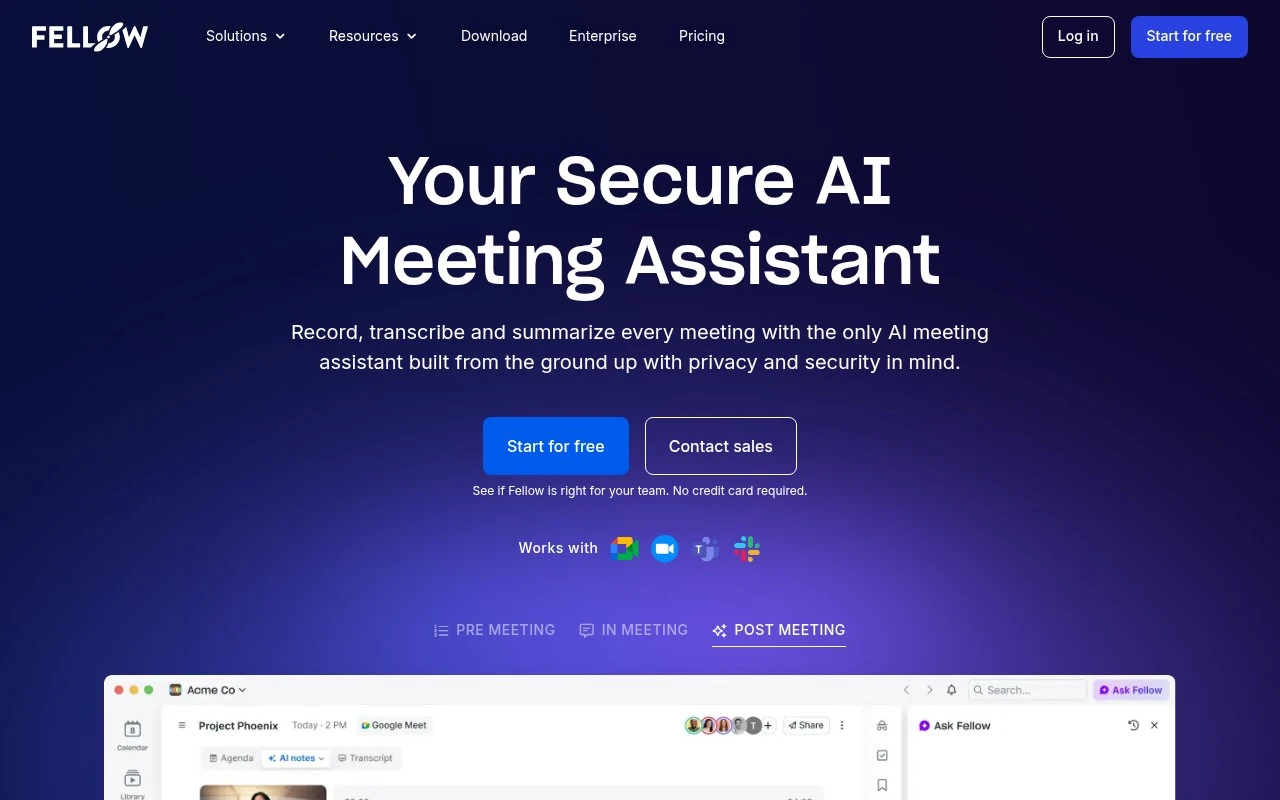
Fellow is an AI meeting assistant and meeting management platform that records and transcribes meetings, generates summaries, and tracks agendas, decisions, and action items. It integrates with calendars and video conferencing tools to centralize meeting notes and follow-up workflows.
Meeting NotesSummarization

FYAI Score

9.1 / 10

Based on 2,422 reviews

Pricing:

Freemium

Best for:

Enterprise teams needing governed, searchable meeting knowledge

Score Breakdown

  • Ease of use9.3 / 10
  • Features9.2 / 10
  • Pricing9.1 / 10
  • Integrations9.1 / 10
  • Support8.9 / 10

PRODUCT PREVIEW

What this AI tool does

Fellow is an AI meeting assistant and notetaker for teams and organizations that need reliable meeting notes, searchable records, and accountable follow-through from everyday conversations. It records meetings, can transcribe audio, summarizes discussion, captures decisions, and turns action items into usable context for the people who were in the room and the people who were not. At its core, the platform treats meetings as an operational knowledge source rather than a one-time calendar event. A discussion can become a transcript, an audio summarization, a concise recap, and a structured record of what was agreed. That makes it useful for recurring team meetings, executive reviews, customer conversations, hiring panels, project updates, and cross-functional planning. For managers and team leads, the value is in continuity. Meeting notes do not disappear into private documents or scattered chat threads, and follow-ups are easier to track after the call ends. Fellow helps teams preserve the reasoning behind decisions, not just the final task list, which is important when work spans departments, time zones, and multiple stakeholders. Governance is a central part of the product’s identity. Fellow is built for organizations that need control over how meeting records are created, stored, accessed, and retained. Permissioned access, audit trails, redaction capabilities, and retention options such as zero-day retention make the platform more suitable for enterprise and regulated environments than lightweight personal note takers. AskFellow extends the meeting archive into an AI knowledge layer. Instead of manually searching through transcripts or asking colleagues to repeat what happened, users can query past meetings and retrieve relevant answers from authorized records. This shifts the meeting assistant from passive documentation toward an internal agent that helps teams reuse institutional memory. In regulated or privacy-sensitive settings, the emphasis is not only on convenience. Legal, financial, healthcare, public sector, and enterprise teams often need evidence of who accessed information, what was captured, and how long records were kept. Fellow positions itself around these requirements by combining AI-generated meeting intelligence with centralized administrative control. Revenue, customer success, and operations teams can also benefit when meeting outcomes need to connect with broader workflows. The platform’s structured decisions and action items can support handoffs, follow-up processes, and CRM automation workflows when paired with the systems a team already uses. The practical aim is to reduce the gap between what was said in a meeting and what happens afterward. Rather than being only a transcription utility, Fellow is best understood as a meeting intelligence platform for organizations that want AI assistance without losing governance over sensitive conversations. Its story is about making meetings more usable after they happen, while giving administrators the controls needed to deploy that capability at scale.

Use cases

Best for

Meeting Notes

Fellow records meetings and generates searchable notes with summaries, decisions, and assigned action items.

Transcribe Audio

Upload or capture meeting audio in Fellow to produce a transcript with speaker labels and searchable text.

CRM Automation

Use AskFellow to pull decisions and action items from meeting records and paste them into CRM fields for updates.

ANALYSIS

Strengths & limitations

Strengths
  • Best suited to meeting-heavy organizations because it turns recordings, transcripts, summaries, decisions, and action items into searchable team knowledge.
  • Strong fit for regulated or security-conscious teams because it emphasizes permissioned access, audit trails, redaction, retention controls, and centralized meeting governance.
  • Useful for cross-functional teams because AskFellow can answer questions across accessible meetings and help create follow-ups or CRM update suggestions from discussions.

Limitations
  • Less suitable for small teams that only need lightweight personal notes because Fellow’s governance, permissions, and meeting repository features add more structure than they may need.
  • Org-wide use can become a paid commitment because Fellow is freemium and the most useful team, governance, and scale requirements typically sit beyond basic individual use.
  • Less suitable for teams that avoid recording meetings because its value depends on capturing and storing meeting transcripts and records under clear consent and data-handling processes.

Evaluation

FYAI score breakdown

Our structured evaluation across five key criteria

9.1 / 10

Overall score

Based on 2,422 reviews

  • Ease of use9.3 / 10
  • Features9.2 / 10
  • Pricing9.1 / 10
  • Integrations9.1 / 10
  • Support8.9 / 10

What users say

Findings from public reviews, documentation and community sources.

  • Ease of use

    Software Advice lists Fellow with “Overall Rating 4.9” across 37 reviews and a visible “Ease of use” rating of 5.

  • Features

    Fellow’s pricing page says Fellow “records, transcribes, and summarizes meetings,” captures “AI action items,” offers AskFellow for meeting insights, and provides transcription in “99 languages.”

  • Pricing

    Fellow’s pricing page lists a Free tier, Team at “$7 per user / month billed annually” or $11 monthly, Business at $15 annually or $23 monthly, and Enterprise at $25 annually. Fellow’s pricing page says Business includes unlimited AI notes/recordings, Enterprise includes advanced controls, and the Free tier is capped at 5 lifetime AI notes and recordings per user.

  • Integrations

    Fellow’s homepage states it has “over 50 integrations,” including Zoom, Google Meet, Microsoft Teams, and Slack, plus API access on paid tiers.

  • Support

    Fellow’s pricing page lists “Chat & email support” across all tiers, with an “Onboarding program” and “Dedicated account manager” available on higher tiers.

Who is this for?

Best for teams that want AI meeting notes across common meeting tools, Fellow’s pricing page says Fellow “records, transcribes, and summarizes meetings,” captures “AI action items,” and supports transcription in “99 languages.” Fellow’s homepage states it has “over 50 integrations,” which helps teams connect Fellow to existing productivity workflows. Less suited to users who need ongoing AI meeting notes at no cost, Fellow’s Free tier is capped at 5 lifetime AI notes and recordings per user.

PRODUCT PREVIEW

Feature highlights

AI meeting notes

Capture recordings, transcripts, summaries, decisions, and action items.

AskFellow agent

Search and query past meetings to find answers and next steps fast.

Meeting governance

Permissioned access, audit trails, redaction, and retention controls.

COMPARE

Discover curated alternatives worth comparing

Compare similar AI tools based on features, pricing and use cases

7.8/ 10Based on 31 reviews

Wudpecker

Meeting NotesSummarization
Turns recordings into notes, summaries, action items, and Q&A
Best for:
Knowledge workers
Pricing
Freemium

9.0/ 10Based on 1,589 reviews

Toggl Track

Time & Habit Tracking
Tracks time, automates activity capture, and reports team data
Best for:
Operations teams
Pricing
Freemium

8.5/ 10Based on 2,648 reviews

Todoist

Task & Project Management
Captures tasks, organizes schedules, and clarifies action plans
Best for:
Knowledge workers
Pricing
Freemium

Run meetings people actually value. Use Fellow to turn every discussion into clear decisions, owners, and next steps—starting today.

FAQ

Frequently asked
questions

Everything you need to know about this AI tool,
its features, pricing, use cases, and limitations.

Who is Fellow best suited for?
Fellow is best suited for teams that run frequent meetings and need searchable records, summaries, action items, and follow-ups in one controlled workspace. It is especially relevant for sales, customer success, leadership, HR, product, engineering, IT, and regulated financial services teams that need structured meeting outputs and access controls.
How much does Fellow cost?
Fellow uses a freemium pricing model, so teams can start with a free option and upgrade for broader or more advanced use. Paid plans are most relevant when organizations need wider team adoption, stronger administration, workflow integrations, governance controls, or meeting intelligence connected to systems such as CRM tools.
How does Fellow compare with other AI meeting assistants?
Fellow is most comparable to AI meeting assistants that record, transcribe, summarize, and extract action items from meetings. Its differentiation is its focus on centralized meeting records, permissioned access, follow-up generation, and CRM-related workflow updates, rather than only producing standalone transcripts or simple meeting notes.
How long does it take to set up Fellow?
Fellow is strongest as a meeting capture and meeting-derived workflow tool, not as a full project management or general knowledge management system. Its value also depends on teams being comfortable recording meetings and connecting it to conferencing, CRM, and productivity tools so it can generate useful outputs.
Is Fellow a good fit for teams with privacy or compliance requirements?
Fellow is designed with organization-level privacy, centralized access control, auditability, and security needs in mind for meeting records. Teams in regulated or sensitive environments should still review its current security documentation, retention options, access controls, and compliance posture against their own legal, data handling, and procurement requirements.