Curated ToolThis tool is part of our curated AI directory. We only include tools that meet our standards for relevance, usability and real-world value.

Coda

AI in Coda docs to write, summarize, and generate tables

Meeting NotesKnowledge Search
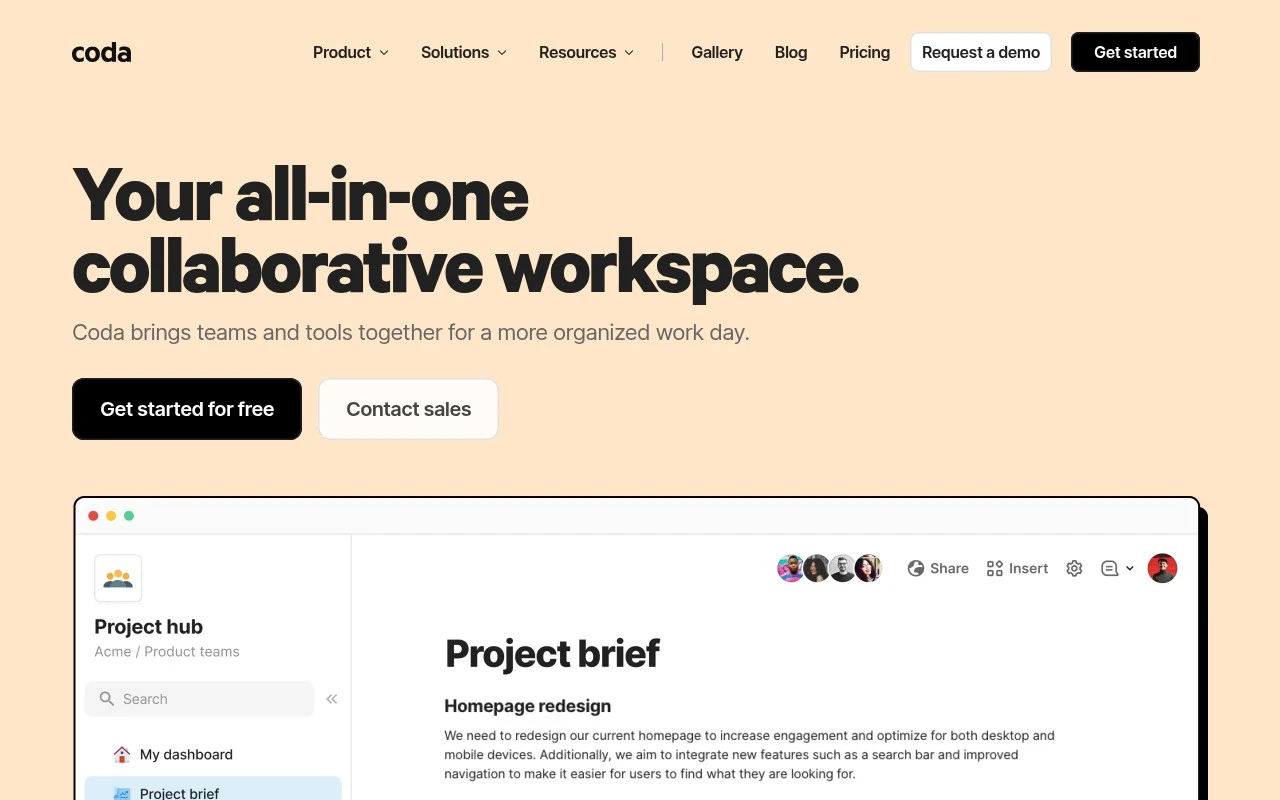
Coda is an all-in-one collaborative workspace that blends the familiarity of docs with structured tables, app-like controls, automations, AI assistance, and integrations. Teams use it to replace scattered documents, spreadsheets, trackers, and lightweight internal tools with customizable workspaces for planning, coordination, and decision-making.

FYAI Score

8.5 / 10

Based on 493 reviews

Pricing:

Freemium

Best for:

Product and ops teams building shared workflows and trackers

Score Breakdown

  • Ease of use8.3 / 10
  • Features8.6 / 10
  • Pricing8.4 / 10
  • Integrations9.2 / 10
  • Support7.9 / 10

PRODUCT PREVIEW

What this AI tool does

Coda is a collaborative workspace that combines documents, tables, and lightweight app-building in one place. It’s designed for teams and individuals who want to organize information and turn it into something actionable without switching between multiple tools. You can use it to draft plans, track projects, manage shared data, and create simple workflows that update as your work changes. Because content and structured data live together, it’s often used for internal hubs, team trackers, and living documentation that stays current. This tool is best suited for people looking for a flexible system that can start as a document and gradually become a more structured workspace. It can support both personal organization and team collaboration, depending on how you set it up.

Use cases

Best for

Project Management

Plan projects in Coda using tables, timelines, and status views that sync updates across docs, tasks, and dashboards.

Task Management

Track tasks with assignable rows, due dates, and automations that send reminders and update statuses based on rules.

Meeting Notes

Capture meeting notes in a doc linked to action items and decisions, then auto-assign follow-ups from the notes table.

ANALYSIS

Strengths & limitations

Strengths
  • Combines docs, structured tables, formulas, buttons, automations, and app-like workflows in one workspace.
  • Supports many team-specific templates and use cases, including product roadmaps, sales hubs, hiring systems, launch briefs, and meeting forums.
  • Includes Coda AI features for chat, drafting, summarizing, generating tables, and applying AI across table columns.
Limitations
  • Teams may need to design and maintain their own Coda docs and workflows rather than using a fixed-purpose application out of the box.
  • Its broad feature set can be more than necessary for users who only need simple documents or basic spreadsheets.
  • Replacing specialized apps depends on the team’s workflow complexity and available integrations, so Coda may not eliminate every tool in a stack.

Evaluation

FYAI score breakdown

Our structured evaluation across five key criteria

8.5 / 10

Overall score

Based on 493 reviews

  • Ease of use8.3 / 10
  • Features8.6 / 10
  • Pricing8.4 / 10
  • Integrations9.2 / 10
  • Support7.9 / 10

What users say

Findings from public reviews, documentation and community sources.

  • Ease of use

    Software Advice includes a user quote saying Coda is “very easy to use and intuitive.” Coda’s own page says Coda is “familiar like a doc” so teams can “jump in quickly.”

  • Features

    Coda positions itself as an “all-in-one platform” combining “docs,” “spreadsheets,” “applications,” and “AI,” with formulas, buttons, automations, and connected tables. G2 shows a 4.6/5 rating from 493 reviews and highlights user praise for “flexibility and customization.”

  • Pricing

    A Reddit pricing discussion states that a single user can use Coda for free, or pay “$12 on our Pro plan” and “$36 on our Team plan.”

  • Integrations

    Coda’s own page says users can “create workflows across your must-have tools” and names Google Calendar, Slack, Figma, and Jira. Coda’s own page claims “600+ integrations.”

  • Support

    G2 shows a 4.6/5 rating from 493 reviews for Coda.

Who is this for?

Best for teams that want one workspace for documents, spreadsheet-style work, apps, and AI. Coda positions itself as an “all-in-one platform” combining “docs,” “spreadsheets,” “applications,” and “AI.” Less suited to teams that only need a simple document tool, because Coda includes building blocks such as formulas, buttons, automations, and connected tables that can add setup work.

PRODUCT PREVIEW

Feature highlights

Docs + tables

Combine narrative docs with structured tables in one flexible page.

Automations

Trigger workflows, reminders, and updates without manual busywork.

Integrations

Connect tools like Slack and Jira to keep work in sync.

COMPARE

Discover curated alternatives worth comparing

Compare similar AI tools based on features, pricing and use cases

7.8/ 10Based on 31 reviews

Wudpecker

Meeting NotesSummarization
Turns meeting recordings into notes, summaries, and action items
Best for:
Knowledge workers
Pricing
Freemium

9.0/ 10Based on 1.589 reviews

Toggl Track

Time & Habit Tracking
Tracks time with automatic activity detection and reporting.
Best for:
Operations teams
Pricing
Freemium

8.5/ 10Based on 2.648 reviews

Todoist

Task & Project Management
Organize, schedule, and share tasks with AI-assisted planning
Best for:
Knowledge workers
Pricing
Freemium

Bring docs, data, and decisions into one place. Start building a workspace your team actually uses—and keep projects moving with clarity.

FAQ

Frequently asked
questions

Everything you need to know about this AI tool,
its features, pricing, use cases, and limitations.

What types of teams and workflows is Coda a good fit for?
Coda works well for teams that want docs and lightweight databases in one place—things like project trackers, meeting hubs, product specs, and internal wikis with interactive tables. It’s a strong option when you need custom workflows and cross-linked pages rather than a fixed task-only view. If your work is primarily ticket-based engineering or complex CRM pipelines, you may find specialized tools faster to operate day-to-day.
How does Coda’s free plan compare to paid plans in practice?
Coda’s free tier is usually enough to test a doc-based workflow and basic collaboration, but teams often hit limits around advanced features, scale, and admin controls. Paid plans are typically where you get stronger automation, more robust sharing/permissions options, and capabilities that matter for larger rollouts. If you expect many editors or need governance features, budget for a paid plan early.
When should I choose Coda over Notion, Airtable, or Google Workspace?
Choose Coda if you want documents that behave like apps—tables, formulas, buttons, and automations embedded directly in the doc. Notion is often simpler for knowledge bases and writing-first workflows, while Airtable tends to be better for database-first teams that live in structured records and views. Google Workspace is usually the safer pick when you need familiar docs/sheets and straightforward sharing across large organizations.
How quickly can a team get set up in Coda, and what onboarding effort should I expect?
Coda’s flexibility can lead to inconsistent doc structures if you don’t set standards, which can make navigation and maintenance harder over time. Power features (formulas, automations, integrations) add capability but also complexity compared with simpler doc tools. Costs can rise with larger teams or when you need higher-tier features and more editors.
What should I check about data privacy, security, and compliance before using Coda?
Review Coda’s security documentation for items like encryption, access controls, audit/admin features, and any available compliance attestations relevant to your industry. If you plan to connect external tools via integrations, confirm what data is synced, where it’s stored, and who can authorize connections. For regulated environments, verify whether your required data residency, retention, and legal agreements (e.g., DPA) are supported on your intended plan.