Curated ToolThis tool is part of our curated AI directory. We only include tools that meet our standards for relevance, usability and real-world value.

Amie

Amie is a productivity app that combines calendar scheduling and task management, letting users place to-dos directly on their calendar and organize meetings, tasks, and routines in one timeline.
Meeting NotesEmail Assistant

FYAI Score

7.6 / 10

Based on 4 reviews + FYAI product analysis

Pricing:

Freemium

Best for:

Busy managers and operators who run lots of meetings and follow-ups

Score Breakdown

  • Ease of use7.1 / 10
  • Features7.4 / 10
  • Pricing7.3 / 10
  • Integrations8.2 / 10
  • Support8.3 / 10

PRODUCT PREVIEW

What this AI tool does

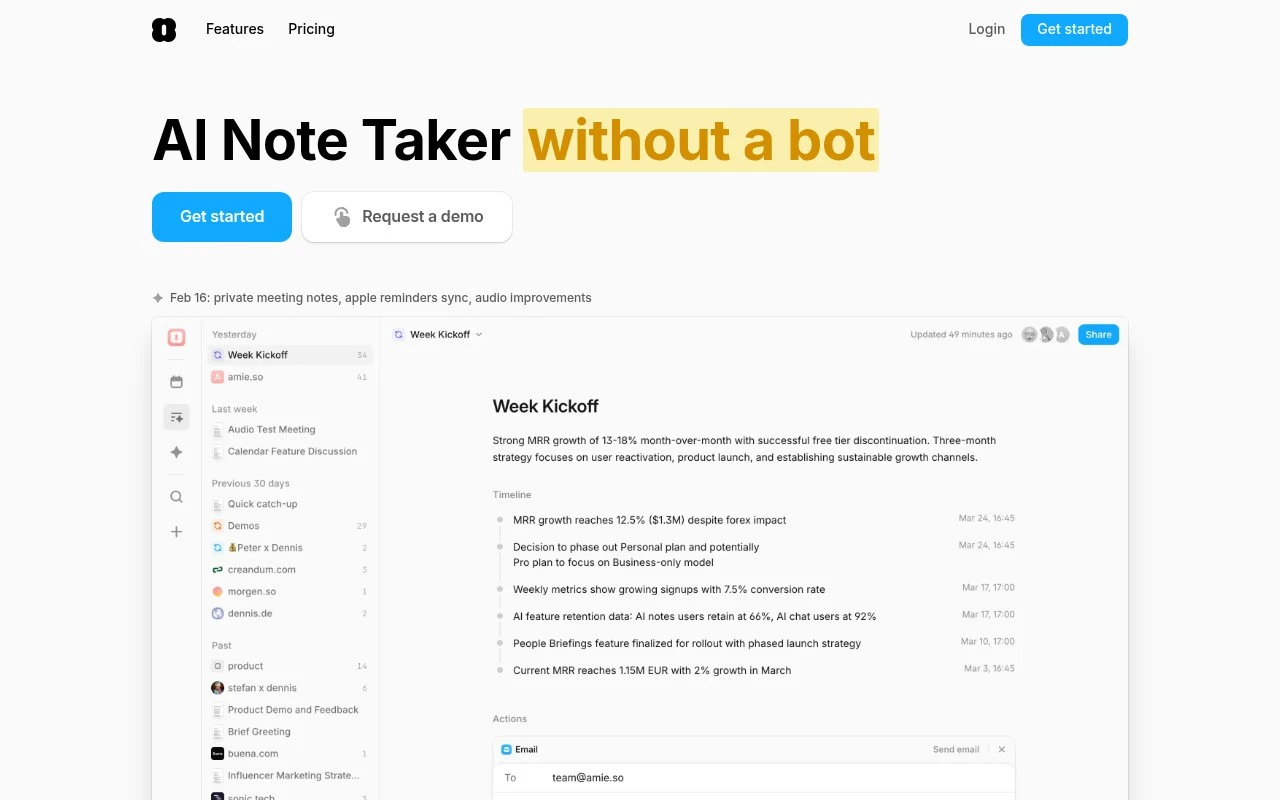
Amie is an AI note taker and meeting workflow assistant for people and teams that want meetings to produce clear decisions, useful records, and completed follow-ups. It is built around the idea that meeting notes are only valuable when they connect to the work that happens afterward, from tasks and calendar changes to emails, CRM updates, shared pages, and tickets. Unlike many meeting assistants, the recording experience is designed to stay out of the call itself. The tool records meetings locally, so there is no visible bot joining the conversation, which can make discussions feel more natural and reduce the friction of introducing an AI assistant into sensitive or client-facing meetings. That approach is especially relevant for teams that care about privacy, meeting etiquette, and keeping the call experience familiar. At its core, the platform captures the conversation and turns it into structured meeting notes, summaries, decisions, and action items. Audio summarization is only part of the product story, because the aim is to understand what happened in context rather than simply produce a transcript. Users can add private notes before or during meetings, giving the assistant extra background that helps it interpret priorities, names, projects, or next steps more accurately. For founders, operators, sales teams, recruiters, consultants, and managers, Amie is best at converting meeting context into practical follow-through. A conversation can become a task list, a draft email, a customer record update, a project page, or a ticket without forcing the user to manually reconstruct what was said. This makes it useful for people whose day is filled with calls and whose real bottleneck is the administrative work that follows each one. Search across meeting history gives the product a second role as an organizational memory. Instead of digging through old notes or asking colleagues to recall a decision, users can search or ask questions across past conversations. This can help with finding commitments, understanding why a decision was made, checking what a customer requested, or recovering details from recurring meetings. The workflow layer is where the tool moves beyond traditional transcription. Task management, calendar automation, email writing, CRM automation, shared documentation, and issue tracking are treated as natural extensions of the meeting record. The meeting becomes a source of truth that can push work into the systems where teams already operate, reducing the gap between discussion and execution. A practical strength of the product is its fit for both individual productivity and team coordination. An individual user can rely on it to remember details, prepare follow-ups, and avoid losing commitments. A team can use the same meeting context to align on ownership, keep customer information current, and make recurring discussions more actionable over time. Amie positions itself as a meeting assistant for the full lifecycle of a conversation, from capture to context to action. Its value is not limited to better notes, although that is the starting point. The broader promise is a calmer meeting workflow where the assistant records discreetly, summarizes intelligently, remembers past discussions, and helps move the next steps into the tools where real work gets done.

Use cases

Best for

Meeting Notes

Amie records meetings locally and generates summaries and action items you can search or ask questions across later.

Task Management

It turns meeting action items into follow-up tasks and can trigger calendar changes, CRM updates, tickets, or shared pages.

Email Writing

It drafts follow-up emails from meeting context and your private notes, so messages reflect decisions and next steps.

ANALYSIS

Strengths & limitations

Strengths
  • Bot-free local recording keeps meetings free of an extra attendee, which suits customer-facing and sensitive conversations where a visible recording bot can be disruptive.
  • Meeting summaries, action items, and private notes work together as context, which helps busy teams turn conversations into usable follow-up without rewriting notes manually.
  • Search and question answering across meeting history make past decisions easier to retrieve, which benefits teams with recurring customer, recruiting, sales, or project calls.

Limitations
  • Less suitable for teams that only need basic transcription because Amie is built around broader meeting workflows and follow-up automation.
  • Follow-up automation depends on connected calendars, CRMs, task tools, or ticketing systems, so teams with fragmented or unsupported workflows will get less value from it.
  • The freemium model is less suitable for heavy team-wide use if free limits are exceeded, because broader usage and advanced workflow needs typically push teams toward paid access.

Evaluation

FYAI score breakdown

Our structured evaluation across five key criteria

7.6 / 10

Overall score

Based on 4 reviews + FYAI product analysis

  • Ease of use7.1 / 10
  • Features7.4 / 10
  • Pricing7.3 / 10
  • Integrations8.2 / 10
  • Support8.3 / 10

What users say

Findings from public reviews, documentation and community sources.

  • Ease of use

    In a Reddit launch discussion about Amie, a user wrote that they had “run into so many bugs.”

  • Features

    Amie’s website lists “AI summaries,” “Action items,” bot-free meeting recording, and AI chat/actions. Amie’s website also describes workflow follow-ups such as drafting emails and creating Linear tickets.

  • Pricing

    Amie’s pricing page shows a 7-day free trial, Pro and Business tiers, and a 20% yearly discount. Amie’s pricing page lists plan differences such as unlimited calendars/todos/meeting notes and Business features including custom branding, advanced integrations, audit log, and customer success.

  • Integrations

    Amie’s website lists Google and Apple Calendar, Gmail, Slack, Notion, HubSpot, Pipedrive, and Linear integrations. Amie’s website also says meetings are supported across Zoom, Google Meet, Slack Huddle, and Microsoft Teams.

  • Support

    Amie’s docs cover “Getting Started,” installation across Mac/Windows/iOS/web, integration tutorials, feature guides, and account/billing topics. Amie’s docs describe a “Quick Start” for getting users running “in under 5 minutes.”

Who is this for?

Best for teams that want meeting notes connected to follow-up work, Amie’s website lists “AI summaries,” “Action items,” bot-free meeting recording, and workflows such as drafting emails and creating Linear tickets. Less suited to users with low tolerance for bugs, in a Reddit launch discussion, a user wrote that they had “run into so many bugs,” which could mean routine planning requires troubleshooting.

PRODUCT PREVIEW

Feature highlights

Local meeting capture

Record meetings without a bot joining your call.

Smart summaries & tasks

Get action items and decisions tailored to your meeting context.

Search meeting history

Ask questions and find answers across all past meetings.

COMPARE

Discover curated alternatives worth comparing

Compare similar AI tools based on features, pricing and use cases

7.8/ 10Based on 31 reviews

Wudpecker

Meeting NotesSummarization
Turns recordings into notes, summaries, action items, and Q&A
Best for:
Knowledge workers
Pricing
Freemium

9.0/ 10Based on 1,589 reviews

Toggl Track

Time & Habit Tracking
Tracks time, automates activity capture, and reports team data
Best for:
Operations teams
Pricing
Freemium

8.5/ 10Based on 2,648 reviews

Todoist

Task & Project Management
Captures tasks, organizes schedules, and clarifies action plans
Best for:
Knowledge workers
Pricing
Freemium

Turn every meeting into clear next steps and follow-through. Start using Amie today and stay on top of work without scrambling for notes.

FAQ

Frequently asked
questions

Everything you need to know about this AI tool,
its features, pricing, use cases, and limitations.

Who is Amie best suited for?
Amie is best suited for professionals and teams that turn frequent meetings into follow-up work. It fits customer-facing, sales, founder, operations, recruiting, and project teams that need meeting notes, action items, CRM updates, task planning, email drafts, and calendar changes from conversation context.
Is Amie free, and what do paid plans add?
Amie uses a freemium model, so users can start on a free plan and upgrade for broader usage or team needs. Buyers should check Amie’s current pricing page for the latest plan limits around recording, transcription, AI features, integrations, collaboration, and workspace administration.
How does Amie compare with other AI meeting note takers?
Amie is more workflow-oriented than many basic AI meeting note tools. Its strengths are bot-free recording, summaries, action items, AI chat over meeting history, and follow-up actions across tools such as Slack, Notion, HubSpot, Pipedrive, Linear, calendars, and Gmail. The best choice depends on team size, budget, and workflow depth.
How much setup does Amie require?
Amie may be more than a team needs if the only requirement is simple meeting summaries. Its site emphasizes Mac-specific interface elements, so buyers should verify the experience on their preferred platforms. Some workflow areas and integrations are also marked as coming soon, including Attio, Personio, Ashby, and Greenhouse.
What should teams check about privacy and compliance before using Amie?
Teams should review how Amie records, transcribes, stores, shares, and exports meeting data before using it for sensitive conversations. Important checks include participant consent, retention settings, access controls, connected app permissions, CRM or recruiting data exposure, and Amie’s current security and compliance documentation.