Curated ToolThis tool is part of our curated AI directory. We only include tools that meet our standards for relevance, usability and real-world value.

Airtable

Builds databases and apps with AI to analyze records and run workflows

Task & Project Management
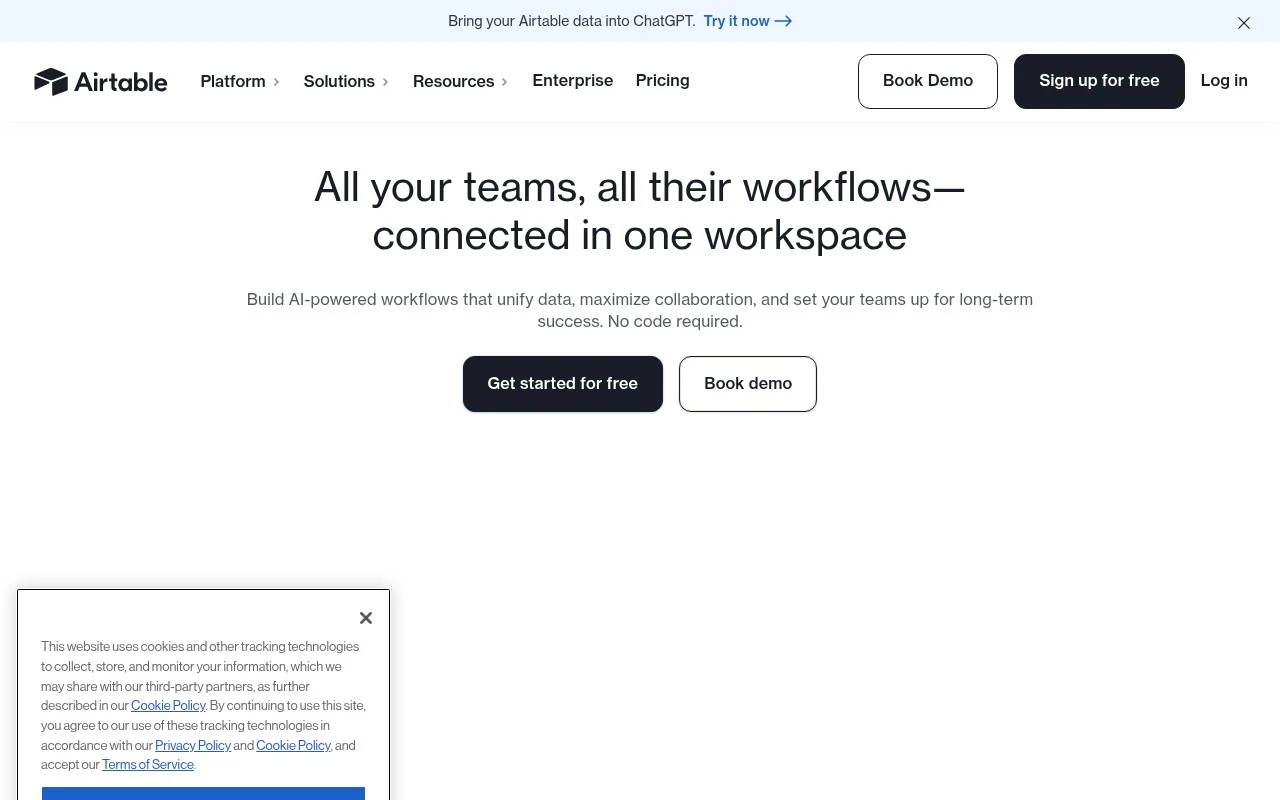
Airtable is a no-code work management and app-building platform centered on structured, collaborative data. Teams use it to create custom workflow apps, manage operational records, automate manual tasks, and add AI capabilities across business processes. Its current positioning emphasizes enterprise-ready AI workflows, apps, and agents, with administration, permissions, security, compliance, and scalability features for larger organizations.

FYAI Score

8.6 / 10

Based on 3.279 reviews

Pricing:

Freemium

Best for:

Ops and program teams building custom workflows on structured data

Score Breakdown

  • Ease of use9.2 / 10
  • Features9.3 / 10
  • Pricing7.8 / 10
  • Integrations8.2 / 10
  • Support7.7 / 10

PRODUCT PREVIEW

What this AI tool does

Airtable is a flexible workspace for organizing information and coordinating work in one place. It combines the structure of a database with the familiarity of a spreadsheet, making it easier to track projects, manage content, and maintain shared records without needing to write code. Teams often use it to collect data through forms, connect related records, and view the same information in different ways depending on the task. It can also integrate with other tools and support basic automation, which helps reduce manual updates and keep workflows consistent as projects change.

Use cases

Best for

App Generation

Build internal apps by turning Airtable tables into forms, views, and interfaces with automations and permissions.

Project Management

Manage projects by tracking milestones, owners, and status in linked tables with timeline and Kanban views.

Task Management

Manage tasks by assigning records, setting due dates, and triggering reminders via Airtable Automations.

ANALYSIS

Strengths & limitations

Strengths
  • Combines structured data management, collaboration, app building, automation, and AI features in one workspace.
  • Designed for non-technical builders, allowing teams to create workflow apps without writing code.
  • Offers enterprise-oriented controls such as permissions, admin roles, compliance support, auditability, and data residency options.
Limitations
  • The official homepage emphasizes broad AI and enterprise positioning more than detailed product mechanics, so some implementation details may require further review.
  • Teams with simple spreadsheet needs may find a full app-building and workflow platform more than they need.
  • Advanced governance, scaling, and AI deployment may still require careful setup by operations, IT, or administrators.

Evaluation

FYAI score breakdown

Our structured evaluation across five key criteria

8.6 / 10

Overall score

Based on 3.279 reviews

  • Ease of use9.2 / 10
  • Features9.3 / 10
  • Pricing7.8 / 10
  • Integrations8.2 / 10
  • Support7.7 / 10

What users say

Findings from public reviews, documentation and community sources.

  • Ease of use

    G2 reports 4.6/5 across 3,279 reviews and says users praise Airtable for “ease of use and flexibility” and managing workflows “without needing technical expertise.” Capterra’s snippet says Airtable is “very easy to use” and combines spreadsheet simplicity with database power.

  • Features

    Airtable’s own features page describes a no-code operations platform with “custom interfaces, automations, and agents,” an AI builder, and a relational database foundation. Airtable’s features page says HyperDB scales “up to 100M records in a single table.”

  • Pricing

    Airtable’s pricing page lists a Free plan, Team at “$20/user/month when billed annually,” Business at “$45/user/month when billed annually,” and custom Enterprise Scale pricing.

  • Integrations

    Airtable’s features page highlights integrations with “Jira, Salesforce, and Tableau.” Airtable’s pricing FAQ references API limits, indicating programmable access.

  • Support

    Airtable’s pricing page includes “Billing FAQ,” “Contact Sales,” payment options, usage-limit explanations, and enterprise-plan guidance.

Who is this for?

Best for teams that need no-code workflow databases, G2 says users manage workflows “without needing technical expertise,” and Airtable’s features page lists custom interfaces, automations, and a relational database foundation. Less suited to teams that only need inexpensive general productivity seats, Airtable’s pricing page lists Team at “$20/user/month when billed annually” and Business at “$45/user/month when billed annually,” so expanding seats adds per-user cost.

PRODUCT PREVIEW

Feature highlights

No-code apps

Turn tables into workflow apps with forms, views, and interfaces.

Automations

Trigger actions, approvals, and notifications to cut manual work.

Enterprise controls

Granular permissions, admin tools, and compliance-ready security.

COMPARE

Discover curated alternatives worth comparing

Compare similar AI tools based on features, pricing and use cases

7.8/ 10Based on 31 reviews

Wudpecker

Meeting NotesSummarization
Turns meeting recordings into notes, summaries, and action items
Best for:
Knowledge workers
Pricing
Freemium

9.0/ 10Based on 1.589 reviews

Toggl Track

Time & Habit Tracking
Tracks time with automatic activity detection and reporting.
Best for:
Operations teams
Pricing
Freemium

8.5/ 10Based on 2.648 reviews

Todoist

Task & Project Management
Organize, schedule, and share tasks with AI-assisted planning
Best for:
Knowledge workers
Pricing
Freemium

Bring order to complex work with a system your team actually uses. Start building workflows that stay in sync, scale fast, and keep everyone aligned in Airtable.

FAQ

Frequently asked
questions

Everything you need to know about this AI tool,
its features, pricing, use cases, and limitations.

When is Airtable a good fit for AI-assisted workflows, and when should I pick something else?
Airtable is a strong fit when your work is structured (records, fields, statuses) and you want AI to summarize project updates, triage feedback, flag risks, or draft/review content tied to operational data. It’s also useful if you need automations and integrations to let AI-driven workflows read/write records. If your team mainly needs a simple task list, or you require deep domain-specific features (e.g., full CRM or ITSM), a specialized system may be a better primary tool.
What are the practical differences between Airtable’s free plan and paid plans for AI and automation?
Free plans are typically fine for testing a base and basic collaboration, but you’ll hit limits around advanced features like higher automation capacity, advanced permissions, and enterprise controls. AI capabilities and larger-scale usage are generally tied to paid tiers or add-ons, depending on your workspace setup. If AI is central to your workflow, confirm what’s included in your plan and whether usage is capped.
How does Airtable compare with Notion, Smartsheet, and Google Sheets for AI-enabled operations work?
Compared with Google Sheets, Airtable is usually better for relational data, permissions, and building app-like interfaces and automations without heavy scripting. Versus Notion, Airtable tends to be stronger for structured operational databases and workflow automation, while Notion often wins for docs and knowledge management. Against Smartsheet, Airtable is typically more flexible for custom data models and app building, while Smartsheet can feel more familiar for traditional project tracking.
How quickly can a team get value from Airtable, and what onboarding effort should I expect?
Airtable’s flexibility can lead to inconsistent schemas across bases unless you enforce standards, which can reduce reporting quality and automation reliability. It may not fully replace specialized systems of record that need deep workflows, audit trails, or domain-specific objects. Cost and complexity can rise as you add more automations, integrations, and enterprise controls.
What should I check about data privacy, security, and compliance when using Airtable AI?
Review how Airtable handles data used for AI features, including whether content is retained, used for model training, or shared with subprocessors, and what controls exist to limit exposure. For regulated environments, validate enterprise capabilities such as SSO, granular permissions, audit logs, data residency options (if needed), and contractual terms like DPA/SOC 2. Also confirm how automations and integrations move data between Airtable and third-party services.