Curated ToolThis tool is part of our curated AI directory. We only include tools that meet our standards for relevance, usability and real-world value.

Gong

Gong is a revenue intelligence platform that captures and analyzes sales calls, meetings, emails, and CRM activity to surface deal insights, coaching opportunities, and pipeline visibility for sales teams.
Sales & OutreachCRM & Segmentation

FYAI Score

8.4 / 10

Based on 6,678 reviews

Pricing:

Paid

Best for:

Revenue teams improving sales execution, coaching, and forecasting

Score Breakdown

  • Ease of use8.0 / 10
  • Features9.4 / 10
  • Pricing7.1 / 10
  • Integrations9.0 / 10
  • Support8.5 / 10

PRODUCT PREVIEW

What this AI tool does

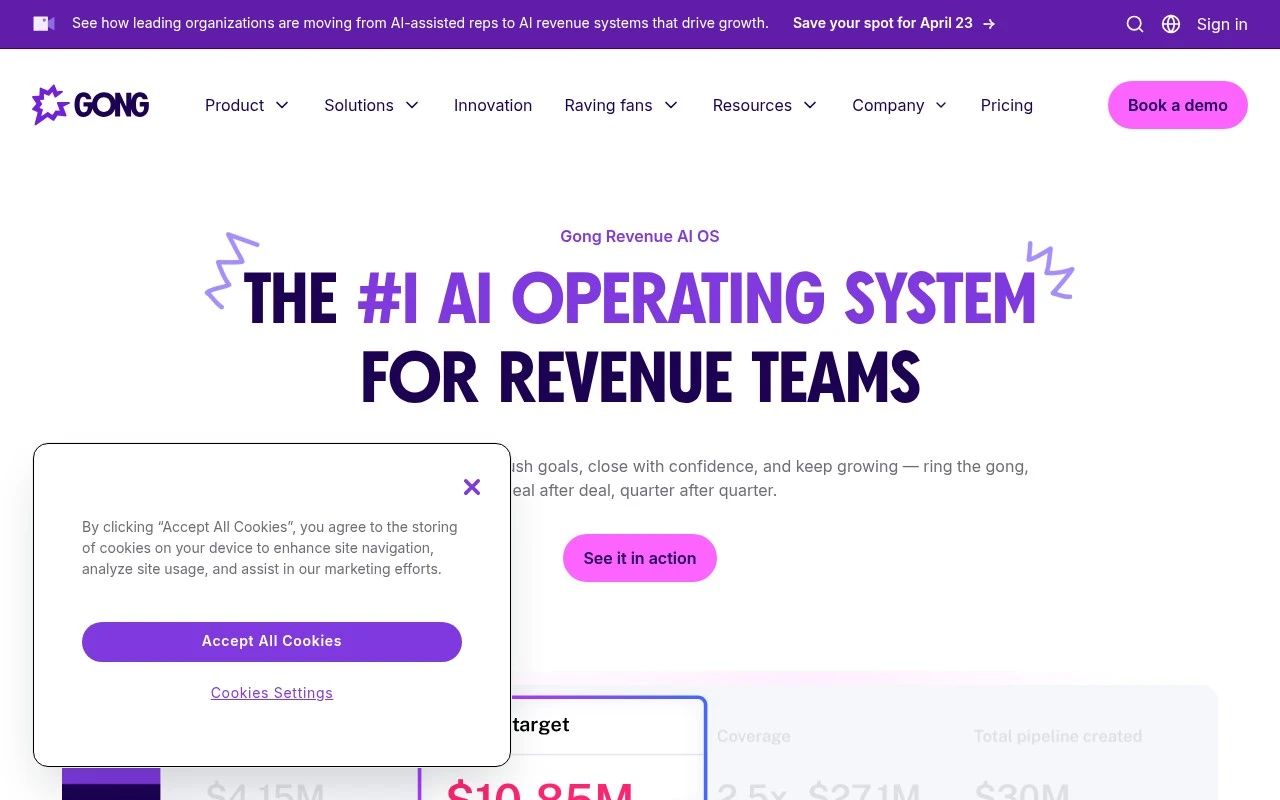
Gong is a Revenue AI OS for revenue teams that turns customer interactions, CRM activity, and go-to-market data into sales execution, revenue forecasting, coaching, and workflow automation. Gong is built for sales, customer success, RevOps, and frontline managers who need a clearer view of what is happening across deals, pipelines, and customer conversations. For sales teams, the platform acts as a system of intelligence on top of the tools they already use. Instead of relying only on rep notes or CRM fields, it captures and analyzes calls, emails, meetings, deal records, and account activity to create a more complete picture of buyer engagement. That makes Gong for sales teams especially useful when leaders want to understand not just outcomes, but the behaviors and conversations that led to them. At its core is a revenue data graph that connects people, accounts, opportunities, activities, and conversation signals. This structure gives the platform context that a standalone call recorder or dashboard would not have. Deal analysis becomes more precise because the system can connect what buyers said, what changed in the CRM, how stakeholders engaged, and whether next steps are actually moving forward. Rather than positioning AI as a generic assistant, Gong applies AI to the daily work of revenue teams. Its AI agents and applications help surface risks, recommend actions, summarize customer interactions, and reduce the manual work that often slows sellers down. The result is a platform that supports sales execution while also improving the quality of data used for planning and management. Managers use the platform to coach from real customer evidence instead of anecdotal feedback. Conversation intelligence can show how reps handle objections, position value, discuss competitors, or create urgency. In a sales enablement context, this helps teams turn high-performing behaviors into repeatable playbooks and gives new hires more concrete examples of what effective selling looks like. Revenue forecasting is another major part of the Gong story. By analyzing deal activity, buyer engagement, pipeline changes, and historical patterns, the platform helps teams identify which opportunities are likely to close, which are at risk, and where forecasts may be overly optimistic. This gives sales leaders and RevOps teams a more evidence-based way to run forecast calls and inspect pipeline health. Pipeline automation and CRM automation are also central to how the platform is used. Gong can help reduce administrative burden by capturing interaction data, updating workflows, prompting follow-ups, and bringing important deal signals into the systems teams already depend on. This is particularly valuable in revenue organizations where incomplete CRM data can weaken forecasts, handoffs, and management visibility. Purpose-built applications extend the system into specific revenue workflows. Gong Engage supports outbound and seller execution, Gong Forecast focuses on forecast management and pipeline visibility, and Gong Enable connects sales enablement with real performance data. Together, these products make the platform feel less like a single-point tool and more like an operating layer for revenue work. The overall character of Gong is analytical, operational, and deeply tied to the realities of modern B2B selling. It is best suited to teams that have enough customer interaction volume and revenue complexity to benefit from AI-driven visibility across conversations, deals, and workflows. For organizations trying to make sales execution more consistent, forecasts more trustworthy, and coaching more evidence-based, Gong provides a unified way to turn revenue data into action.

Use cases

Best for

Deal Analysis

Analyzes call transcripts, emails, and CRM fields to surface deal risks, next steps, and stakeholder gaps.

Sales Enablement

Gong captures and indexes customer conversations so reps can find winning talk tracks and share clips for coaching.

Revenue Forecasting

Uses pipeline changes and deal activity signals to generate forecast rollups and highlight commits at risk.

ANALYSIS

Strengths & limitations

Strengths
  • Best suited to mid-market and enterprise revenue teams because it turns sales calls, emails, meetings, and CRM activity into a shared view of pipeline health and deal risk.
  • Useful for sales leaders and enablement teams because conversation intelligence and coaching workflows help standardize rep feedback and improve execution across teams.
  • Strong fit for revenue operations because forecasting, engagement, and automation features sit in one platform rather than requiring separate point tools for each workflow.
Limitations
  • Less suitable for very small sales teams because Gong is a paid revenue platform whose benefits depend on broad adoption across reps, managers, and operations.
  • Requires meaningful setup and governance because it depends on connecting customer interactions, CRM data, and GTM systems to produce useful insights and workflows.
  • Not ideal for teams looking for a general marketing automation or content creation tool because Gong is focused on revenue execution, sales engagement, forecasting, and coaching workflows.

Evaluation

FYAI score breakdown

Our structured evaluation across five key criteria

8.4 / 10

Overall score

Based on 6,678 reviews

  • Ease of use8.0 / 10
  • Features9.4 / 10
  • Pricing7.1 / 10
  • Integrations9.0 / 10
  • Support8.5 / 10

What users say

Findings from public reviews, documentation and community sources.

  • Ease of use

    G2 shows Gong rated 4.7/5 across 6,678 verified reviews. Gong is positioned as broadly usable across GTM teams, while its enterprise revenue-AI scope suggests more onboarding than lightweight marketing tools.

  • Features

    Gong’s own page describes a Revenue AI OS covering interaction capture and analysis, workflow automation, Gong Engage, and Gong Forecast. Gong’s own page also references Gong Enable, Gong Agents, and a Revenue Graph.

  • Pricing

    Gong’s pricing page states that pricing “depends on a few factors,” with licenses priced per user plus a platform fee. Gong’s pricing page asks buyers to request a customized proposal rather than using a public pricing table with public price points and packaged tiers.

  • Integrations

    Gong Collective describes an integration ecosystem with “robust integrations and bespoke services,” plus options to “Build an integration” and partner solutions listed. Gong’s pricing page states customers can integrate their existing tech stack for free.

  • Support

    SoftwareAdvice shows Gong rated 4.8/5 across 561 reviews. SoftwareAdvice users highlight practical value such as calls being analyzed for engagement and talk ratio.

Who is this for?

Best for GTM teams that want revenue workflows tied to captured interactions, Gong’s own page describes a Revenue AI OS covering interaction capture and analysis, workflow automation, Gong Engage, and Gong Forecast. Less suited to buyers who need a transparent self-serve pricing table, Gong’s pricing page says pricing “depends on a few factors,” uses per-user licenses plus a platform fee, and asks buyers to request a customized proposal.

PRODUCT PREVIEW

Feature highlights

Call intelligence

Capture and analyze calls to surface risks, next steps, and insights.

Forecast accuracy

Turn deal signals into reliable forecasts and pipeline visibility.

Workflow automation

Automate follow-ups, CRM updates, and playbooks across the GTM team.

COMPARE

Discover curated alternatives worth comparing

Compare similar AI tools based on features, pricing and use cases

7.8/ 10Based on 31 reviews

Wudpecker

Meeting NotesSummarization
Turns recordings into notes, summaries, action items, and Q&A
Best for:
Knowledge workers
Pricing
Freemium

9.0/ 10Based on 1,589 reviews

Toggl Track

Time & Habit Tracking
Tracks time, automates activity capture, and reports team data
Best for:
Operations teams
Pricing
Freemium

8.5/ 10Based on 2,648 reviews

Todoist

Task & Project Management
Captures tasks, organizes schedules, and clarifies action plans
Best for:
Knowledge workers
Pricing
Freemium

See what top reps do differently. Use Gong to turn every customer conversation into coaching insights and more predictable revenue.

FAQ

Frequently asked
questions

Everything you need to know about this AI tool,
its features, pricing, use cases, and limitations.

Who is Gong best suited for?
Gong is best suited for mid-market and enterprise revenue teams that need to analyze sales conversations, manage pipeline risk, improve forecasting, coach reps, and automate follow-up workflows. It is a stronger fit for sales, revenue operations, enablement, and customer-facing GTM teams than for general meeting productivity or non-sales collaboration.
Is Gong free or paid?
Gong is a paid revenue AI platform, not a free general-purpose meeting notes tool. Buyers should evaluate pricing in relation to team size, sales process complexity, CRM requirements, forecasting needs, and expected adoption across sales, revenue operations, enablement, and customer-facing teams.
What should I compare Gong against when looking at alternatives?
Gong should be compared with tools that support conversation intelligence, sales enablement, revenue forecasting, CRM automation, deal analysis, and pipeline management. The right alternative depends on whether the team mainly needs call insights, coaching, forecasting accuracy, engagement workflows, or a broader revenue intelligence platform.
How much setup effort does Gong require?
Gong is primarily built for revenue organizations, so it may be more platform than smaller teams or non-GTM departments need. Its AI insights depend on having enough customer interactions and connected revenue data, and buyers should consider implementation effort, user adoption, governance, and whether the platform breadth matches their actual sales process.
What privacy and compliance questions should buyers ask about Gong?
Buyers should evaluate how Gong captures, stores, analyzes, and shares customer interaction data, especially call recordings, transcripts, CRM fields, and forecasting information. Revenue teams should confirm permission controls, retention settings, consent workflows, integration access, regional data requirements, and current compliance documentation directly with Gong before deployment.