Curated ToolThis tool is part of our curated AI directory. We only include tools that meet our standards for relevance, usability and real-world value.

Zoho

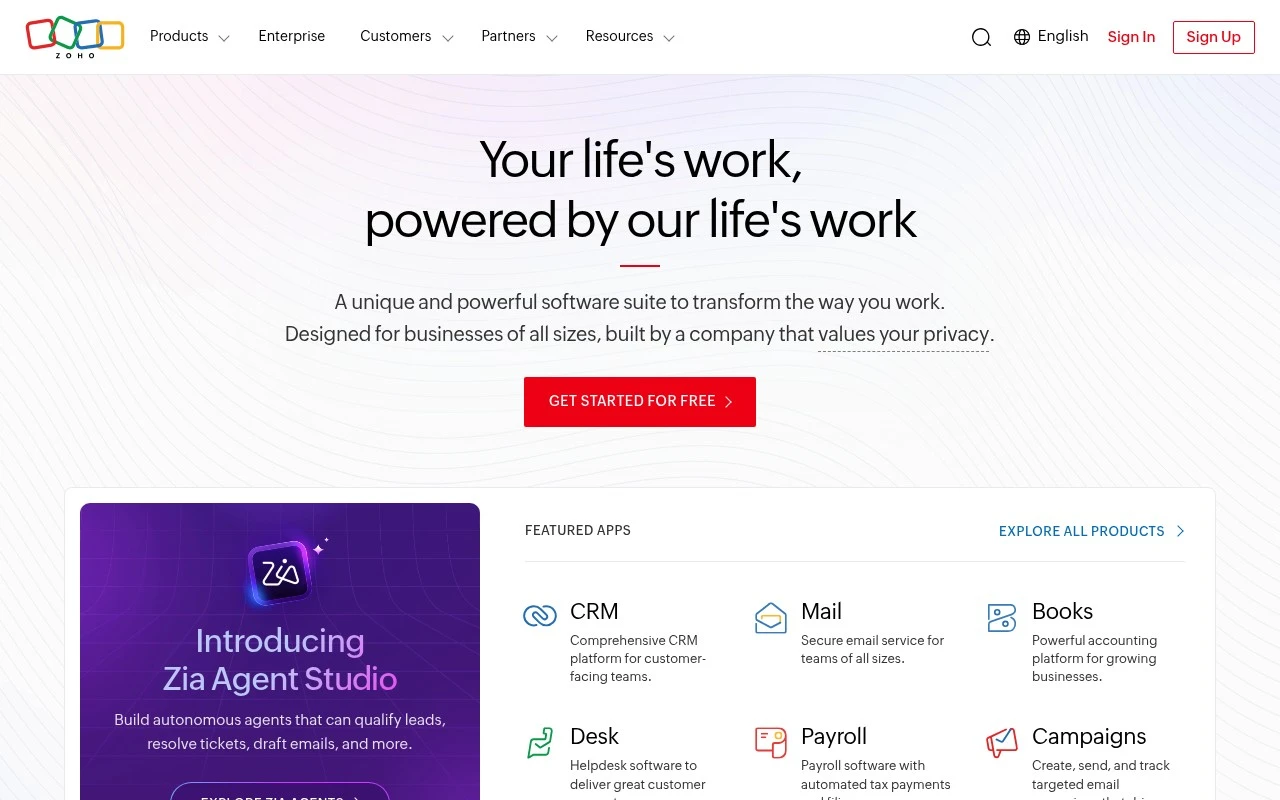
Zoho is a cloud-based business software suite that provides applications for CRM, email, accounting, project management, HR, and customer support. It helps organizations manage sales pipelines, communications, finances, and internal operations from a unified platform.
Customer Support Bots

FYAI Score

7.8 / 10

Based on 31,824 reviews

Pricing:

Freemium

Best for:

SMBs needing one suite for CRM, finance, HR, and support

Score Breakdown

  • Ease of use7.4 / 10
  • Features7.1 / 10
  • Pricing8.4 / 10
  • Integrations8.9 / 10
  • Support7.6 / 10

PRODUCT PREVIEW

What this AI tool does

Zoho is a privacy-focused cloud business software ecosystem for organizations that want CRM, finance, HR, support, collaboration, analytics, and operations tools connected in one place. Rather than serving a single department, it is built as a broad operating layer for running many parts of a business through connected applications. Instead of centering on one flagship product, the platform brings together more than 55 apps that cover common business needs from first customer contact to back-office administration. Zoho is designed for startups, small businesses, mid-market teams, and distributed organizations that prefer an integrated suite over a patchwork of unrelated tools. For sales and revenue teams, the CRM side of the ecosystem is one of its best-known strengths. Zoho supports lead scoring, pipeline automation, deal analysis, crm automation, and report generation, helping teams track prospects, manage accounts, and understand which opportunities are moving forward. The value is not only in storing customer data, but in connecting that data with email, marketing, support, and finance activity. Marketing, service, and customer success teams can use the same ecosystem to coordinate outreach and support. The platform can help users create email campaigns, run marketing automation, manage tickets through customer support automation, and keep customer context visible across departments. When these workflows are connected, a support interaction, a campaign response, or a sales update can become part of a shared customer history rather than a separate record in another system. Finance and operations are also central to the product story. Tools such as Zoho Books bring invoicing, bookkeeping, expense tracking, and financial reporting into the wider business environment. That makes it useful for teams that want customer records, billing activity, and operational data to inform one another without constant manual reconciliation. Inside the organization, HR and productivity apps extend the suite beyond customer-facing work. Zoho People supports hr automation, while project management and task management tools help teams plan work, assign responsibilities, and follow progress. Mail, documents, meetings, and collaboration apps give the ecosystem a workplace layer, so teams can communicate and execute without leaving the broader platform. Analytics gives the suite a more strategic dimension. Data visualization, business intelligence, dashboard generation, and report generation help teams turn activity across sales, finance, support, and operations into usable insight. For leaders, the appeal is the ability to see patterns across departments rather than relying only on isolated app-level metrics. Automation is one of the main reasons the suite works as an ecosystem rather than a collection of separate apps. Workflow automation and integration automation can connect triggers, approvals, alerts, and data movement across multiple business processes. Zoho is best at bringing everyday business workflows into a connected environment where information can move from one team to another with less manual handoff. Zoho One represents the fullest version of that idea, packaging the broader suite as a single platform for managing an entire business. It is especially relevant for organizations that want standardized tools across departments while still giving each team software suited to its function. The result is a system that can start with one need, such as CRM or invoicing, and expand as the company’s operational complexity grows. A defining part of the brand is its emphasis on privacy and long-term control of business data. In a market where many cloud tools rely heavily on advertising models or fragmented third-party integrations, the platform positions itself around ownership, security, and breadth. Zoho is not just a CRM or an accounting app, it is a connected business software environment built for companies that want many essential systems to work together under one roof.

Use cases

Best for

CRM Automation

Zoho CRM automates lead capture, deal stages, and follow-up workflows using rules, assignments, and scheduled actions.

Invoicing

Zoho Books creates invoices from contacts and items, applies taxes, and tracks payment status with reminders and reconciliation.

Project Management

Zoho Projects plans work with tasks, milestones, and dependencies, and tracks progress with timelines and timesheets.

ANALYSIS

Strengths & limitations

Strengths
  • Best suited to organisations that want one vendor for CRM, email, finance, HR and support, because Zoho’s 55+ app ecosystem can reduce the need to stitch together many separate tools.
  • Strong fit for privacy-conscious businesses, because Zoho positions its cloud suite around privacy-focused business operations.
  • Good option for companies that expect to grow across departments, because Zoho One and individual apps let teams start with selected tools and expand into a wider operating platform.

Limitations
  • Less suitable for teams shopping for a dedicated conversational AI platform, because Zoho is primarily a broad business software suite rather than a single-purpose AI tool.
  • Less suitable for teams that only need a lightweight point solution, because the breadth of Zoho’s ecosystem can add evaluation, configuration and administration overhead.
  • Freemium pricing can become limiting for expanding teams, because broader usage across apps, users and departments typically moves buyers toward paid subscriptions.

Evaluation

FYAI score breakdown

Our structured evaluation across five key criteria

7.8 / 10

Overall score

Based on 31,824 reviews

  • Ease of use7.4 / 10
  • Features7.1 / 10
  • Pricing8.4 / 10
  • Integrations8.9 / 10
  • Support7.6 / 10

What users say

Findings from public reviews, documentation and community sources.

  • Ease of use

    G2 review coverage for Zoho CRM reports that users find it “easy to use,” and the G2 snippet says Zoho CRM “helps organize customer data efficiently” and automates repetitive tasks.

  • Features

    Zoho’s own page describes a “ruim 55 apps” business suite including CRM, Mail, Books, and Zoho One as a unified operating system for business.

  • Pricing

    Zoho’s CRM pricing page lists a “Free · 3 users” plan plus Standard and Professional tiers with free trials.

  • Integrations

    Zoho’s CRM integrations page states “1,100+ ready-to-use app integration” across marketing, sales, finance, booking, telephony, and communications.

  • Support

    Zoho’s own page says its enterprise offering includes “professional services, infrastructure, support and security.”

Who is this for?

Best for organizations that want conversational workflows connected to a broader business suite, Zoho’s own page describes a “ruim 55 apps” suite including CRM, Mail, Books, and Zoho One. Zoho’s CRM integrations page also states “1,100+ ready-to-use app integration,” which fits CRM-centered workflows across marketing, sales, finance, booking, telephony, and communications. Less suited to teams evaluating conversational-AI-specific bot design, NLP, or channel automation depth, Zoho’s supplied page describes an end-to-end business suite rather than detailing those capabilities.

PRODUCT PREVIEW

Feature highlights

55+ Connected Apps

Run sales, finance, HR, and support with shared data across apps.

CRM to Close Loop

Track leads to deals and follow-ups with a unified customer view.

Privacy-First Cloud

Built with strong privacy controls to keep business data protected.

COMPARE

Discover curated alternatives worth comparing

Compare similar AI tools based on features, pricing and use cases

8.1/ 10FYAI score

Helply

Customer Support BotsKnowledge Base Bots
Answers tickets, drafts replies, flags gaps and churn risks
Best for:
Customer support teams
Pricing
Freemium

8.7/ 10Based on 7,757 reviews

Zoho Desk

Customer Support BotsKnowledge Base Bots
Handles routine tickets, flags issues, and drafts replies
Best for:
Customer support teams
Pricing
Freemium

8.3/ 10Based on 2 reviews

Zendesk

Customer Support BotsChatbots
Automates support, assists agents, and analyzes tickets
Best for:
Customer support teams
Pricing
Freemium

Start responding faster and engaging customers 24/7 with zoho. See why growing teams use it to convert more chats into loyal customers.

FAQ

Frequently asked
questions

Everything you need to know about this AI tool,
its features, pricing, use cases, and limitations.

Who is Zoho best suited for?
Zoho is best suited for businesses that want multiple operational tools in one cloud software ecosystem. It fits teams managing CRM, email, accounting, HR, helpdesk, and related workflows, especially when separate departmental systems are becoming hard to coordinate.
Does Zoho have a free plan, and when would I need to pay?
Zoho follows a freemium pricing model, so some users can start without paying. Paid plans are typically relevant when a business needs broader app access, higher usage capacity, more users, advanced administration, or a more complete suite such as an all-in-one operating environment.
When should I consider Zoho instead of other business software tools?
Zoho is worth considering when breadth and system consolidation matter more than choosing separate specialist tools for every department. Compared with narrower alternatives, its main advantage is covering CRM, finance, HR, support, email, and operations under one vendor ecosystem.
How long does it usually take to set up Zoho?
Zoho’s main trade-off is that its broad suite can be more than a team needs if the requirement is only one narrow tool. Buyers evaluating it for conversational AI should also verify the specific AI capabilities they need, because Zoho is primarily positioned as a business software suite.
How should I evaluate Zoho for privacy and compliance?
Zoho states that it does not sell user data and does not rely on an advertising-based business model. Buyers should still review current privacy terms, data residency options, security controls, compliance certifications, access management, and contractual requirements before using it for sensitive business data.