Curated ToolThis tool is part of our curated AI directory. We only include tools that meet our standards for relevance, usability and real-world value.

Zendesk

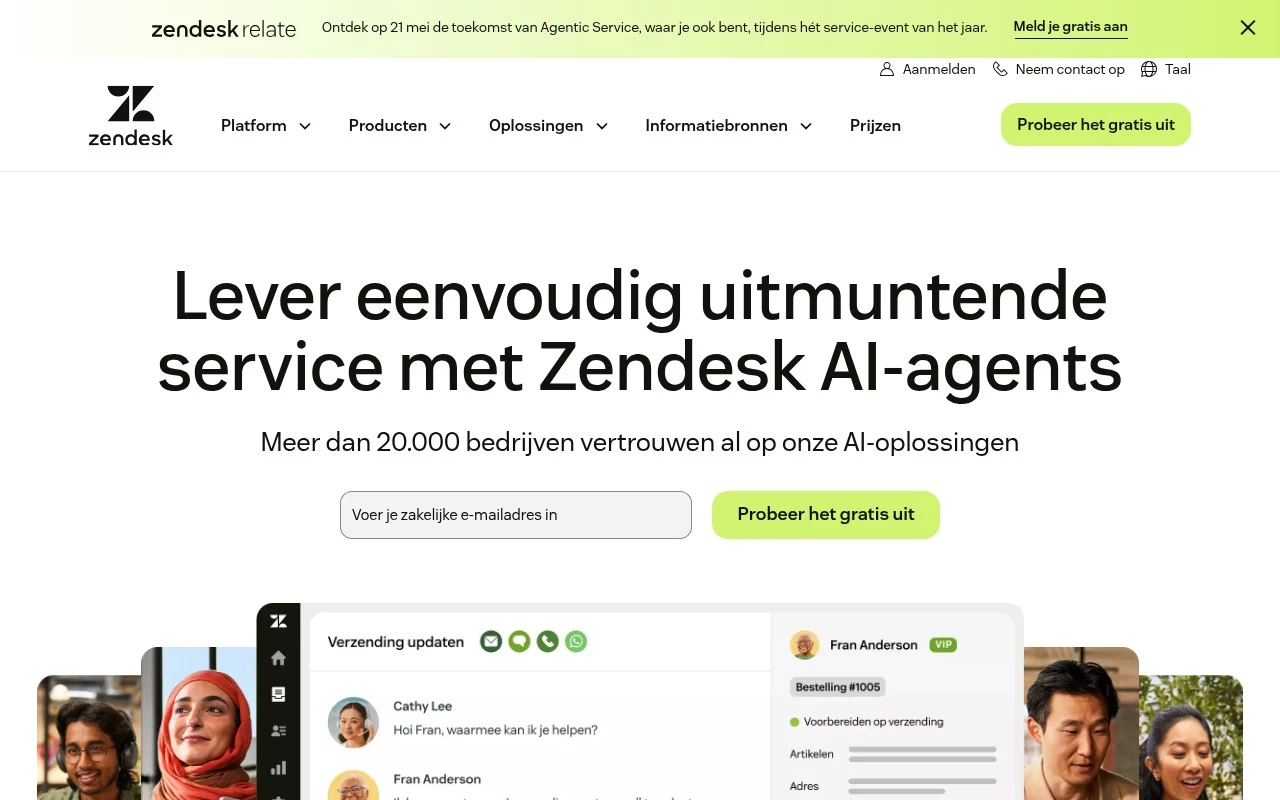
Zendesk is a customer service platform that helps businesses manage support tickets, live chat, messaging, knowledge bases, and customer interactions across channels. It includes tools for routing, workflow automation, reporting, and self-service support.
Customer Support BotsChatbots

FYAI Score

8.3 / 10

Based on 2 reviews

Pricing:

Freemium

Best for:

Support and CX teams handling high-volume customer service

Score Breakdown

  • Ease of use7.7 / 10
  • Features9.3 / 10
  • Pricing8.0 / 10
  • Integrations9.4 / 10
  • Support7.0 / 10

PRODUCT PREVIEW

What this AI tool does

Zendesk is a unified AI-first service platform for customer support, employee service, and contact center teams that need to manage conversations, automate service work, and keep support data in one operational system. Zendesk is built for organisations handling high volumes of requests across channels, where speed, consistency, and visibility matter as much as the individual reply. At its core, the platform turns service interactions into structured work. Tickets, messages, calls, self-service content, customer profiles, automation rules, and performance data sit together so teams can move from fragmented inboxes to a more controlled service operation. This makes it useful for support teams that have outgrown simple helpdesk tools but do not want every workflow scattered across separate systems. AI is now central to the way the platform is positioned. Autonomous AI agents can resolve common requests, guide customers through standard processes, and reduce the volume of conversations that need a human response. For human agents, AI assistance helps with suggested replies, summarisation, intent detection, routing, and knowledge-driven responses, so the platform supports both full customer support automation and human-in-the-loop service. For service leaders, Zendesk is strongest when it combines automation with operational oversight. Quality monitoring, analytics, report generation, workforce visibility, and conversation intelligence help managers understand where demand is coming from, which agents need support, and which processes create friction. The goal is not only to answer tickets faster, but to make the service organisation easier to measure and improve. Knowledge management plays an important role in that story. The platform can connect support articles, internal documentation, and knowledge base search with both agents and AI systems, helping answers stay consistent across self-service, chatbots, and assisted support. This is especially important for teams that want chatbot deployment to be grounded in approved content rather than improvised responses. Across customer support and employee service, the workflow model is designed to adapt to different kinds of requests. Workflow automation can route issues, trigger approvals, escalate urgent cases, collect missing information, and standardise repetitive processes. That flexibility lets the same platform support external customers, internal IT or HR requests, and contact center operations without forcing every team into an identical pattern. A large app marketplace extends the platform beyond its native service tools. Integrations with CRM systems, ecommerce platforms, communication tools, productivity suites, data warehouses, and specialist business apps help Zendesk fit into existing technology stacks. For teams that depend on context from other systems, this integration layer is a major part of the product’s value. Zendesk is best at giving service teams a shared system where AI, human agents, knowledge, workflows, and reporting can operate together. It is not simply a chatbot tool, a ticketing inbox, or a reporting dashboard, although it includes elements of all three. Its broader identity is a service operations platform for organisations that want automation and human support to reinforce each other rather than live in separate tools.

Use cases

Best for

Customer Support Automation

Zendesk uses AI agents and macros to auto respond to tickets and route requests by intent, language, and priority.

Workflow Automation

Zendesk triggers workflows that assign tickets, set SLAs, escalate breaches, and notify teams based on ticket events and fields.

Report Generation

Zendesk Explore generates support reports by querying ticket and CSAT data into dashboards with scheduled exports.

ANALYSIS

Strengths & limitations

Strengths
  • Best suited to high-volume service teams because it keeps customer support, employee service, AI automation, agent workflows, analytics, and contact center operations in one platform.
  • Strong fit for teams adopting AI-first support because it combines autonomous agents, agent assistance, intent detection, sentiment understanding, and knowledge-driven responses within the service workflow.
  • Useful for organisations with existing business systems because Zendesk has a large app marketplace and integration ecosystem for connecting support data with the wider stack.

Limitations
  • Less suitable for very small teams that only need a simple shared inbox because the platform breadth can add administration, configuration, and process overhead.
  • The freemium model is limiting for scaled service operations because advanced capabilities and higher-volume usage typically move teams into paid subscriptions.
  • AI performance depends on well-maintained knowledge, clean workflows, and service data, so teams without those foundations may need significant setup before automation is effective.

Evaluation

FYAI score breakdown

Our structured evaluation across five key criteria

8.3 / 10

Overall score

Based on 2 reviews

  • Ease of use7.7 / 10
  • Features9.3 / 10
  • Pricing8.0 / 10
  • Integrations9.4 / 10
  • Support7.0 / 10

What users say

Findings from public reviews, documentation and community sources.

  • Ease of use

    Zendesk.nl states “Start binnen enkele minuten, niet maanden” and “Koppel je kennis en ga met een paar klikken live. Zonder scripts of developers.” Zendesk.nl presents setup around connecting knowledge and going live in a few clicks for AI service workflows.

  • Features

    Zendesk.nl lists autonomous “AI agents,” omnichannel support, messaging/live chat, voice, knowledge base, Copilot, quality assurance, workforce management, reporting and analytics. Zendesk.nl claims AI agents can handle complex issues “volledig autonoom” across channels.

  • Pricing

    The Zendesk pricing page lists Support Team at “€19 agent/maand,” Suite Team at “€55 agent/maand,” and Suite Professional at “€115 agent/maand,” billed annually. The Zendesk pricing page places meaningful AI/omnichannel capability in higher per-agent tiers.

  • Integrations

    The Zendesk marketplace describes its ecosystem as including “more than 1,800 apps, partners and integrations.” The Zendesk integration page references connecting favorite tools across CRM, social media, and other apps.

  • Support

    A Reddit comment about Zendesk support says, “Their customer service is so bad, we were begging for responses,” with “weeks” passing and “never” getting a proper account review. Zendesk has visible help-center and community resources.

Who is this for?

Best for customer-support teams that want a broad service platform, Zendesk.nl lists autonomous “AI agents,” omnichannel support, Copilot, and reporting and analytics in the conversational-AI service stack. Less suited to teams trying to keep AI/omnichannel costs low, the Zendesk pricing page lists Support Team at “€19 agent/maand” and Suite Professional at “€115 agent/maand,” billed annually, while meaningful AI/omnichannel capability sits in higher per-agent tiers. Less suited to teams that rely on fast vendor responses, a Reddit comment describes “weeks” passing and “never” getting a proper account review.

PRODUCT PREVIEW

Feature highlights

AI Agents & Bots

Automate answers and actions across chat, email, and messaging.

Agent Assist AI

Suggests replies, summarizes threads, and surfaces next best steps.

QA & Analytics

Monitor quality, track trends, and improve service performance.

COMPARE

Discover curated alternatives worth comparing

Compare similar AI tools based on features, pricing and use cases

8.1/ 10FYAI score

Helply

Customer Support BotsKnowledge Base Bots
Answers tickets, drafts replies, flags gaps and churn risks
Best for:
Customer support teams
Pricing
Freemium

8.7/ 10Based on 7,757 reviews

Zoho Desk

Customer Support BotsKnowledge Base Bots
Handles routine tickets, flags issues, and drafts replies
Best for:
Customer support teams
Pricing
Freemium

7.8/ 10Based on 31,824 reviews

Zoho

Customer Support Bots
Runs business apps for sales, finance, HR, and support teams
Best for:
Operations teams
Pricing
Freemium

Join thousands of support teams using Zendesk to resolve issues faster and deliver consistently great customer experiences. Start improving every interaction today.

FAQ

Frequently asked
questions

Everything you need to know about this AI tool,
its features, pricing, use cases, and limitations.

Who is Zendesk best suited for?
Zendesk is best suited for customer service, contact center, CX, and IT support teams that need centralized support operations across tickets, messaging, chat, voice, and self-service. It fits organizations that want AI agents, agent assistance, analytics, quality management, and workforce planning in one broader service platform.
Does Zendesk have a free plan or is it paid?
Zendesk follows a freemium pricing model, with paid plans used for more complete service operations and advanced capabilities. Buyers should check Zendesk’s current pricing page for plan details, because AI automation, voice, analytics, workforce management, and governance features may vary by package or add-on.
What are the best alternatives to Zendesk?
The best Zendesk alternative depends on whether a team needs simple ticketing, a shared inbox, chatbot automation, or a full contact center platform. Zendesk is strongest when teams want broad support operations, AI agents, reporting, knowledge workflows, QA, and workforce tools in a single environment.
How long does Zendesk take to set up?
Zendesk’s main trade-off is breadth: teams that only need a simple inbox or basic ticketing may find it more platform than they need. AI results also depend on good knowledge content, workflow design, integration setup, governance, and monitoring, rather than becoming fully optimized automatically after deployment.
Is Zendesk suitable for handling sensitive customer data?
Zendesk can be evaluated for sensitive support operations, but buyers should review its current security, privacy, compliance, data retention, and access control documentation before deployment. Support platforms often process customer messages, tickets, call details, and employee interactions, so governance around integrations and AI use should be checked carefully.