Curated ToolThis tool is part of our curated AI directory. We only include tools that meet our standards for relevance, usability and real-world value.

Voiceflow

Design and deploy AI agents for chat and voice conversations

Customer Support BotsAgent Builders
Voiceflow is an enterprise conversational AI platform for teams that need to create and manage AI agents for customer experience. It combines visual workflow design, real-time collaboration, prototyping, deployment, and API connectivity so product, support, design, and engineering teams can build agents for support, lead generation, and other customer-facing conversations.

FYAI Score

8.7 / 10

Based on 110 reviews

Pricing:

Freemium

Best for:

CX teams building and managing AI support agents

Score Breakdown

  • Ease of use9.1 / 10
  • Features9.1 / 10
  • Pricing7.7 / 10
  • Integrations8.5 / 10
  • Support9.1 / 10

PRODUCT PREVIEW

What this AI tool does

Voiceflow is a platform for designing and managing conversational experiences, such as chatbots and voice assistants. It provides a structured way to map out how a conversation should flow, define what the assistant should say, and handle user inputs across different paths. Teams can use it to prototype ideas, collaborate on conversation design, and iterate based on testing and feedback. It’s commonly used by product, design, and development teams that need a shared workspace to plan conversational logic before connecting it to deployment channels or backend services. As an informational tool, it’s most useful when you want to document conversation behavior clearly, reduce ambiguity in handoffs, and keep changes organized over time. The focus is on building understandable conversation flows that can be reviewed and refined as requirements evolve.

Use cases

Best for

Agent Building

Voiceflow lets teams visually design, prototype, and deploy AI agents with shared workflows, testing, and API integrations.

Customer Support Automation

It automates customer support by routing intents, calling knowledge sources or APIs, and handing off to humans when needed.

Call Automation

It powers call automation by connecting voice channels to dialog flows that capture caller inputs and trigger backend actions via APIs.

ANALYSIS

Strengths & limitations

Strengths
  • Supports both visual conversation design and developer-oriented API capabilities.
  • Built for omnichannel deployment, including web chat, voice widgets, phone, mobile, and custom interfaces through APIs.
  • Designed for collaborative enterprise teams, with use cases spanning product, CX, support, conversation design, and engineering.
Limitations
  • The official site positions it mainly around enterprise customer experience, so it may be more than needed for simple one-off chatbots.
  • Advanced deployments still appear to require planning around workflows, integrations, and business logic.
  • The provided site text does not give enough detail to compare pricing, model options, or implementation complexity.

Evaluation

FYAI score breakdown

Our structured evaluation across five key criteria

8.7 / 10

Overall score

Based on 110 reviews

  • Ease of use9.1 / 10
  • Features9.1 / 10
  • Pricing7.7 / 10
  • Integrations8.5 / 10
  • Support9.1 / 10

What users say

Findings from public reviews, documentation and community sources.

  • Ease of use

    G2 lists Voiceflow at 4.6/5 from 110 reviews, with users saying Voiceflow “reduces confusion, saves development time, and makes client collaboration smoother.” Voiceflow’s own customer quotes describe the platform as “incredibly user-friendly” and “Beginner friendly.”

  • Features

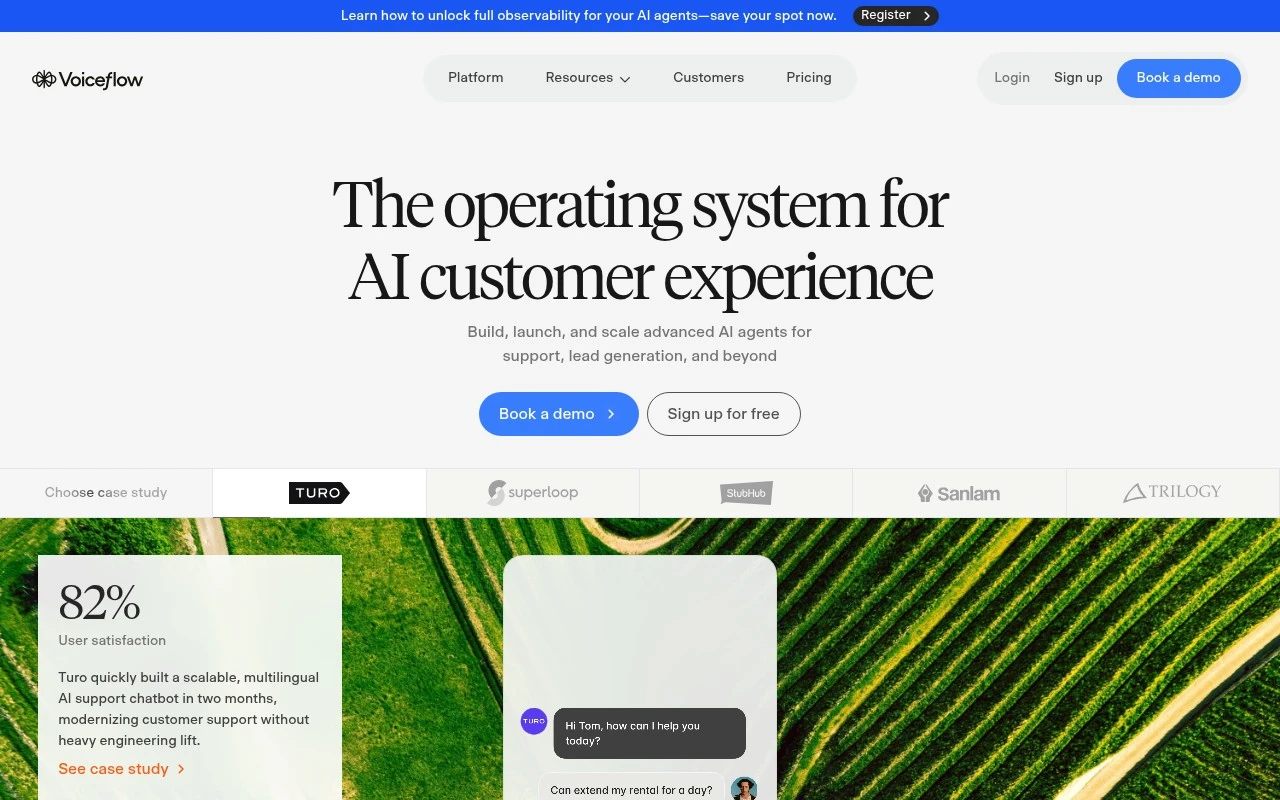
    Voiceflow’s homepage positions the platform to “Build, launch, and scale advanced AI agents” across support, lead generation, and omnichannel use cases, including web embed, phone, mobile/API, and real-time collaboration. Voiceflow’s homepage cites “10K+ live agents in production,” “500 ms latency for voice,” and “300k messages per minute.”

  • Pricing

    Voiceflow’s pricing page presents a free trial with “no credit card required” for agencies and says billing is “Transparent, usage-based.” Voiceflow’s pricing page uses “Book a demo” and “Request pricing” for business plans.

  • Integrations

    Voiceflow’s integrations page lists native integrations including “Zendesk,” “Salesforce,” “HubSpot,” and “Shopify.” Voiceflow’s integrations page says agents can “create tickets, update records, and send messages,” and Voiceflow’s broader positioning references APIs and access to major model providers.

  • Support

    Voiceflow’s homepage surfaces “Powerful documentation for designers and developers,” and Voiceflow’s pricing page includes “Implementation support: self-serve or fully managed.” Voiceflow’s homepage includes a customer quote saying the “Voiceflow team… helped and answered any questions.”

Who is this for?

Best for teams building support, lead generation, or omnichannel AI agents, Voiceflow’s homepage cites web embed, phone, mobile/API, and “10K+ live agents in production.” Best for teams that need CRM or CX connections, Voiceflow’s integrations page lists “Zendesk,” “Salesforce,” “HubSpot,” and “Shopify,” and says agents can “create tickets, update records, and send messages.” Less suited to buyers who need concrete public price amounts before engaging sales, Voiceflow’s pricing page uses “Book a demo” and “Request pricing” for business plans.

PRODUCT PREVIEW

Feature highlights

Visual agent builder

Design conversation flows and logic in a collaborative visual canvas.

Team collaboration

Co-edit, comment, and review changes with roles and shared workspaces.

API & tool calling

Connect agents to your systems via APIs for real actions and data.

COMPARE

Discover curated alternatives worth comparing

Compare similar AI tools based on features, pricing and use cases

8.1/ 10FYAI score

Helply

Customer Support BotsKnowledge Base Bots
Answers support tickets, drafts replies, and flags churn risk
Best for:
Customer support teams
Pricing
Freemium

8.7/ 10Based on 7.757 reviews

Zoho Desk

Customer Support BotsKnowledge Base Bots
Uses Zia AI to triage tickets, draft replies, and flag issues
Best for:
Customer support teams
Pricing
Freemium

7.8/ 10Based on 31.824 reviews

Zoho

Customer Support Bots
Cloud suite for CRM, finance, HR, and business operations
Best for:
Operations teams
Pricing
Freemium

Join teams building better voice and chat experiences. Prototype, test, and launch conversations faster with voiceflow today.

FAQ

Frequently asked
questions

Everything you need to know about this AI tool,
its features, pricing, use cases, and limitations.

What types of conversational projects is voiceflow a good fit for?
voiceflow is a strong choice for teams building voice-first assistants and structured conversational flows that need to ship to platforms like Alexa or Google Assistant. It works well for customer support triage, FAQs, and guided workflows where conversation paths can be designed and tested collaboratively. If you need highly custom runtime logic or deep control over every deployment detail, you may find it less flexible than code-first frameworks.
Does voiceflow have a free plan, and what are the practical limitations compared to paid tiers?
voiceflow typically offers a free entry option suitable for trying the builder and prototyping, but it’s not designed for sustained team usage at scale. Paid plans are usually where collaboration, higher usage limits, and production-oriented features become viable. If you expect multiple editors or heavier testing/traffic, budget for a paid tier early to avoid hitting caps mid-project.
How does voiceflow compare with other conversational AI builders like Botpress, Dialogflow, or Amazon Lex?
voiceflow emphasizes a visual design workflow and team collaboration, while tools like Dialogflow or Lex often lean more toward NLU configuration and cloud-native deployment patterns. If your priority is rapid conversation design with stakeholder review, voiceflow can be easier to iterate in than more engineering-centric stacks. If you need tight integration with a specific cloud ecosystem or advanced customization, a platform-native option may fit better.
How quickly can a team get a working assistant live with voiceflow, and what onboarding effort should you expect?
voiceflow can feel limiting for developers who want deep customization beyond what the visual builder exposes. Costs may rise with additional team members and higher usage, which can matter for startups or agencies managing multiple clients. Because deployment often relies on third-party voice platforms, you may have less control over certain runtime behaviors and user experience constraints.
What should I consider about data handling, privacy, and compliance when using voiceflow?
Review what conversation logs, transcripts, and testing data voiceflow stores by default, and confirm how long data is retained and how it can be deleted. If you deploy to Alexa or Google Assistant, remember data may also be processed under those platforms’ policies, so compliance is shared across vendors. For regulated use cases, validate access controls, auditability, and whether your required agreements (e.g., DPA) and regional hosting needs are supported.