Userbot
Curated ToolThis tool is part of our curated AI directory. We only include tools that meet our standards for relevance, usability and real-world value.

Userbot

Userbot is a conversational AI customer service platform that builds chatbots to answer customer questions, hand unresolved conversations to human agents, and learn from those agent replies. It supports integration automation across websites, messaging channels, and business workflows.
Customer Support BotsAgent Builders

FYAI Score

7.4 / 10

Based on 13 reviews + FYAI product analysis

Pricing:

Paid

Best for:

Enterprise CX and IT teams building governed AI agent teams

Score Breakdown

  • Ease of use7.7 / 10
  • Features7.4 / 10
  • Pricing7.1 / 10
  • Integrations7.5 / 10
  • Support7.3 / 10

PRODUCT PREVIEW

What this AI tool does

Userbot
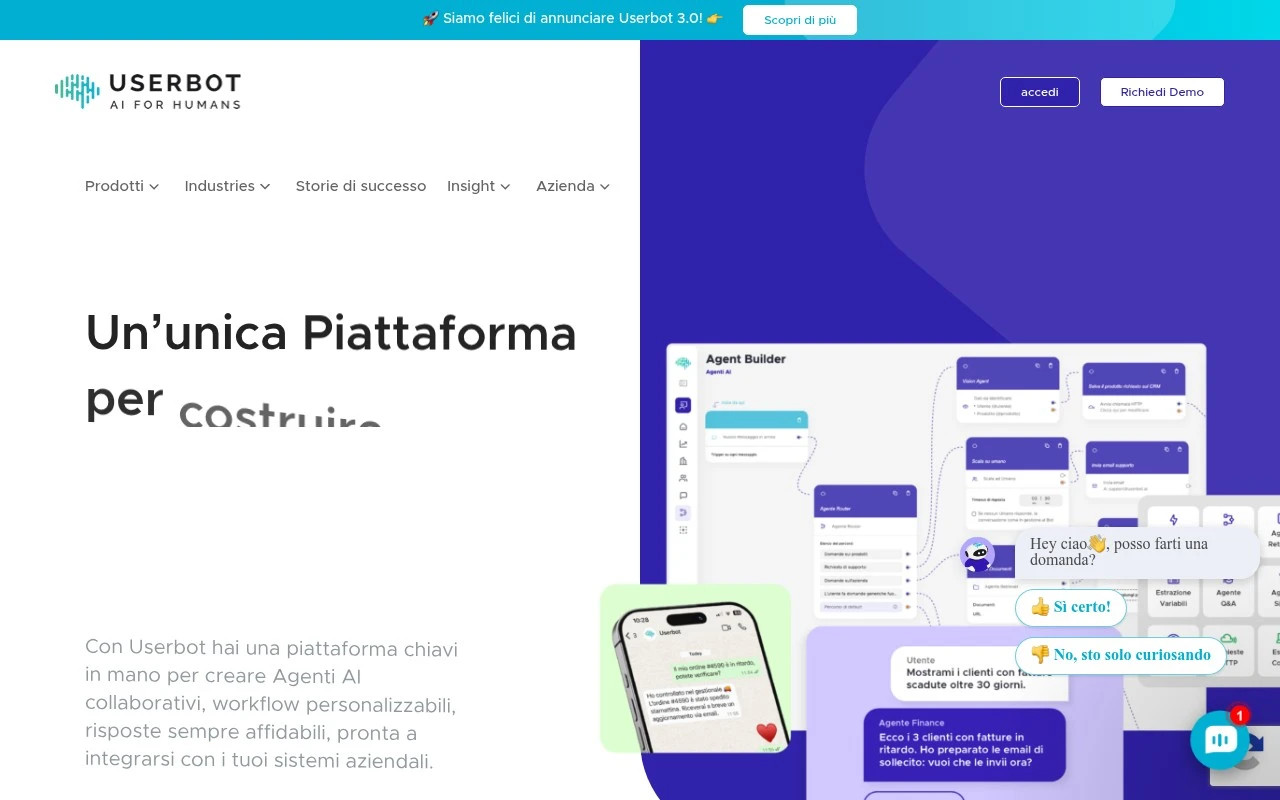
Userbot is a no-code, visual AI-agent builder for enterprises that want to design, deploy, and govern teams of specialized AI agents across customer support, sales, operations, and internal service workflows. Userbot is best suited to organizations that need more than a simple chatbot, especially when knowledge grounding, integration automation, human handoff, analytics, and brand control all need to work together in one managed environment. For enterprises, the main idea is to make agent building accessible without reducing it to a lightweight widget. Teams can visually configure agents, define roles, connect approved knowledge sources, and shape how conversations should move between automation and people. This makes the platform useful for business users and operations teams, while still giving technical teams a controlled way to connect systems and supervise deployment. At its core, the platform is built around grounded conversational AI. Agents can draw on a company knowledge base to answer with context rather than relying only on generic model behaviour, which is important for customer support automation and internal knowledge base search. The goal is not just to respond quickly, but to respond consistently, in line with company information, service rules, and escalation policies. The multi-agent model is what gives Userbot a more enterprise-oriented character. Instead of treating automation as a single assistant with one broad job, the platform supports teams of agents with different responsibilities, such as answering product questions, qualifying leads, resolving common support issues, or routing complex requests. Userbot helps enterprises orchestrate these agents so that customer conversations and operational workflows can move through the right expertise at the right time. Omnichannel deployment extends that agent layer into the places where users already communicate. The platform supports chat and messaging experiences that can be adapted for different customer touchpoints, with multilingual communication and brand customization helping the experience feel aligned with the organization rather than like a generic chatbot deployment. This matters for companies that need automation to operate across markets, channels, and audience types without fragmenting the service experience. Integration automation is a central part of the story because AI agents become more useful when they can interact with business systems. Through API-based integrations, the platform can connect conversational flows with existing tools, data sources, and operational processes. That makes it relevant not only for answering questions, but also for workflow automation where an agent may need to retrieve information, trigger an action, update a record, or hand a case to a human team. Human escalation is treated as part of the operating model rather than an afterthought. When an agent reaches a boundary, confidence threshold, policy rule, or customer need that requires a person, conversations can be escalated to human operators. This balance helps enterprises adopt AI in customer-facing environments without expecting automation to handle every situation on its own. Governance and measurement give the platform its management layer. Analytics help teams understand performance, identify automation gaps, and improve agent behaviour over time, while security and GDPR-oriented controls support enterprise requirements around data handling and compliance. For organizations deploying AI across customer and internal interactions, these capabilities are as important as the conversational interface itself. For organizations comparing AI agent platforms, Userbot is positioned as a practical bridge between no-code chatbot builders and more complex custom AI systems. It is designed for teams that want visual configuration, structured control, and scalable agent operations, without building every orchestration layer from scratch. In that sense, Userbot is an enterprise AI-agent platform for turning company knowledge, integrations, and service processes into managed conversational automation.

Use cases

Best for

Agent Building

Build and manage specialized AI agents in a visual no-code canvas with knowledge-base grounding and governance controls.

Workflow Automation

Automate workflows by orchestrating multiple agents and triggering API integrations with human escalation and analytics.

Customer Support Automation

Userbot automates customer support across chat and messaging channels using grounded answers, multilingual replies, and handoff to humans.

ANALYSIS

Strengths & limitations

Strengths
  • Best suited to enterprise teams that need governed agent deployment, because its no-code visual builder supports specialized agent teams without requiring every workflow owner to code.
  • Strong fit for regulated or knowledge-heavy support operations, because agents can be grounded in verified business knowledge with human escalation and GDPR-oriented governance.
  • Useful for organizations with fragmented customer channels and back-office systems, because it combines omnichannel messaging, API integrations, analytics, multilingual communication, and brand customization.

Limitations
  • Less suitable for small teams that only need a simple website chatbot, because its enterprise multi-agent structure can add more governance and setup than lightweight deployments require.
  • Requires upfront knowledge-base curation and workflow mapping, because grounded multi-agent automation depends on verified content, defined roles, and clear escalation paths.
  • Less suitable for teams that want full code-level control over agent runtime and model behavior, because the platform is centered on no-code visual configuration rather than custom development.

Evaluation

FYAI score breakdown

Our structured evaluation across five key criteria

7.4 / 10

Overall score

Based on 13 reviews + FYAI product analysis

  • Ease of use7.7 / 10
  • Features7.4 / 10
  • Pricing7.1 / 10
  • Integrations7.5 / 10
  • Support7.3 / 10

What users say

Findings from public reviews, documentation and community sources.

  • Ease of use

    Userbot describes an end-to-end guided setup and a visual no-code platform that lets users build automations “anche senza alcuna competenza tecnica,” and G2 reviews say Userbot is “Easy to install, easy to connect.”

  • Features

    Userbot product page lists multi-agent orchestration, knowledge-base grounding from documents/endpoints/websites, multilingual agents, and escalation to humans.

  • Pricing

    Userbot pricing page is oriented around the product overview and demo flow rather than showing public tier names, included limits, or amounts.

  • Integrations

    Userbot product page states agents can connect to business systems such as “ERP, CRM, Ticketing,” exchange data via “API o webhook,” and operate across email, web, app, and messaging systems.

  • Support

    Userbot site positions Userbot as an enterprise platform with a demo-led sales motion. Userbot site says the company has supported private and public-sector organizations for nearly 10 years.

Who is this for?

Best for organizations that need conversational agents connected to internal knowledge and operations, Userbot product page lists multi-agent orchestration, knowledge-base grounding from documents/endpoints/websites, and escalation to humans. Less suited to teams that need to compare plans before contacting sales, Userbot pricing page does not show public tier names, included limits, or amounts.

PRODUCT PREVIEW

Feature highlights

Multi-agent orchestration

Coordinate specialist agents to solve requests end-to-end.

Knowledge-base grounding

Ground answers in your docs to keep responses accurate and on-brand.

Governance & GDPR

Enterprise security controls, auditability, and compliant operations.

COMPARE

Discover curated alternatives worth comparing

Compare similar AI tools based on features, pricing and use cases

8.1/ 10FYAI score

Helply

Customer Support BotsKnowledge Base Bots
Answers tickets, drafts replies, flags gaps and churn risks
Best for:
Customer support teams
Pricing
Freemium

8.7/ 10Based on 7,757 reviews

Zoho Desk

Customer Support BotsKnowledge Base Bots
Handles routine tickets, flags issues, and drafts replies
Best for:
Customer support teams
Pricing
Freemium

7.8/ 10Based on 31,824 reviews

Zoho

Customer Support Bots
Runs business apps for sales, finance, HR, and support teams
Best for:
Operations teams
Pricing
Freemium

Userbot

Start answering shoppers instantly and reduce support load. See why e-commerce teams choose Userbot to boost satisfaction and speed up every response.

FAQ

Frequently asked
questions

Everything you need to know about this AI tool,
its features, pricing, use cases, and limitations.

Who is Userbot best suited for?
Userbot is best suited for organizations that need governed AI agents for customer service, operations, sales, marketing, or public-sector workflows. It fits teams that want agents to answer from approved knowledge sources, coordinate tasks across roles, connect to internal systems, and escalate complex cases to human staff.
Is Userbot free or paid?
Userbot is a paid platform aimed at business and enterprise use cases. Buyers should expect pricing to depend on factors such as deployment scope, integrations, channels, automation complexity, and support needs. For current commercial details, teams should check Userbot directly through userbot.ai.
How does Userbot compare with other conversational AI tools?
Userbot differs from simpler chatbot tools by focusing on governed, multi-agent workflows rather than only single conversational assistants. It is a stronger fit when teams need knowledge-based answers, workflow automation, API or webhook integrations, ticket routing, human escalation, and reporting. The best choice depends on scale, budget, and integration needs.
How long does it take to set up Userbot?
Userbot’s main trade-off is that it appears designed for structured business deployments, not lightweight personal chatbot creation. Its value depends on clean knowledge bases, well-defined processes, and integration work with internal systems. Teams should also validate pricing, implementation timelines, and operational requirements before committing.
How should we evaluate Userbot for privacy and compliance?
Userbot is positioned for governed enterprise AI use, with features such as dashboards, reporting, human escalation, GDPR-oriented positioning, and visibility into agent decisions. Organizations handling sensitive data should still confirm current security controls, data retention, access permissions, hosting options, auditability, and compliance commitments directly with Userbot.