Trengo
Curated ToolThis tool is part of our curated AI directory. We only include tools that meet our standards for relevance, usability and real-world value.

Trengo

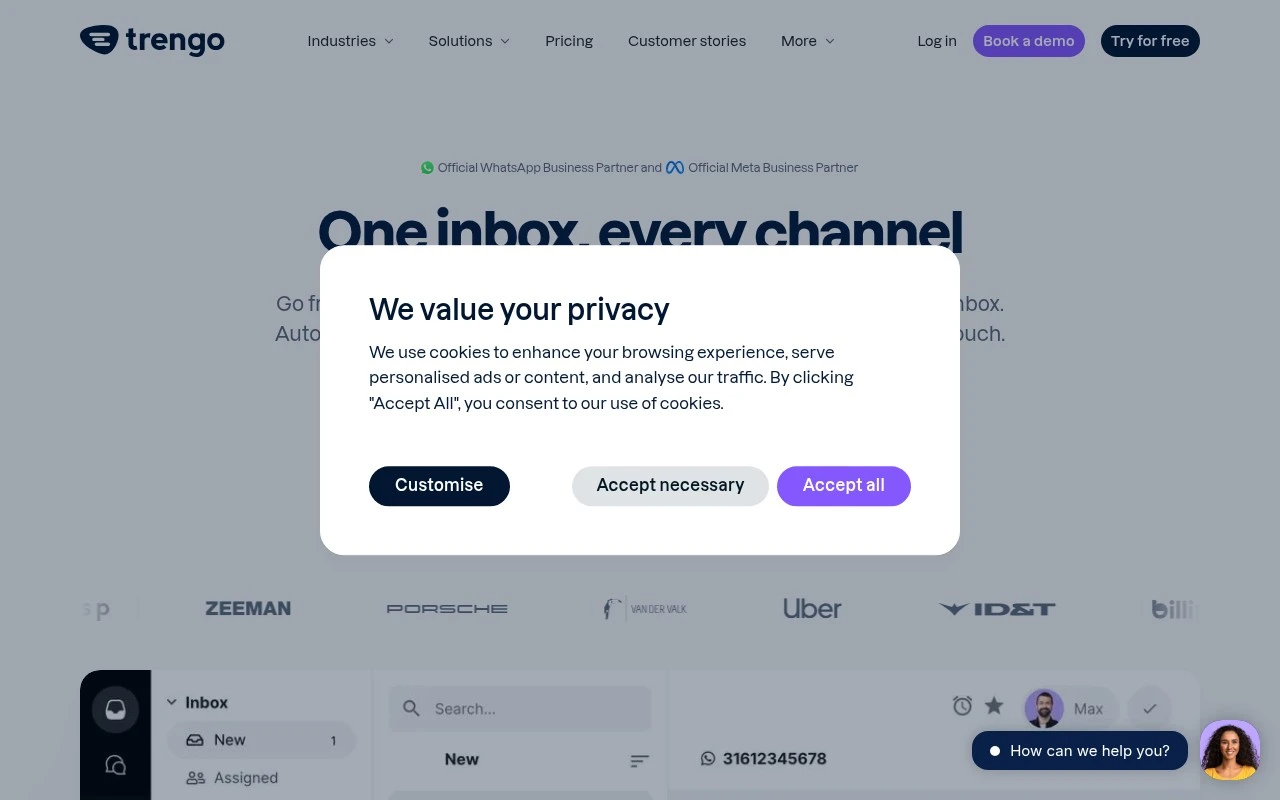
Trengo is a customer communication platform that lets teams manage conversations from channels such as email, WhatsApp, live chat, social messaging, and voice in a shared inbox. It also supports team collaboration, routing, and automation for customer service workflows.
Customer Support BotsChatbots

Trengo

FYAI Score

8.2 / 10

Based on 246 reviews

Pricing:

Paid

Best for:

Support and sales teams handling high-volume WhatsApp and omnichannel queries

Score Breakdown

  • Ease of use8.4 / 10
  • Features8.1 / 10
  • Pricing7.8 / 10
  • Integrations8.2 / 10
  • Support8.5 / 10

PRODUCT PREVIEW

What this AI tool does

Trengo
Trengo is an omnichannel customer communication platform for teams that manage support, sales, and commerce conversations across WhatsApp Business, email, live chat, social media, and voice. Trengo is built for organisations that want one shared workspace for customer messages, with AI and automation helping teams respond faster without losing the context of each conversation. At its centre is the shared inbox, where conversations from multiple channels are brought into a single team environment. Instead of switching between WhatsApp, email clients, social inboxes, and chat tools, agents can assign messages, collaborate internally, view history, and keep customer communication organised from one place. WhatsApp Business is a major part of the product’s identity. Trengo is especially strong for businesses that use WhatsApp as a primary service, sales, or post-purchase channel, because it combines official WhatsApp Business messaging with routing, templates, team ownership, and automation. This makes it useful for companies that receive high volumes of conversational enquiries and need structure around a channel that customers already prefer. AI-assisted customer communication extends the platform beyond a traditional inbox. The tool can support teams with AI agents, suggested replies, automated handling of common questions, and workflows that reduce repetitive manual work. In practice, this positions the platform as both a communication hub and a customer support automation layer for teams that want to scale service without simply adding more agents. Automation journeys help businesses design the path a customer takes before, during, or after speaking to a human. A simple enquiry might be qualified automatically, routed to the right department, or answered by an AI agent before a teammate steps in. For teams planning chatbot deployment across live chat, WhatsApp, or other messaging channels, this creates a more controlled way to combine self-service with human support. For customer-facing teams, the value is not just speed but continuity. Sales can pick up a conversation that started through chat, support can see previous order-related messages, and managers can track workload across channels. The platform is designed for environments where a customer may move between touchpoints but still expects the business to remember the conversation. Commerce and service operations are a natural fit. Retailers, travel companies, education providers, service businesses, and B2C brands can use the platform to answer product questions, handle delivery updates, resolve support requests, and follow up on leads. Integrations with business systems help connect these conversations with the data teams need to act, rather than treating every message as an isolated ticket. Unlike a single-channel helpdesk or a basic website chat widget, the broader product story is about centralising modern customer communication. It recognises that customers often choose the most convenient channel in the moment, while teams need consistent processes behind the scenes. The platform gives those teams a shared operating layer for messaging, automation, and AI-supported service. Trengo is best understood as a practical omnichannel inbox and AI communication platform for teams that rely heavily on messaging, especially WhatsApp Business, to serve customers at scale. Its character is operational rather than experimental: it brings together channels, teammates, automation, and AI agents so businesses can manage everyday customer conversations with more speed, consistency, and control.

Use cases

Best for

Omnichannel Support

Manage WhatsApp, email, live chat, social, and voice conversations in a shared inbox so agents reply without switching tools.

Customer Support Automation

Trengo automates support with AI agents, routing rules, and journey workflows that tag, assign, and answer common requests.

Chatbot Deployment

Deploy chatbots on WhatsApp Business and web chat to collect details, answer FAQs, and hand off to agents in the same thread.

ANALYSIS

Strengths & limitations

Strengths
  • Best suited to teams with high WhatsApp Business and multichannel message volume because conversations from email, live chat, social channels, and voice can be handled from one shared inbox.
  • Useful for support and sales teams that receive repetitive questions because AI agents and automation journeys can deflect common requests and qualify leads before a human agent steps in.
  • Strong fit for eCommerce and customer-facing teams because integrations and team inbox workflows help connect conversations with order, sales, and support processes.

Limitations
  • Less suitable for teams that only use one simple support channel because an omnichannel inbox and automation platform can add more structure than they need.
  • Requires upfront setup for channels, routing rules, AI agents, and automation journeys, so teams without time to design conversation workflows may see slower adoption.
  • Paid positioning makes it a poorer fit for very small teams or occasional-use projects that need a free or lightweight customer messaging tool.

Evaluation

FYAI score breakdown

Our structured evaluation across five key criteria

8.2 / 10

Overall score

Based on 246 reviews

  • Ease of use8.4 / 10
  • Features8.1 / 10
  • Pricing7.8 / 10
  • Integrations8.2 / 10
  • Support8.5 / 10

What users say

Findings from public reviews, documentation and community sources.

  • Ease of use

    G2’s review summary says users “consistently praise Trengo for its ease of use and efficient communication capabilities,” and Trengo’s own page positions the product as “one easy-to-use inbox” with AI Agents that can be set up “in minutes” and require “No developer.”

  • Features

    Trengo’s product and pricing pages list omnichannel and AI features including WhatsApp, live chat, AI Agent, and AI Journeys. Trengo’s product and pricing pages also list collaboration tools, reporting, and security controls.

  • Pricing

    Trengo’s pricing page lists Boost at €299/month annually for 10 users and 6,000 conversations/year, Pro at €499/month annually for 20 users and 18,000 conversations/year, and Enterprise custom pricing. Trengo’s pricing page also references add-ons.

  • Integrations

    Trengo lists ecommerce/data integrations including Shopify, Lightspeed, and WooCommerce. Trengo’s pricing page references API actions, custom integrations “Via APIs,” and custom-built integrations on Enterprise.

  • Support

    Trengo’s pricing page lists support via email, messaging, phone support, personalised onboarding, and success-manager options. Capterra notes Trengo provides “email/help desk, FAQ/forum, knowledge base, phone support, and chat” with mixed user feedback.

Who is this for?

Best for teams that need customer conversations across multiple channels in one inbox, Trengo’s product and pricing pages list WhatsApp, email, Instagram, Facebook, voice, live chat, AI Agent, and AI Journeys. Less suited to teams looking for a low-cost entry point, Trengo’s pricing page lists Boost at €299/month annually for 10 users and 6,000 conversations/year, with add-ons also referenced.

PRODUCT PREVIEW

Feature highlights

Omnichannel inbox

Manage WhatsApp, email, chat, socials, and voice in one shared view.

AI agents

Automate replies and triage so agents focus on complex conversations.

Automation journeys

Route, tag, and follow up automatically with rules and integrations.

COMPARE

Discover curated alternatives worth comparing

Compare similar AI tools based on features, pricing and use cases

8.1/ 10FYAI score

Helply

Customer Support BotsKnowledge Base Bots
Answers tickets, drafts replies, flags gaps and churn risks
Best for:
Customer support teams
Pricing
Freemium

8.7/ 10Based on 7,757 reviews

Zoho Desk

Customer Support BotsKnowledge Base Bots
Handles routine tickets, flags issues, and drafts replies
Best for:
Customer support teams
Pricing
Freemium

7.8/ 10Based on 31,824 reviews

Zoho

Customer Support Bots
Runs business apps for sales, finance, HR, and support teams
Best for:
Operations teams
Pricing
Freemium

Trengo

Bring every customer conversation into one place and respond faster with confidence. See why growing teams choose Trengo to deliver support customers love.

FAQ

Frequently asked
questions

Everything you need to know about this AI tool,
its features, pricing, use cases, and limitations.

Who is Trengo best suited for?
Trengo is best suited for support, sales, and eCommerce teams that manage customer conversations across several channels. It is particularly relevant for businesses using WhatsApp Business, email, live chat, social media, and voice, and for teams that want AI agents and automations to reduce repetitive manual replies.
Does Trengo offer a free plan?
Trengo is a paid customer engagement platform, so buyers should review its current pricing on trengo.com before committing. The main value is in consolidating multiple communication channels, automation journeys, AI agents, and commerce integrations, which is typically more relevant for teams with ongoing customer conversation volume.
What are the best alternatives to Trengo?
The best alternative to Trengo depends on whether a team prioritizes omnichannel inbox management, customer support automation, eCommerce integrations, or traditional ticketing workflows. Trengo is strongest for shared inbox use across WhatsApp, email, chat, social, and voice, while other tools may fit better for ticket-first support operations.
How hard is it to set up Trengo?
Trengo may be unnecessary for businesses that only use one simple support channel or have low customer conversation volume. Its AI and automation results also depend on setup quality, knowledge availability, and query complexity, so teams should test common support and sales scenarios before relying heavily on automation.
What should buyers check about Trengo’s privacy and compliance?
Buyers should review Trengo’s current security, privacy, data retention, and compliance documentation before using it for sensitive customer conversations. Teams handling payments, personal data, or regulated information should also confirm access controls, integration permissions, data processing terms, and how AI agents use customer and business knowledge.