Tars
Curated ToolThis tool is part of our curated AI directory. We only include tools that meet our standards for relevance, usability and real-world value.

Tars

Tars is a conversational AI platform for building chatbots and chat-based landing pages that answer questions, capture leads, and guide users through forms or workflows on websites and messaging channels.
Customer Support BotsAgent Builders

FYAI Score

8.2 / 10

Based on 3 reviews + FYAI product analysis

Pricing:

Paid

Best for:

Support and growth teams automating customer chats and lead capture

Score Breakdown

  • Ease of use8.0 / 10
  • Features7.9 / 10
  • Pricing8.0 / 10
  • Integrations8.8 / 10
  • Support8.9 / 10

PRODUCT PREVIEW

What this AI tool does

Tars
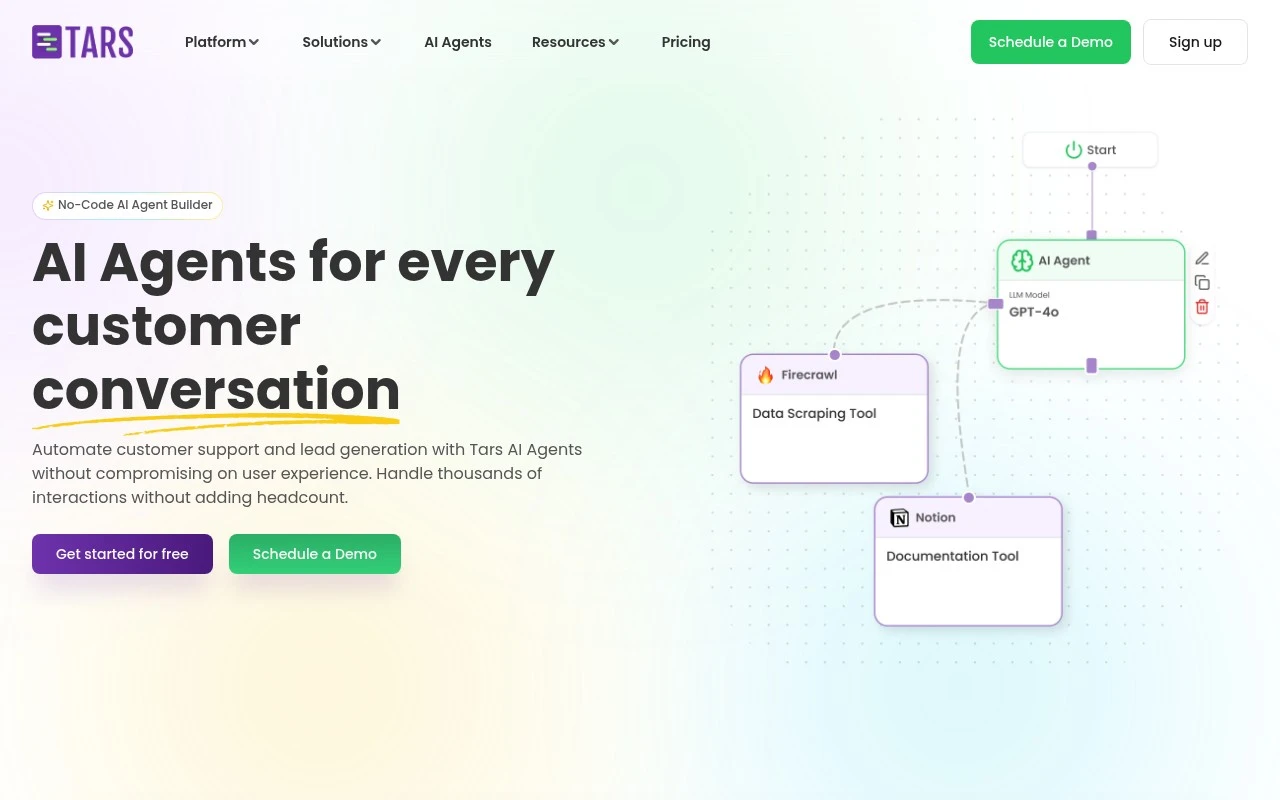
Tars is a no-code conversational AI agent platform for teams that want to automate customer interactions across support, lead generation, and digital service journeys. Tars helps businesses build AI agents without engineering-heavy development, then deploy those agents on customer-facing channels such as websites, WhatsApp, and Slack. For customer experience teams, the platform sits between a traditional chatbot builder and a more flexible AI agent workspace. It is designed for organizations that need structured conversation flows, prompt-driven responses, workflow logic, and integrations with business systems in one environment. Tars is especially relevant for customer support automation where speed, consistency, and measurable resolution matter. The building experience is centered on a visual drag-and-drop interface, which makes agent building accessible to non-technical teams. Users can shape the conversation, define goals, configure prompts, and create workflows that guide how an agent should respond in different situations. This gives teams more control than a generic chat widget while avoiding the complexity of custom AI development. In support settings, Tars can handle common questions, route users to the right resource, collect context before escalation, and reduce repetitive work for human agents. The goal is not only to answer queries, but to create a more efficient front line for customer service. By connecting to data sources and business tools, the platform can support more useful, context-aware conversations. For growth and marketing teams, Tars is also used for lead capture and qualification. Instead of relying only on static forms, teams can guide visitors through conversational journeys that collect information, identify intent, and move prospects toward a desired action. This makes the tool useful on landing pages, campaign pages, and other points where a business wants to convert interest into a measurable outcome. Chatbot deployment is part of the broader product story rather than a final afterthought. Once an agent is built and tested, teams can publish it where customers already communicate, including web chat, messaging apps, and collaboration environments. That multi-channel approach helps businesses keep the same service or lead generation logic consistent across different touchpoints. Testing and performance measurement are important to how the platform is positioned. Teams can review agent behavior before launch, then use analytics to understand visits, goal completion, resolution, sentiment, and conversation quality over time. These insights help operators improve prompts, refine workflows, and identify where automation is working well or where human intervention is still needed. Tars is best suited for support, marketing, and operations teams that want practical conversational AI without building a full agent stack from scratch. Its character is pragmatic and business-oriented, with an emphasis on automation that can be designed, deployed, monitored, and improved by the teams closest to the customer experience.

Use cases

Best for

Customer Support Automation

Automate support chats by routing questions through workflows, pulling answers from connected data sources, and handing off to agents.

Lead Capture

Capture leads by running website or WhatsApp conversations that qualify visitors, collect contact details, and push data to connected tools.

Agent Building

Tars lets teams build AI agents in a no-code drag-and-drop builder with prompts, branching logic, testing, and multi-channel deployment.

ANALYSIS

Strengths & limitations

Strengths
  • No-code visual building is well suited to support, CX, marketing, and sales teams that need to launch conversational agents without engineering-heavy implementation.
  • Multi-channel deployment across websites, WhatsApp, and Slack helps teams automate conversations where customers and prospects already engage.
  • Built-in workflows, data-source connections, testing, and analytics make it useful for teams that want to monitor goal completion, resolution, sentiment, and conversation performance.

Limitations
  • Less suitable for teams that need fully custom conversational applications because it is designed around configurable no-code agents and workflows.
  • The paid pricing model is a drawback for very small teams or experimental projects that need a free long-term automation option.
  • Teams with strict data governance requirements need careful rollout planning because Tars connects customer conversations with external channels, data sources, and business tools.

Evaluation

FYAI score breakdown

Our structured evaluation across five key criteria

8.2 / 10

Overall score

Based on 3 reviews + FYAI product analysis

  • Ease of use8.0 / 10
  • Features7.9 / 10
  • Pricing8.0 / 10
  • Integrations8.8 / 10
  • Support8.9 / 10

What users say

Findings from public reviews, documentation and community sources.

  • Ease of use

    The Tars website describes a no-code workflow with a “visual drag-and-drop builder,” “thousands of pre-built Templates,” and the ability to “Build production-ready AI Agents in minutes, not months.” The Tars website also quotes a customer saying “The AI agents are not difficult to build once you have an idea of what you are doing.”

  • Features

    The Tars website says the platform includes AI agents trained on user data, context/sentiment/intent handling, multiple LLM options, and guardrails. The Tars website also references deployment across website/WhatsApp/Slack and analytics for visits, goal completion, CX scores, resolution rates, and sentiment analysis.

  • Pricing

    The Tars pricing page lists a Freemium plan at “$0 /month” for “50 conversations per month,” Premium at “$499 /month,” and Enterprise as “Custom Pricing.” The Tars pricing page states live chat and professional support are add-ons.

  • Integrations

    The Tars website states Tars can “integrate seamlessly with 600+ tools,” including Firecrawl, Notion, HubSpot, WhatsApp, and Slack. The Tars pricing page cites Google Analytics, Facebook Pixel, AdWords conversion tags, Zapier, and “any third party through APIs.”

  • Support

    The Tars pricing page says Freemium includes “help guides” and “Community support,” Premium includes “Live Chat support,” and Enterprise includes “White-glove onboarding” plus a “Dedicated account manager.” The Tars pricing page quotes customers describing the team as “Very responsive and supportive” and “Always at disposal.”

Who is this for?

Best for teams that want to build conversational AI without code, the Tars website describes a “visual drag-and-drop builder,” “thousands of pre-built Templates,” and deployment across website/WhatsApp/Slack. Less suited to teams that need included high-touch help on the lowest plan, the Tars pricing page says Freemium includes “help guides” and “Community support,” while “Live Chat support” is on Premium and “White-glove onboarding” plus a “Dedicated account manager” are on Enterprise.

PRODUCT PREVIEW

Feature highlights

No-code agent builder

Drag-and-drop flows to launch support and lead-gen agents fast.

Workflows & tools

Connect prompts, data, and business apps to automate next steps.

Conversation analytics

Track resolution, sentiment, goals, and performance to optimize.

COMPARE

Discover curated alternatives worth comparing

Compare similar AI tools based on features, pricing and use cases

8.1/ 10FYAI score

Helply

Customer Support BotsKnowledge Base Bots
Answers tickets, drafts replies, flags gaps and churn risks
Best for:
Customer support teams
Pricing
Freemium

8.7/ 10Based on 7,757 reviews

Zoho Desk

Customer Support BotsKnowledge Base Bots
Handles routine tickets, flags issues, and drafts replies
Best for:
Customer support teams
Pricing
Freemium

7.8/ 10Based on 31,824 reviews

Zoho

Customer Support Bots
Runs business apps for sales, finance, HR, and support teams
Best for:
Operations teams
Pricing
Freemium

Tars

Turn more visitors into qualified leads with conversational landing pages. Start building with Tars today and see higher engagement and conversions.

FAQ

Frequently asked
questions

Everything you need to know about this AI tool,
its features, pricing, use cases, and limitations.

Who is Tars best suited for?
Tars is best suited for teams that need no-code conversational AI for customer support, lead qualification, and service workflows. It fits customer experience, marketing, sales, admissions, public service, and operations teams that want to automate high-volume website, WhatsApp, Slack, or link-based conversations without a heavy engineering build.
How much does Tars cost?
Tars is a paid conversational AI platform, but detailed public pricing and plan limits are not clearly listed on its main site. Buyers should contact Tars or check hellotars.com for current pricing, included channels, usage limits, integrations, support levels, and any onboarding costs before comparing it with other chatbot platforms.
How does Tars compare with other conversational AI tools?
Tars is strongest when the goal is to build customer-facing AI agents through a no-code workflow builder with templates, prompts, deployment channels, testing, and analytics. Compared with broader automation or developer-focused agent platforms, it is more oriented toward support automation, lead capture, and structured customer conversation flows.
How quickly can a team set up Tars?
The main trade-offs with Tars are pricing transparency, integration clarity, and use-case focus. Public plan details are limited, the full list behind its 600+ integration claim should be verified, and the platform is mainly aimed at customer support and lead generation rather than general-purpose internal automation or developer agent frameworks.
What should buyers check about Tars data privacy and compliance?
Teams evaluating Tars should confirm how conversation data is stored, retained, accessed, and used when configuring AI agents and LLM prompts. Buyers in regulated industries should also review current security documentation, compliance certifications, data processing terms, user consent requirements, and whether integrations with CRM, ticketing, or messaging systems meet internal policies.