Curated ToolThis tool is part of our curated AI directory. We only include tools that meet our standards for relevance, usability and real-world value.

Syntflow

Capabilities unclear; site claims AI-agent orchestration platform

Agent Builders
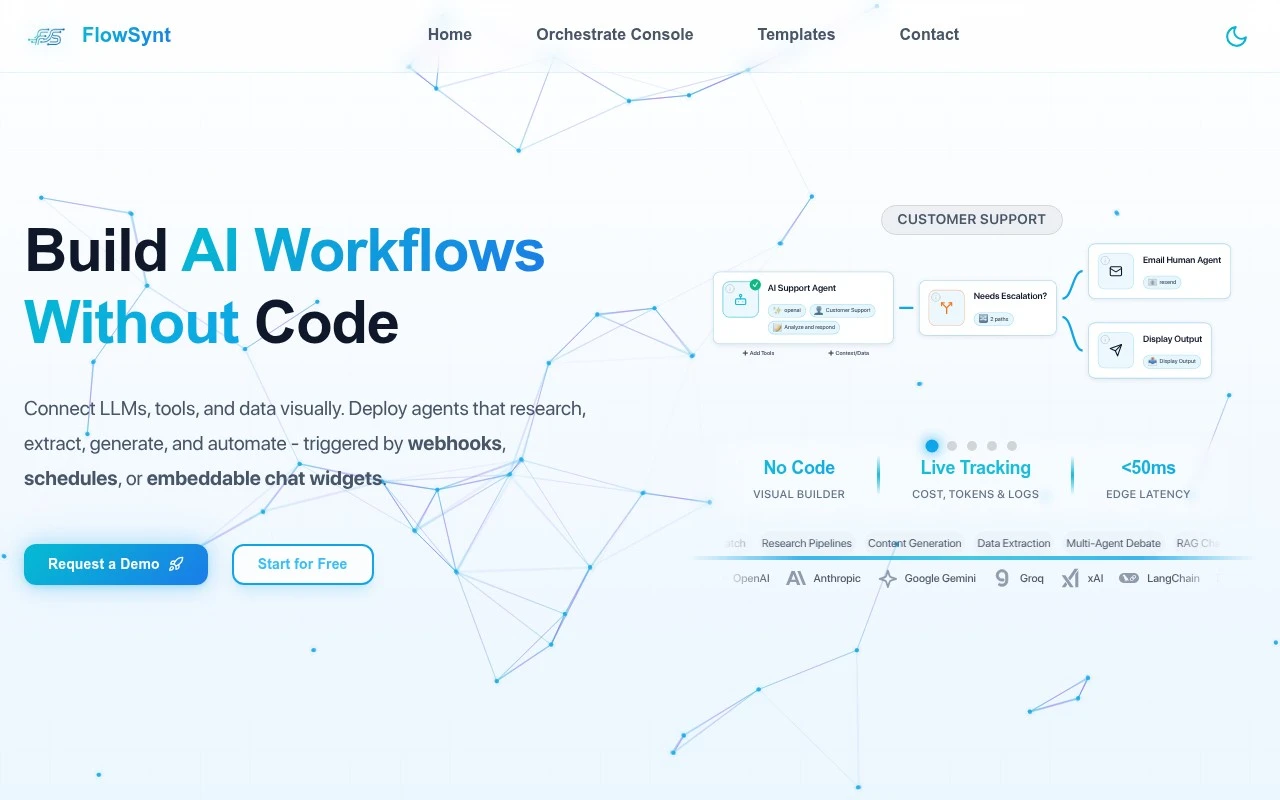
Syntflow, presented on the site as FlowSynt, appears to position itself as an enterprise platform for visually orchestrating AI agents and agent collaboration. The available official content is too limited to confirm specific capabilities, integrations, deployment model, or user workflows, so the tool needs manual review before it can be described more concretely.

FYAI Score

7.3 / 10

FYAI rating based on features, pricing and integrations

Pricing:

Free trial

Best for:

Enterprise AI teams orchestrating multi-agent workflows

Score Breakdown

  • Ease of use7.0 / 10
  • Features7.0 / 10
  • Pricing7.1 / 10
  • Integrations8.4 / 10
  • Support7.2 / 10

PRODUCT PREVIEW

What this AI tool does

Syntflow is an AI tool designed to help people turn ideas and inputs into structured outputs through guided, automated workflows. It’s intended for users who want a more consistent way to move from a prompt or starting material to a usable result, without having to manually manage every step of the process. In practice, syntflow can be used to organize tasks that involve repeated patterns—such as drafting, transforming, or refining content—by keeping the work in a clear sequence. This makes it easier to review what happened at each stage, adjust inputs when needed, and maintain a predictable process for similar requests over time.

Use cases

Best for

Visual Agent Orchestration

Use Syntflow to verify it provides a visual interface for orchestrating AI agents into coordinated workflows.

Enterprise Agent Collaboration

Use it to assess whether the platform supports enterprise team collaboration around AI agents and shared workflow orchestration.

AI Infrastructure Coordination Review

Use it to review whether its agent orchestration could coordinate AI infrastructure tasks, pending more product documentation.

ANALYSIS

Strengths & limitations

Strengths
  • The stated focus on visual AI-agent orchestration is clear at a high level.
  • The site positions the product for enterprise AI infrastructure and agent collaboration.
  • The visual-orchestration framing may be relevant for teams trying to understand complex agent systems.
Limitations
  • The official text does not provide enough detail to verify actual product functionality.
  • Specific features, integrations, supported agent frameworks, and workflow mechanics are not confirmed.
  • The naming mismatch between Syntflow and FlowSynt requires review to ensure the product identity is correct.

Evaluation

FYAI score breakdown

Our structured evaluation across five key criteria

7.3 / 10

Overall score

FYAI rating based on features, pricing and integrations

  • Ease of use7.0 / 10
  • Features7.0 / 10
  • Pricing7.1 / 10
  • Integrations8.4 / 10
  • Support7.2 / 10

What users say

Findings from public reviews, documentation and community sources.

  • Ease of use

    Reddit testing feedback described Synthflow as having “better pacing” and being “a bit smoother,” while also saying Synthflow was “still brittle” and felt “more like a fancy IVR than an agent.”

  • Features

    A Reddit user discussion frames Synthflow around an “AI Voice receptionist” that calls opted-in leads and creates a lead score, and another Reddit test mentions callbacks. The same Reddit testing feedback called Synthflow “still brittle.”

  • Pricing

    Synthflow’s pricing page says “Enterprise contracts start at $30,000 annually,” and Reddit agency discussion cites an “Agency plan” at “$1,250/month.” Public snippets also describe per-minute pricing starting at “$0.08/min.”

  • Integrations

    Synthflow’s integration documentation says Synthflow covers “CRM, scheduling, payments, automation, and telephony workflows” and supports “purchased numbers, Twilio, and SIP or PBX.” Synthflow’s indexed integrations page states connectivity to “over 200+ apps” and “developer tools via API.”

  • Support

    The Reddit testing thread focuses on Synthflow product experience, and the Reddit agency discussion focuses on Synthflow pricing rather than support responsiveness.

Who is this for?

Best for teams building voice-agent workflows around reception, opted-in lead calling, lead scoring, and callbacks, Reddit user discussion frames Synthflow around an “AI Voice receptionist” that calls opted-in leads and creates a lead score. Best for teams that need workflow connections, Synthflow’s indexed integrations page states connectivity to “over 200+ apps” and “developer tools via API.” Less suited to smaller teams, Synthflow’s pricing page says “Enterprise contracts start at $30,000 annually,” and Reddit agency discussion cites an “Agency plan” at “$1,250/month.” Less suited to buyers expecting agent-like conversations, Reddit testing feedback said Synthflow was “still brittle” and felt “more like a fancy IVR than an agent.”

PRODUCT PREVIEW

Feature highlights

Visual agent flows

Design and manage agent workflows with a visual orchestration layer.

Agent collaboration

Coordinate multiple agents to work together on shared tasks.

Enterprise orchestration

Structure agent operations for consistent, repeatable team execution.

COMPARE

Discover curated alternatives worth comparing

Compare similar AI tools based on features, pricing and use cases

8.1/ 10FYAI score

Helply

Customer Support BotsKnowledge Base Bots
Answers support tickets, drafts replies, and flags churn risk
Best for:
Customer support teams
Pricing
Freemium

8.7/ 10Based on 7.757 reviews

Zoho Desk

Customer Support BotsKnowledge Base Bots
Uses Zia AI to triage tickets, draft replies, and flag issues
Best for:
Customer support teams
Pricing
Freemium

7.8/ 10Based on 31.824 reviews

Zoho

Customer Support Bots
Cloud suite for CRM, finance, HR, and business operations
Best for:
Operations teams
Pricing
Freemium

Start resolving customer questions instantly with Syntflow. Deliver faster, more consistent support and keep customers satisfied—day and night.

FAQ

Frequently asked
questions

Everything you need to know about this AI tool,
its features, pricing, use cases, and limitations.

What customer support use cases is Syntflow a good fit for?
Syntflow fits high-volume, repeatable support workflows like order status, password resets, basic troubleshooting, and ticket triage. It’s most useful when you want consistent answers across channels and clear handoff rules to human agents. If your support relies heavily on nuanced judgment or domain-specific expertise, you’ll likely need more customization and tighter escalation paths.
Does Syntflow have a free plan, and what are the typical limitations compared to paid tiers?
Syntflow’s availability of a free tier depends on current packaging, but trials are common for tools in this category. Free/trial access usually limits conversation volume, channels, integrations (like CRM), and advanced analytics. If CRM sync and production-grade routing are must-haves, expect to evaluate a paid plan.
How does Syntflow compare with other conversational AI support tools?
Compared with broader chatbot platforms, Syntflow is typically evaluated on how well it automates routine support while integrating into existing CRM workflows. If you need deep omnichannel marketing automation or complex bot-building ecosystems, some competitors may offer more breadth. If your priority is support deflection plus structured handoffs, Syntflow can be a practical shortlist option.
How quickly can a team set up Syntflow and go live?
Syntflow may miss nuance in complex or ambiguous customer messages, which can create friction without strong fallback-to-agent handling. It can also require meaningful upfront effort to train and refine flows, especially for specialized industries. The more unique your policies and terminology are, the more ongoing tuning you should plan for.
What should I check regarding Syntflow’s data handling, privacy, and compliance?
Confirm what customer data Syntflow stores, how long it’s retained, and whether transcripts are used for model improvement. Review encryption, access controls, and whether you can restrict or redact sensitive fields before they reach the bot. If you operate under GDPR/CCPA or industry rules, ask for documentation (e.g., DPA, subprocessors, data residency options) and verify CRM integration permissions.