LiveChat
Curated ToolThis tool is part of our curated AI directory. We only include tools that meet our standards for relevance, usability and real-world value.

LiveChat

LiveChat is a customer service platform that lets businesses add real-time chat to their websites and manage conversations with visitors and customers from an agent workspace.
Customer Support BotsChatbots

LiveChat

FYAI Score

8.6 / 10

Based on 1,727 reviews

Pricing:

Paid

Best for:

Support and sales teams helping website visitors in real time

Score Breakdown

  • Ease of use9.3 / 10
  • Features7.8 / 10
  • Pricing8.2 / 10
  • Integrations8.8 / 10
  • Support9.0 / 10

PRODUCT PREVIEW

What this AI tool does

LiveChat
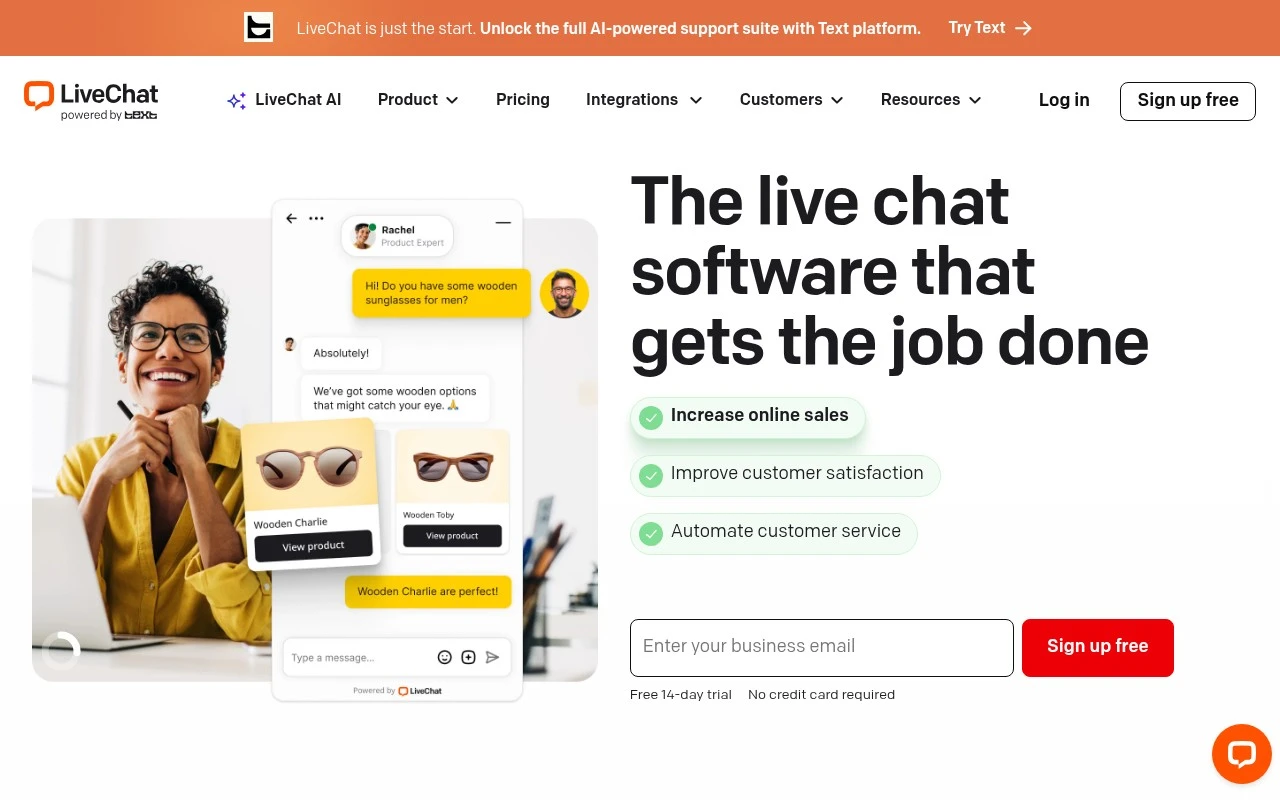
LiveChat is a website live chat platform for businesses that want to support customers, engage visitors, and convert browsing intent into conversations while people are still on the site. It is built around a real-time chat app for human agents, with surrounding tools that help teams manage sales, service, routing, follow-up, and performance measurement from one workspace. For support teams, the platform is designed to shorten the path between a customer question and a useful answer. Agents can handle multiple conversations, see context about the visitor, use prepared responses, and keep chats organised with tags and assignments. That makes it useful for businesses that need fast, human help without forcing every customer into email queues or phone support. Sales-oriented teams use the same conversation layer to guide visitors at moments of intent. Proactive customer engagement tools can invite a shopper or prospect to chat based on behaviour, such as time on page, cart activity, or navigation patterns. In ecommerce and lead-generation contexts, this turns the chat widget into more than a support channel, since it can also support product recommendations, qualification, and conversion assistance. Automation is a major part of how the platform scales beyond purely manual chat. Chatbot deployment can help answer common questions, collect contact details, qualify leads, route conversations, or handle repetitive support flows before an agent joins. This gives businesses a way to combine customer support automation with human escalation, rather than choosing between a fully automated bot and a fully manual help desk. Inside the agent workspace, AI features are focused on practical assistance during and after conversations. The in-app Copilot can help improve wording, suggest tags, summarise chats, and provide real-time guidance so agents can respond with more clarity and consistency. These capabilities are especially useful for busy teams that want better documentation and faster replies without making every agent build their own workflow from scratch. Reporting gives managers a clearer view of how conversations affect both service quality and revenue outcomes. LiveChat includes analytics for chat volume, response performance, agent activity, customer satisfaction, and sales tracking, helping teams connect individual conversations to broader business goals. The value is not only in seeing how many chats were handled, but in understanding which interactions contribute to support efficiency, lead capture, and purchases. A broad integration ecosystem makes the tool fit into existing business stacks rather than sitting apart from them. With 200+ integrations across ecommerce platforms, website builders, CRM systems, marketing tools, analytics products, and help desk workflows, teams can connect chat activity to the systems they already use. This is important for companies that need conversation data to move with the customer journey, from first visit to order, ticket, or follow-up campaign. For growing businesses, LiveChat is best suited to teams that see website conversations as both a customer experience channel and a commercial opportunity. It has the structure needed for organised support operations, but it also gives sales and marketing teams ways to engage visitors before they leave. Its overall character is practical and operational: a mature live chat platform that blends human service, automation, AI assistance, and integrations into a single customer communication layer.

Use cases

Best for

Proactive Customer Engagement

Use LiveChat to trigger proactive chat invites on key pages or behaviors so agents can engage visitors while they browse.

Product Recommendations

Agents use live chat to ask needs questions and share product links or carts in real time based on what the visitor is viewing.

Customer Support Automation

Set up chatbot flows to answer FAQs, collect details, and route chats to the right team with tags and summaries for agents.

ANALYSIS

Strengths & limitations

Strengths
  • Best suited to ecommerce, B2B, and support teams that want human agents to engage website visitors in real time from a shared live chat app.
  • Strong integration coverage fits teams that need live chat connected to ecommerce, website, CRM, and support workflows through a large integration ecosystem.
  • AI features support agent productivity because chatbots can handle routine inquiries while Copilot helps with text improvement, tag suggestions, summaries, and response assistance.

Limitations
  • Less suitable for teams that need a free live chat option because LiveChat is a paid product.
  • Less suitable as a standalone full contact center because its core fit is website live chat rather than replacing every support, ticketing, voice, and operations workflow.
  • Less suitable for teams seeking fully autonomous AI support because its AI features are mainly designed to automate routine chats and assist human agents.

Evaluation

FYAI score breakdown

Our structured evaluation across five key criteria

8.6 / 10

Overall score

Based on 1,727 reviews

  • Ease of use9.3 / 10
  • Features7.8 / 10
  • Pricing8.2 / 10
  • Integrations8.8 / 10
  • Support9.0 / 10

What users say

Findings from public reviews, documentation and community sources.

  • Ease of use

    LiveChat describes its product page as “intuitive customer service software,” “Quick to set up,” and “easy for your team to use.” G2 lists 810 reviews for LiveChat and highlights reviewer language that it is “easy and fast” for real-time communication.

  • Features

    LiveChat’s site lists live website support, sales engagement, AI chatbot automation, and Copilot features including “Text enhancement,” “Tag suggestions,” and “Chat summary.” LiveChat’s site positions the product as AI-assisted live chat plus chatbot automation rather than a fully standalone AI-agent platform.

  • Pricing

    LiveChat’s pricing page lists a “Free 14-day trial,” “No credit card required,” and annual per-person prices of $19 Starter, $49 Team, and $79 Business, plus Enterprise via sales contact. LiveChat’s pricing page also references plan limits such as visitor tracking and chat-history caps.

  • Integrations

    LiveChat states that users can “Mix and match from 200+ integrations.” LiveChat specifically names WordPress, Squarespace, Mailchimp, Shopify, and BigCommerce as integrations.

  • Support

    LiveChat’s pricing page lists “24/7/365 Support” on the Starter plan. LiveChat’s site navigation includes Help Center and “Chat with us,” and Capterra’s summary says users find the platform “easy to use, reliable, and very helpful.”

Who is this for?

Best for teams that need live website support with quick rollout. LiveChat describes the product as “Quick to set up” and “easy for your team to use.” Best for teams that rely on ecommerce or site-tool connections, since LiveChat states that users can “Mix and match from 200+ integrations” and names Shopify, BigCommerce, WordPress, Squarespace, and Mailchimp. Less suited to teams seeking a fully standalone AI-agent platform, because LiveChat’s own feature evidence positions it as AI-assisted live chat plus chatbot automation.

PRODUCT PREVIEW

Feature highlights

Live website chat

Chat with visitors instantly to answer questions and drive sales.

Sales & chat reports

Track chat performance and revenue impact with built-in analytics.

Chat While They Browse

Engage visitors in real time to answer questions and close more sales.

COMPARE

Discover curated alternatives worth comparing

Compare similar AI tools based on features, pricing and use cases

8.1/ 10FYAI score

Helply

Customer Support BotsKnowledge Base Bots
Answers tickets, drafts replies, flags gaps and churn risks
Best for:
Customer support teams
Pricing
Freemium

8.7/ 10Based on 7,757 reviews

Zoho Desk

Customer Support BotsKnowledge Base Bots
Handles routine tickets, flags issues, and drafts replies
Best for:
Customer support teams
Pricing
Freemium

7.8/ 10Based on 31,824 reviews

Zoho

Customer Support Bots
Runs business apps for sales, finance, HR, and support teams
Best for:
Operations teams
Pricing
Freemium

LiveChat

Turn more visitors into happy customers with faster, friendlier support. See why teams choose LiveChat to resolve questions in real time and boost sales.

FAQ

Frequently asked
questions

Everything you need to know about this AI tool,
its features, pricing, use cases, and limitations.

Who is LiveChat best suited for?
LiveChat is best suited for ecommerce, B2B, and support teams that need real-time website chat for sales and customer service. It fits teams that want a shared inbox, visitor context, reporting, integrations, and AI assistance for repetitive questions, chat summaries, tagging, and faster agent replies.
Does LiveChat have a free plan?
LiveChat is a paid live chat platform, so buyers should compare its plans against their team size, chat volume, and automation needs. The value depends on whether the team will actively use website chat, chatbot workflows, reporting, integrations, and AI-assisted agent features in day-to-day support or sales.
How does LiveChat compare with other customer support chat tools?
LiveChat is strongest for teams that prioritize real-time conversations on business websites, especially for sales, support, and visitor engagement. When comparing it with similar tools, buyers should assess channel coverage, chatbot depth, integrations, reporting, pricing model, ease of setup, and whether agents need AI help inside the chat workflow.
How hard is it to set up LiveChat on a website?
LiveChat is primarily built around website-based live chat, so it may not replace every customer support channel for every business. Its automation is best used for common questions and repetitive tasks, while complex issues may still need human agents. Results also depend on proper workflow design and active team adoption.
What should teams check before using LiveChat for customer data?
Teams should review LiveChat’s current privacy, security, and compliance documentation before sending customer data through the platform. Important checks include data retention, user permissions, audit needs, chatbot data handling, integration permissions, and whether the setup aligns with internal policies for customer support, sales conversations, and regulated information.