Kayako
Curated ToolThis tool is part of our curated AI directory. We only include tools that meet our standards for relevance, usability and real-world value.

Kayako

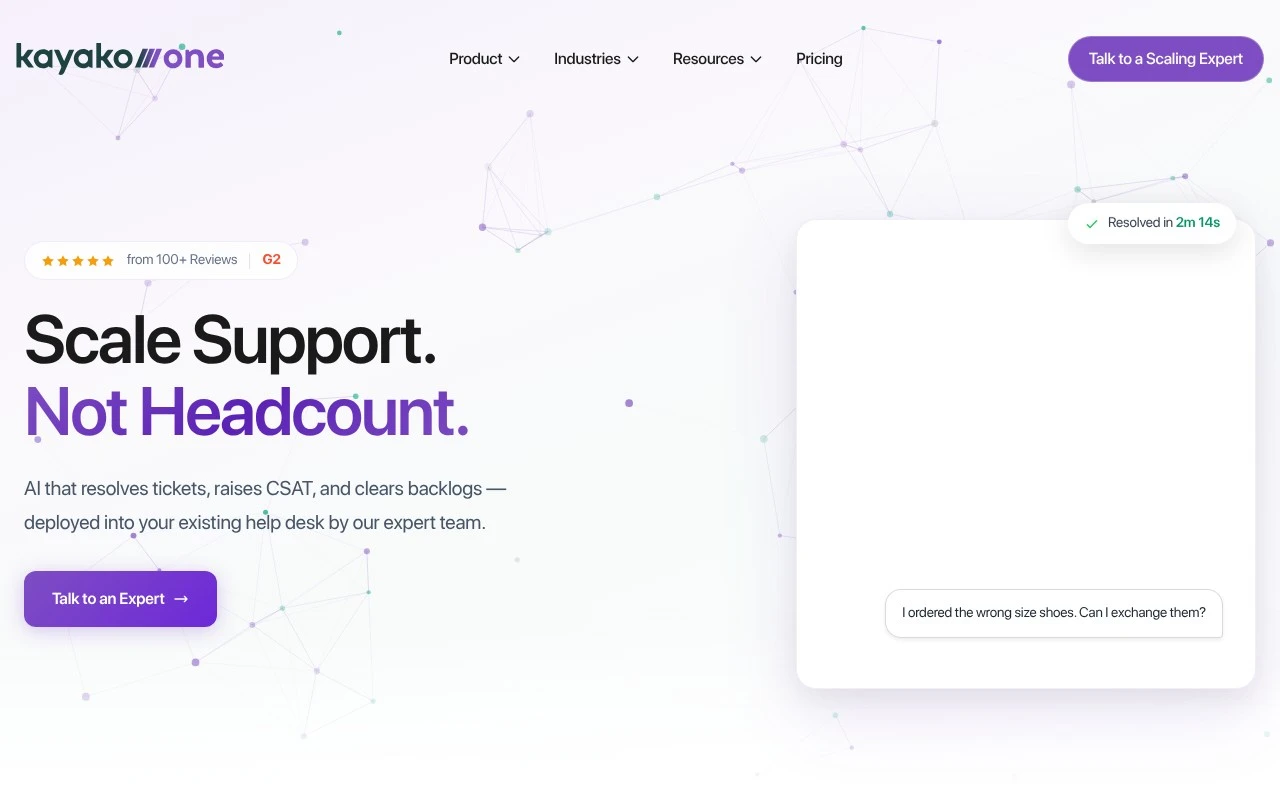
Kayako is customer service software that helps teams manage support conversations across email, live chat, and help center channels. It provides a shared inbox, customer context, and self-service knowledge base tools for handling customer support requests.
Customer Support Bots

Kayako

FYAI Score

8.5 / 10

Based on 227 reviews

Pricing:

Paid

Best for:

Support teams scaling ticket volume without adding headcount

Score Breakdown

  • Ease of use8.0 / 10
  • Features8.3 / 10
  • Pricing8.6 / 10
  • Integrations9.0 / 10
  • Support9.2 / 10

PRODUCT PREVIEW

What this AI tool does

Kayako
Kayako is a customer support platform for teams that want to combine a modern help desk with AI-assisted and AI-automated ticket handling. Kayako brings shared inboxes, customer context, workflow automation, knowledge management, reporting, SLA controls, and security into one support environment, with an AI agent called Kay designed to extend automation across Kayako or other help desk systems. For support teams, the product is built around the reality that most customer service work happens in tickets, conversations, and repeated decisions. The platform helps agents understand who the customer is, what has happened before, and what the likely next step should be. That makes it relevant for companies that need faster response times without losing the nuance of human support. Its AI strategy is deliberately phased rather than presented as an instant replacement for a service team. Kayako emphasizes starting with AI triage, then moving to AI-drafted replies, and only later allowing autonomous resolution once the system has learned from the company’s existing tickets, products, policies, and tone. Kayako is strongest for organizations that want customer support automation introduced with operational control, not switched on as a black box. Kay, the AI support agent, is the clearest expression of that approach. It can classify requests, suggest or draft answers, and resolve suitable issues when the underlying knowledge and workflow design are mature enough. Because Kay can plug into Kayako or other help desk systems, it is positioned not only as a feature inside the help desk, but also as an AI layer for support operations that may already have an existing ticketing stack. Inside the help desk, the value is not only in automation but in bringing daily support work into a more organized flow. Shared inboxes keep teams aligned on ownership and status, while customer history gives agents the context needed to avoid repetitive questions. No-code workflows allow teams to route, prioritize, escalate, and standardize support processes without depending on engineering for every operational change. Operationally, the platform is aimed at teams that care about consistency as much as speed. SLA management and analytics help managers understand where queues are slowing down, which categories create the most workload, and how agent performance or automation coverage is changing over time. A knowledge base supports both self-service and AI response quality, since better source material generally leads to better automated answers. For leaders responsible for support quality, Kayako presents AI as a managed transformation rather than a simple chatbot deployment. The company highlights expert-led implementation, which means the rollout is guided through discovery, setup, training, evaluation, and expansion. That positioning fits businesses that have complex products, established service standards, or concerns about letting AI communicate with customers before it has been properly trained. The platform’s character is practical and service-operations focused. It is not just a ticket queue, and it is not just an AI bot. Kayako is a help desk and AI support automation system for teams that want human agents, workflows, knowledge, analytics, and autonomous support to work from the same customer service foundation.

Use cases

Best for

Customer Support Automation

Kayako uses AI triage and AI-drafted replies to route, prioritize, and answer support tickets in a shared inbox.

Workflow Automation

Kayako runs no-code workflows that assign tickets, trigger SLA timers, and escalate cases based on rules and customer context.

Omnichannel Support

Kayako centralizes email, chat, and help center requests so agents see full customer history and respond from one place.

ANALYSIS

Strengths & limitations

Strengths
  • Best suited to high-volume support teams because AI triage, drafted replies and autonomous resolution can reduce repetitive ticket handling without immediately adding headcount.
  • Strong fit for support operations teams because the help desk combines shared inbox, customer context, no-code workflows, knowledge base, analytics, SLA management and security controls in one platform.
  • Useful for teams adopting AI cautiously because Kayako emphasizes expert-led, phased deployment that starts with triage before moving to drafted answers and autonomous resolution.

Limitations
  • Less suitable for very small or low-volume support teams because the paid platform is oriented toward teams with enough ticket volume to justify AI automation and operational rollout.
  • Less suitable for teams wanting instant plug-and-play automation because effective AI resolution depends on training the system on tickets, products, policies and tone over time.
  • End-to-end action automation requires integrations with relevant business systems, so teams with fragmented or restricted internal tools should expect extra implementation work.

Evaluation

FYAI score breakdown

Our structured evaluation across five key criteria

8.5 / 10

Overall score

Based on 227 reviews

  • Ease of use8.0 / 10
  • Features8.3 / 10
  • Pricing8.6 / 10
  • Integrations9.0 / 10
  • Support9.2 / 10

What users say

Findings from public reviews, documentation and community sources.

  • Ease of use

    G2’s product-review signal says users “consistently praise the ease of use and intuitive interface” and that Kayako “simplifies ticket management and enhances team collaboration.” Kayako’s website positions deployment as expert-led rather than a purely self-serve setup.

  • Features

    Kayako’s website describes a broad AI support/helpdesk platform with “AI Triage,” “AI Answers,” “Continuous Learning,” and an “omnichannel inbox.” Kayako’s website also references “no-code workflow automation,” “knowledge base with semantic search,” “analytics & SLA management,” and enterprise security.

  • Pricing

    Kayako’s pricing page states “$1 Per Resolved Ticket,” with “No seat fees. No setup fees,” and “No charge for escalations or partial resolutions.” Kayako’s pricing page positions the full Kayako One platform through “Talk to an Expert.”

  • Integrations

    Kayako’s integrations page lists “hundreds of apps through Zapier,” “APIs and webhooks,” and pre-built connectors including “Salesforce,” “Slack, Teams, WhatsApp,” and “Shopify, Stripe, Chargebee.” Kayako’s integrations page states, “If your system has an API, Kay can use it.”

  • Support

    Kayako’s website says, “We don’t hand you the keys and walk away,” and describes a “Full white-glove team.” Kayako’s website lists “implementation engineers, prompt experts, and a dedicated success manager.”

Who is this for?

Best for customer support teams that want AI helpdesk deployment with hands-on guidance, Kayako’s website lists “implementation engineers, prompt experts, and a dedicated success manager.” Best for teams with connected support stacks, Kayako’s integrations page lists “hundreds of apps through Zapier,” “APIs and webhooks,” and connectors including “Salesforce,” “Slack, Teams, WhatsApp,” and “Shopify, Stripe, Chargebee.” Less suited to buyers who need a fully self-serve purchase path for the entire platform, Kayako’s pricing page positions the full Kayako One platform through “Talk to an Expert.”

PRODUCT PREVIEW

Feature highlights

AI ticket triage

Auto-categorize, prioritize, and route tickets to the right team.

AI-drafted replies

Generate on-brand answers from your history, products, and tone.

No-code workflows

Automate SLAs, escalations, and approvals without engineering help.

COMPARE

Discover curated alternatives worth comparing

Compare similar AI tools based on features, pricing and use cases

8.1/ 10FYAI score

Helply

Customer Support BotsKnowledge Base Bots
Answers tickets, drafts replies, flags gaps and churn risks
Best for:
Customer support teams
Pricing
Freemium

8.7/ 10Based on 7,757 reviews

Zoho Desk

Customer Support BotsKnowledge Base Bots
Handles routine tickets, flags issues, and drafts replies
Best for:
Customer support teams
Pricing
Freemium

7.8/ 10Based on 31,824 reviews

Zoho

Customer Support Bots
Runs business apps for sales, finance, HR, and support teams
Best for:
Operations teams
Pricing
Freemium

Kayako

Deliver faster, more personal support at scale. See why teams choose Kayako to keep customers happy and agents focused.

FAQ

Frequently asked
questions

Everything you need to know about this AI tool,
its features, pricing, use cases, and limitations.

Who is Kayako best suited for?
Kayako is best suited for support teams with meaningful ticket volume that want to reduce repetitive work without adding headcount. It fits customer support leaders and support operations teams that need a shared inbox, AI triage, routing, reply drafting, escalation handling, workflow automation, knowledge base support, and SLA reporting.
Is Kayako free or paid?
Kayako is a paid customer support platform. Public pricing is not presented as a simple self-serve plan comparison, so buyers should check kayako.com or speak with Kayako for current pricing, packaging, implementation scope, and any limits on AI usage, seats, channels, or connected systems.
How does Kayako compare with other customer support automation tools?
Kayako differs from many support automation tools by combining a full help desk with an AI agent that can also be layered onto existing support systems. It is a stronger fit when teams want ticket routing, drafting, escalation, knowledge-base search, and routine case automation in one workflow.
How hard is it to set up Kayako?
The main trade-off with Kayako is that its AI automation and expert-led implementation may be more involved than lightweight teams need. Buyers should also validate vendor-provided performance claims during evaluation and account for the lack of simple public pricing when comparing it with other help desk options.
What should buyers check about Kayako’s data handling and compliance?
Buyers should review how Kayako handles customer conversations, ticket history, knowledge base content, and data passed to connected systems. Important checks include access controls, data retention, audit logs, regional hosting needs, AI training settings, compliance certifications, and approval controls for automated actions such as refunds or customer record updates.