
Curated ToolThis tool is part of our curated AI directory. We only include tools that meet our standards for relevance, usability and real-world value.
Hume AI
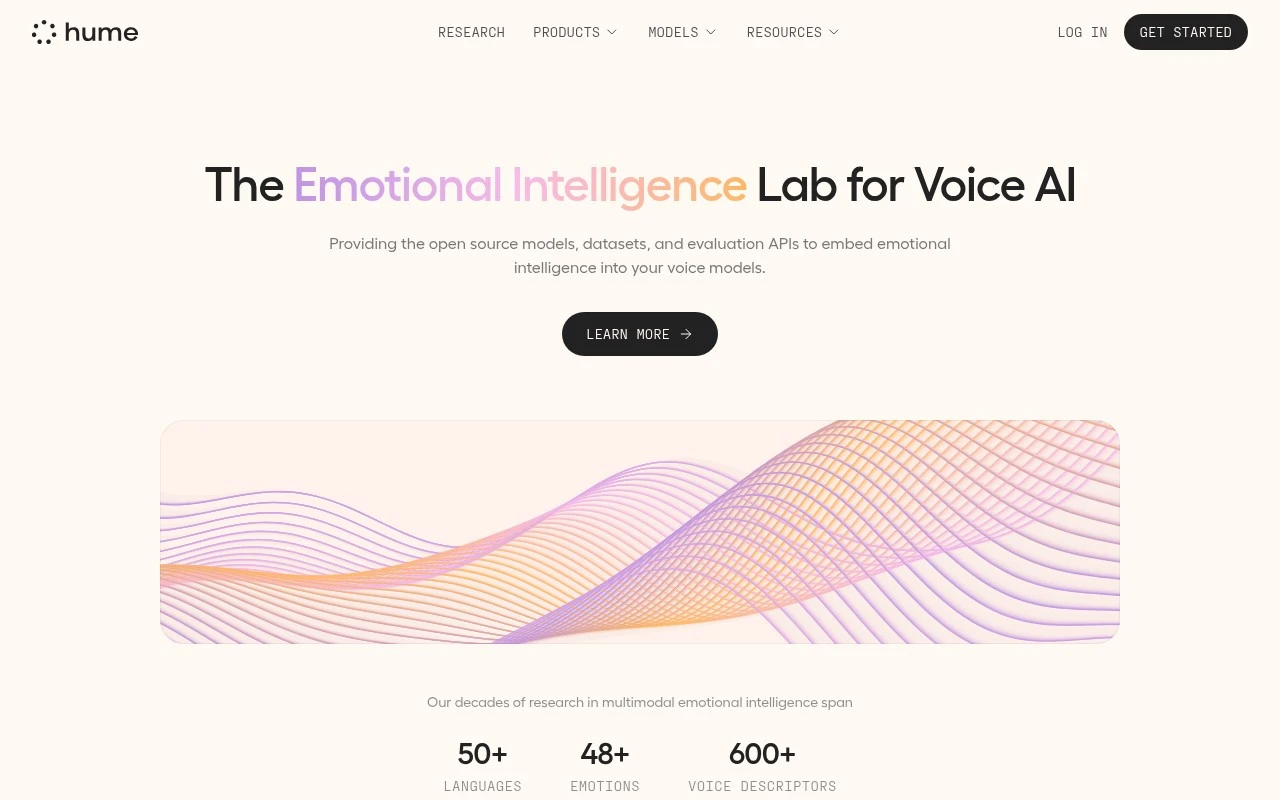
Hume AI is an AI platform for building empathic voice interfaces that interpret emotional cues in speech and generate responsive conversations. Its APIs also analyze vocal, facial, and language signals to help applications understand human expression.
Voice Agents

FYAI Score
8.2 / 10
Based on 12 reviews + FYAI product analysis
Pricing:
Paid only
Best for:
Voice AI teams building emotionally aware conversational audio
Score Breakdown
- Ease of use7.2 / 10
- Features8.2 / 10
- Pricing9.3 / 10
- Integrations8.2 / 10
- Support8.1 / 10
 | Strengths |
-
 Best suited to teams building expressive voice agents because its models and workflows are designed around emotional intelligence in speech.
 -
Useful for voice AI research and product development because it combines evaluation APIs, curated speech datasets, and voice model capabilities in one platform.
-
Strong fit for conversational audio systems that need natural turn-taking because it supports use cases such as interruptible, multilingual, and speech-to-speech interactions.
 | Limitations |
-
 Less suitable for teams focused only on text chatbots because the platform is centered on voice, speech, and audio model development.
 -
Less suitable for non-technical teams seeking a simple no-code assistant builder because its value depends on API integration, model evaluation, and voice AI development workflows.
-
Paid-only access can be a constraint for early experiments or high-volume audio workloads because costs need to be planned before scaling usage.
 | 8.1/ 10FYAI score |
Helply
Customer Support BotsKnowledge Base Bots
Answers tickets, drafts replies, flags gaps and churn risks
Best for: | Customer support teams |
Pricing | Freemium |
 | 8.7/ 10Based on 7,757 reviews |
Zoho Desk
Customer Support BotsKnowledge Base Bots
Handles routine tickets, flags issues, and drafts replies
Best for: | Customer support teams |
Pricing | Freemium |
| 7.8/ 10Based on 31,824 reviews |
Zoho
Customer Support Bots
Runs business apps for sales, finance, HR, and support teams
Best for: | Operations teams |
Pricing | Freemium |