Hiver
Curated ToolThis tool is part of our curated AI directory. We only include tools that meet our standards for relevance, usability and real-world value.

Hiver

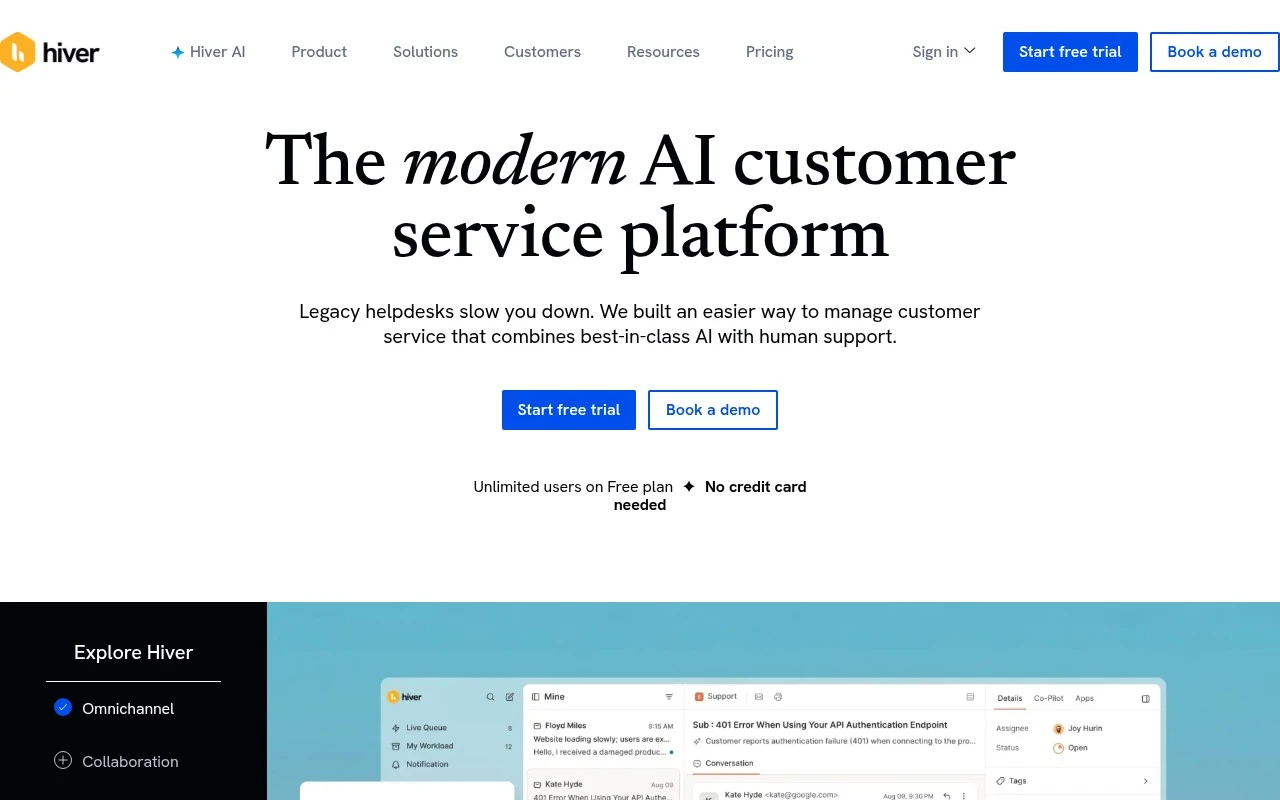
Hiver is a customer service platform built for Google Workspace that lets teams manage shared inboxes such as support@ and info@ directly from Gmail. It supports email assignment, internal collaboration, SLA tracking, and reporting for handling customer conversations.
Customer Support Bots

FYAI Score

8.8 / 10

Based on 1,283 reviews

Pricing:

Paid

Best for:

Customer support teams running complex workflows across channels

Score Breakdown

  • Ease of use9.1 / 10
  • Features8.3 / 10
  • Pricing8.9 / 10
  • Integrations8.9 / 10
  • Support9.2 / 10

PRODUCT PREVIEW

What this AI tool does

Hiver
Hiver is a customer service platform for teams that need to manage support conversations, collaborate across departments, and automate complex workflows from one place. Hiver serves both organizations that want a full omnichannel support system and teams that prefer to run a helpdesk directly inside Gmail. Its core strength is turning everyday customer communication into structured, trackable work without separating agents from the context they need. Two product paths define the platform. Hiver Omni is built for omnichannel support across channels such as email, chat, voice, and connected systems, while Hiver in Gmail turns Gmail into a shared inbox helpdesk with assignments, statuses, internal notes, and service-level controls. This makes it useful for support, operations, finance, IT, and other teams that already work heavily from inboxes but need more discipline than a shared mailbox can provide. For customer-facing teams, the platform is centered on ticket ownership and clear collaboration. Conversations can be routed, assigned, prioritized, and tracked, while internal teams can discuss issues without forwarding threads or losing customer history. Hiver is best at helping teams manage inbox triage, escalation, and cross-functional support work while preserving a simple communication layer for agents. Automation gives the system much of its operational value. Rules, workflows, and AI-assisted processes can reduce repetitive sorting, enforce procedures, and keep requests moving through the right queues. In practice, this supports customer support automation without requiring every workflow to become a rigid, developer-led project. AI is a central part of Hiver’s newer product story. The platform positions its AI copilots and AI agents as tools that can understand ticket context, follow defined procedures, suggest or generate responses, and take action across connected tools. Rather than acting only as a writing assistant, its agentic AI is designed to work with knowledge sources, ticket data, integrations, APIs, and webhooks to complete support tasks within controlled boundaries. Customer context is treated as a working layer, not just a reference panel. Agents can use conversation history, account details, knowledge base content, and connected app data to understand what a customer is asking and what has already happened. This is especially important for teams handling complex requests where the answer depends on policy, order status, internal approvals, or previous interactions. Knowledge management connects directly to support execution. Teams can build and maintain internal or customer-facing knowledge resources, then use that content to help agents respond consistently and help AI systems ground their answers. The result is a support environment where documentation, automation, and live service are connected rather than managed as separate silos. Quality and insight features round out the platform’s role for managers. Reporting, analytics, service-level visibility, and performance signals help leaders understand response times, workload patterns, bottlenecks, and the quality of customer interactions. These tools make Hiver useful not only for handling tickets, but also for improving how a service operation works over time. The Gmail-native experience is one of the tool’s most distinctive traits. Many helpdesks ask teams to leave the inbox behind, but Hiver in Gmail meets users where they already communicate and adds structure around that familiar workflow. This can reduce adoption friction for teams that want accountability and automation without forcing agents into a completely separate helpdesk interface. At a broader level, Hiver is positioned for service teams that need more than a shared inbox but may not want an overly heavy enterprise system. It combines helpdesk fundamentals, omnichannel service, AI agents, workflow automation, and collaboration into a platform designed around real operational complexity. For organizations where customer support depends on both fast responses and coordinated internal action, Hiver offers a practical way to turn conversations into managed service workflows.

Use cases

Best for

Customer Support Automation

Automate support workflows by routing tickets, triggering approvals, and letting AI agents take actions via integrations and webhooks.

Inbox Triage

Hiver turns Gmail into a shared inbox that tags, assigns, and prioritizes incoming emails with ticket status and customer context.

Omnichannel Support

Provide omnichannel support by managing email, chat, and other channels in one queue with shared notes, SLAs, and knowledge base links.

ANALYSIS

Strengths & limitations

Strengths
  • Best suited to support teams that need both omnichannel service management and a Gmail-native shared inbox, because Hiver offers deployment paths for teams that want a full helpdesk or want to keep agents inside Gmail.
  • Strong fit for complex support operations because its AI agents can follow defined procedures, use ticket and connected-tool context, and trigger actions through APIs, webhooks, and integrations.
  • Useful for cross-functional service teams because ticket management, internal collaboration, knowledge management, quality checks, and insights sit within the same support workflow.

Limitations
  • Less suitable for teams that only need a lightweight shared inbox because Hiver’s workflow automation, AI agents, QA, and knowledge features add setup and governance overhead.
  • The Gmail-based offering is a poor fit for organizations standardized on non-Google email environments because that workflow depends on agents working inside Gmail.
  • Paid-only adoption can be a barrier for very small teams or experimental projects because ongoing costs are part of using Hiver rather than an optional upgrade path.

Evaluation

FYAI score breakdown

Our structured evaluation across five key criteria

8.8 / 10

Overall score

Based on 1,283 reviews

  • Ease of use9.1 / 10
  • Features8.3 / 10
  • Pricing8.9 / 10
  • Integrations8.9 / 10
  • Support9.2 / 10

What users say

Findings from public reviews, documentation and community sources.

  • Ease of use

    G2 lists 1,283 reviews for Hiver in Gmail, and G2's summary says users “consistently praise Hiver for its ease of use and seamless integration with Gmail.”

  • Features

    Hiver's website says Hiver covers “email, chat, Slack, voice, socials, and WhatsApp” in one workspace, and lists AI Agents, AI Copilot, AI Knowledge Hub, and AI Insights. Hiver's pricing page marks some advanced AI items as “COMING SOON.”

  • Pricing

    Hiver's pricing page lists a “Free forever” tier, paid annual tiers Growth “$25 /user/month,” Pro “$55 /user/month,” and Elite “$85 /user/month,” and a 7-day Elite trial with no credit card required. Hiver's pricing page places advanced capabilities in higher tiers, and some are marked “COMING SOON.”

  • Integrations

    Hiver's website states Hiver can connect “Salesforce, Shopify, NetSuite, and 1,000+ tools,” and names Jira, Linear, Slack, Confluence, Notion, and Google Sheets. Hiver's website says Pro includes “API access.”

  • Support

    Hiver's pricing page says the Free tier includes “24*7 support” with “round-the-clock access to Hiver's support team over email and chat.” Hiver's pricing page includes a customer quote describing Hiver's support as “responsive and genuinely proactive.”

Who is this for?

Best for support teams that work from Gmail and need multiple customer channels in one workspace, Hiver's website says it covers “email, chat, Slack, voice, socials, and WhatsApp.” Less suited to teams that need every advanced AI capability available immediately, Hiver's pricing page marks some advanced AI items as “COMING SOON,” and advanced capabilities sit in higher tiers.

PRODUCT PREVIEW

Feature highlights

Omnichannel Inbox

Manage email, chat, and more in one queue with full customer context.

Agentic AI Actions

AI follows procedures and triggers actions via APIs, webhooks, and tools.

Workflow Automation

Auto-route, assign, and escalate tickets with SLAs and rules.

COMPARE

Discover curated alternatives worth comparing

Compare similar AI tools based on features, pricing and use cases

8.1/ 10FYAI score

Helply

Customer Support BotsKnowledge Base Bots
Answers tickets, drafts replies, flags gaps and churn risks
Best for:
Customer support teams
Pricing
Freemium

8.7/ 10Based on 7,757 reviews

Zoho Desk

Customer Support BotsKnowledge Base Bots
Handles routine tickets, flags issues, and drafts replies
Best for:
Customer support teams
Pricing
Freemium

7.8/ 10Based on 31,824 reviews

Zoho

Customer Support Bots
Runs business apps for sales, finance, HR, and support teams
Best for:
Operations teams
Pricing
Freemium

Hiver

Bring order to your team inbox and respond faster, together. See why support teams choose Hiver to stay accountable and never miss a customer message.

FAQ

Frequently asked
questions

Everything you need to know about this AI tool,
its features, pricing, use cases, and limitations.

Who is Hiver best suited for?
Hiver is best suited for support, customer success, operations, and account teams that manage shared customer conversations at scale. It fits teams that want either a Gmail-native helpdesk or an omnichannel support workspace, especially when requests require routing, collaboration, customer context, workflow tracking, and AI-assisted triage or resolution.
Does Hiver have a free plan, or is it paid?
Hiver is a paid customer support platform, so teams should review its current plans on hiverhq.com before budgeting. Plan choice can affect access to helpdesk features, automation, AI capabilities, channels, collaboration tools, and implementation support, so buyers should compare what is included against their support volume and workflow needs.
How does Hiver compare with other customer support automation tools?
Hiver stands out for combining a Gmail-native helpdesk option with an omnichannel support product. Compared with similar tools, it is especially relevant for teams that want shared inbox collaboration, ticket workflows, and AI automation connected to support procedures and external systems. The best fit depends on channels, budget, scale, and workflow complexity.
How long does it take to set up Hiver?
Hiver’s main trade-offs are its dependence on Gmail and Chrome workflows for the Gmail-native experience and the setup effort required for advanced AI automation. Teams that do not use Google Workspace, prefer only a standalone helpdesk, or need fully prebuilt automation with minimal configuration should validate fit carefully before committing.
What should teams check about Hiver’s data privacy and compliance?
Teams should review Hiver’s current security, privacy, and compliance documentation before connecting customer conversations, CRM data, ecommerce records, or internal systems. Because Hiver can gather ticket context, call APIs, update external records, and support AI-assisted workflows, buyers should verify access controls, data retention, auditability, vendor policies, and compliance requirements.