HelpCrunch
Curated ToolThis tool is part of our curated AI directory. We only include tools that meet our standards for relevance, usability and real-world value.

HelpCrunch

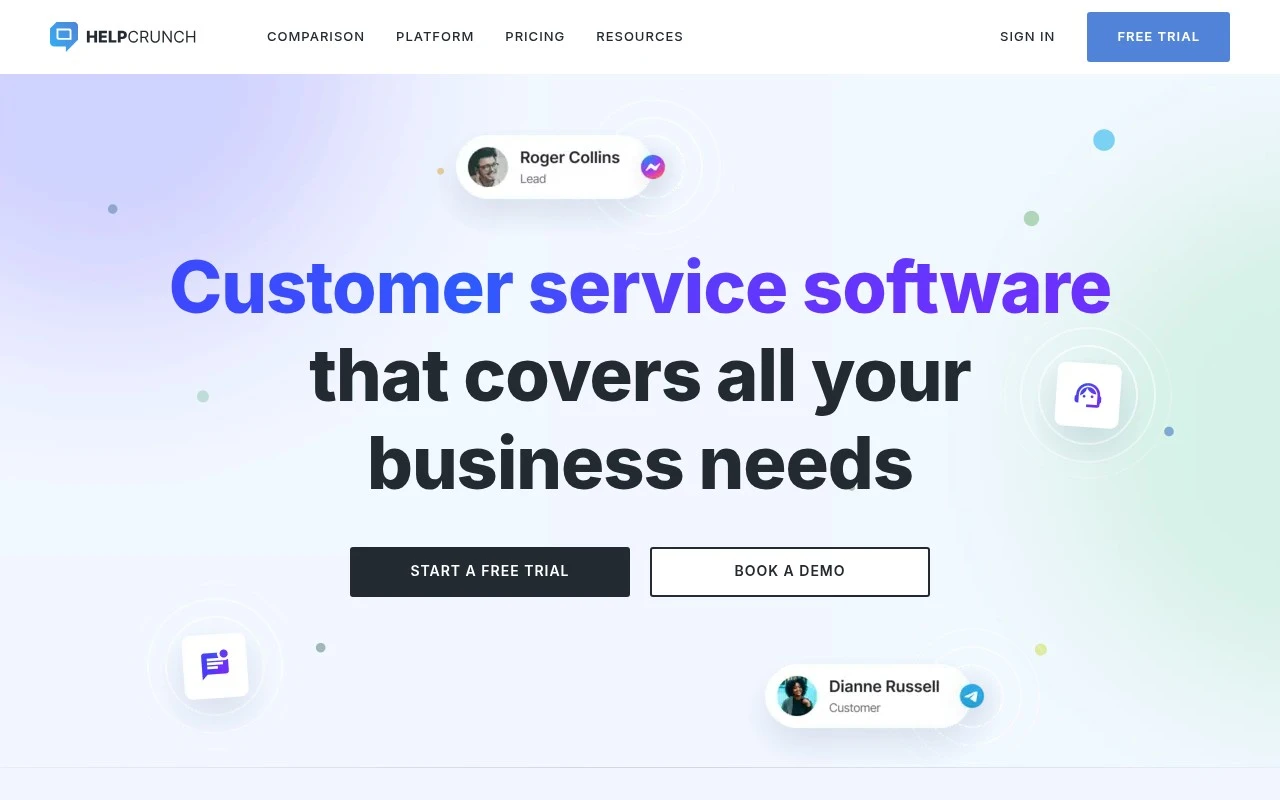
HelpCrunch is a customer communication platform that combines live chat, shared inbox, knowledge base, email campaigns, and chatbots to support website visitors and customers. It can be used for lead capture through customizable chat widgets, forms, and automated messages.
Customer Support BotsSales & Lead Bots

FYAI Score

8.3 / 10

Based on 238 reviews

Pricing:

Freemium

Best for:

Support and sales teams handling customer chats and in-app messaging

Score Breakdown

  • Ease of use8.0 / 10
  • Features7.7 / 10
  • Pricing8.7 / 10
  • Integrations8.3 / 10
  • Support9.3 / 10

PRODUCT PREVIEW

What this AI tool does

HelpCrunch
HelpCrunch is a customer communication platform for support, sales, and engagement teams that combines live chat, shared inbox workflows, automation, a knowledge base, and campaign tools in one workspace. It is built for businesses that want to talk to customers across website, email, and in-app channels without splitting every conversation across separate tools. Its strongest fit is for teams that see customer communication as both a service channel and a source of lead capture, onboarding, retention, and product feedback. For support teams, the platform turns incoming messages into a shared operational flow. Agents can manage conversations from a common inbox, use saved replies, route chats, and keep customer context visible while responding. This makes HelpCrunch useful for companies that have outgrown a basic chat widget but do not yet need a highly complex enterprise help desk. Sales and marketing teams use the same communication layer to start conversations before a visitor submits a form. The customizable chat widget can be configured for lead capture, targeted prompts, and proactive customer engagement, helping teams reach users at moments when intent is high. Popups and email tools extend that journey beyond the first chat, so a captured lead can move into follow-up sequences, onboarding messages, or retention campaigns. AI features in HelpCrunch are focused on practical customer support automation rather than broad general-purpose AI. The platform presents AI mainly through chatbot assistance, instant answers, and editing tools that help agents improve replies or refine help articles. For teams exploring chatbot deployment, this means AI can be introduced into everyday support flows without replacing the human inbox experience entirely. A knowledge base sits at the centre of the self-service story. Businesses can publish help articles, connect them to chat, and make knowledge base search part of the customer journey, so users can find answers before opening a ticket. This is especially valuable for SaaS products, ecommerce stores, and mobile apps where many support questions repeat and need fast, consistent answers. Marketing automation is present in a practical, communication-first form. Teams can create an email campaign, send behaviour-based messages, or use popups to guide customers toward activation, upgrades, or announcements. Rather than positioning itself as a full marketing suite, the platform connects marketing activity to real conversations, which is useful for smaller teams that want campaigns and support history to live close together. For product and engineering teams, SDKs, mobile apps, and API options make HelpCrunch more adaptable than a simple website-only chat tool. In-app support can be embedded into mobile or web products, while programmatic options allow companies to connect customer data, trigger messages, or integrate conversations with existing systems. This gives the platform room to serve both no-code business users and more technical teams. When evaluating HelpCrunch alternatives or looking at HelpCrunch pricing, the main question is whether a team wants an all-in-one customer messaging hub rather than separate tools for chat, email, help articles, and automation. A typical HelpCrunch review would highlight its balance of multichannel communication, customer support automation, and engagement features for growing businesses. It is best understood as a practical operating layer for customer conversations, not just a live chat widget.

Use cases

Best for

Omnichannel Support

Use HelpCrunch to handle omnichannel support via a chat widget, shared inbox, chatbot replies, and a searchable knowledge base.

Marketing Automation

Send automated email campaigns and trigger targeted popups based on user actions to run marketing automation from one platform.

Lead Capture

Capture leads by collecting visitor emails and details through the chat widget, chatbot flows, and popup forms.

ANALYSIS

Strengths & limitations

Strengths
  • Best suited to support, sales, and marketing teams that want one customer communication workspace because it combines live chat, shared inbox, chatbots, knowledge base, popups, and email campaigns.
  • Useful for teams that want faster self-service and agent drafting because its AI features focus on instant answers, chatbot assistance, and editing replies or help articles.
  • Good fit for product-led or app-based businesses because the customizable widget, mobile apps, SDK, and API options support branded web, mobile, and in-app customer conversations.

Limitations
  • Less suitable for teams seeking a standalone advanced AI agent platform because its AI capabilities sit inside a broader customer communication suite rather than defining the whole product.
  • Less suitable for organizations that only need a lightweight email help desk because the combined chat, automation, campaigns, popups, and knowledge base feature set can be more than a simple support queue requires.
  • Growing teams should expect the freemium model to push serious collaboration, automation, or scale requirements into paid plans, so costs can rise as customer conversation volume and team usage increase.

Evaluation

FYAI score breakdown

Our structured evaluation across five key criteria

8.3 / 10

Overall score

Based on 238 reviews

  • Ease of use8.0 / 10
  • Features7.7 / 10
  • Pricing8.7 / 10
  • Integrations8.3 / 10
  • Support9.3 / 10

What users say

Findings from public reviews, documentation and community sources.

  • Ease of use

    HelpCrunch says teams can “Unite all communication channels in one dashboard,” and HelpCrunch says its knowledge base can be built in a “WYSIWYG editor” and launched “in no time.” Capterra lists HelpCrunch at 4.8/5 across 195 reviews.

  • Features

    HelpCrunch product page lists “live chat, chatbot, knowledge base,” plus popups and email marketing. HelpCrunch also lists a shared inbox, multichannel messaging, an AI editor, and mobile apps/SDK.

  • Pricing

    HelpCrunch pricing snippet states a “free 14-day trial,” “No credit card required,” and “No contracts.” HelpCrunch says plans “start from only $15/mo per team member” and mentions “5 AI agents for just $25/mo per team.”

  • Integrations

    HelpCrunch integrations page lists “JavaScript API,” “REST API,” “Webhooks,” and iOS/Android/React Native SDKs. HelpCrunch integrations page says teams can “use Zapier for even more integrations” and names Facebook Pages and Instagram Business account connections for customer support.

  • Support

    SoftwareAdvice’s review summary quotes users saying, “These guys are very responsive to all my team's requests.” HelpCrunch product page states its support team helps with setup and migration, including moving data from previous tools “for free,” and Capterra lists HelpCrunch at 4.8/5 across 195 reviews.

Who is this for?

Best for support and marketing teams consolidating customer conversations, HelpCrunch says teams can “Unite all communication channels in one dashboard,” and lists live chat, chatbot, knowledge base, popups, and email marketing. Less suited to teams that need seat-independent pricing, HelpCrunch says plans “start from only $15/mo per team member” and mentions “5 AI agents for just $25/mo per team,” so costs scale by seats and AI usage.

PRODUCT PREVIEW

Feature highlights

Multichannel inbox

Manage live chat, email, and messages together with team collaboration.

AI chatbot answers

Automate FAQs and deliver instant replies with chatbot assistance.

AI reply editor

Rewrite, polish, and speed up support replies and help articles.

COMPARE

Discover curated alternatives worth comparing

Compare similar AI tools based on features, pricing and use cases

8.1/ 10FYAI score

Helply

Customer Support BotsKnowledge Base Bots
Answers tickets, drafts replies, flags gaps and churn risks
Best for:
Customer support teams
Pricing
Freemium

8.7/ 10Based on 7,757 reviews

Zoho Desk

Customer Support BotsKnowledge Base Bots
Handles routine tickets, flags issues, and drafts replies
Best for:
Customer support teams
Pricing
Freemium

7.8/ 10Based on 31,824 reviews

Zoho

Customer Support Bots
Runs business apps for sales, finance, HR, and support teams
Best for:
Operations teams
Pricing
Freemium

HelpCrunch

Turn every visitor into a happy customer with faster, friendlier conversations. Start engaging in real time with helpcrunch today.

FAQ

Frequently asked
questions

Everything you need to know about this AI tool,
its features, pricing, use cases, and limitations.

Who is HelpCrunch best suited for?
HelpCrunch is best suited for support, sales, and marketing teams that want customer conversations, lead capture, and self-service content in one workspace. It fits businesses using live chat, email, messengers, chatbots, popups, and a knowledge base to manage website engagement and customer support.
Does HelpCrunch have a free plan, and when would we need a paid plan?
HelpCrunch uses a freemium pricing model, so teams can start with a free option and upgrade when their needs grow. Paid use is more relevant for teams that need broader communication workflows, larger usage, more automation, or expanded team features. Check helpcrunch.com for current plan limits.
How does HelpCrunch compare with similar customer communication tools?
HelpCrunch is positioned as an all-in-one customer communication platform rather than a single-purpose live chat or email tool. It combines live chat, chatbots, shared inbox, knowledge base, popups, email marketing, mobile support, and developer APIs. The best alternative depends on team size, channels, automation needs, and budget.
How much setup work does HelpCrunch usually require?
HelpCrunch is not a general-purpose AI automation or content generation platform. Its AI features are focused on customer communication tasks such as chatbot assistance, instant answers, and editing replies or help articles. Teams needing only a simple newsletter tool or standalone knowledge base may find the suite broader than necessary.
What should we check about HelpCrunch data privacy and compliance?
Teams should review HelpCrunch’s current privacy, security, and compliance documentation before using it with customer data. Key areas to verify include how conversations are stored, access controls, data retention, messenger and email channel handling, API or SDK data flows, and any compliance requirements relevant to the business.