Groove
Curated ToolThis tool is part of our curated AI directory. We only include tools that meet our standards for relevance, usability and real-world value.

Groove

Groove is a sales engagement platform that helps revenue teams manage email and calling workflows, track buyer interactions, and sync activity data with Salesforce.
Customer Support Bots

FYAI Score

8.3 / 10

Based on 195 reviews

Pricing:

Paid

Best for:

B2B support teams handling high-volume, multi-channel tickets

Score Breakdown

  • Ease of use8.5 / 10
  • Features7.8 / 10
  • Pricing8.4 / 10
  • Integrations8.0 / 10
  • Support9.1 / 10

PRODUCT PREVIEW

What this AI tool does

Groove
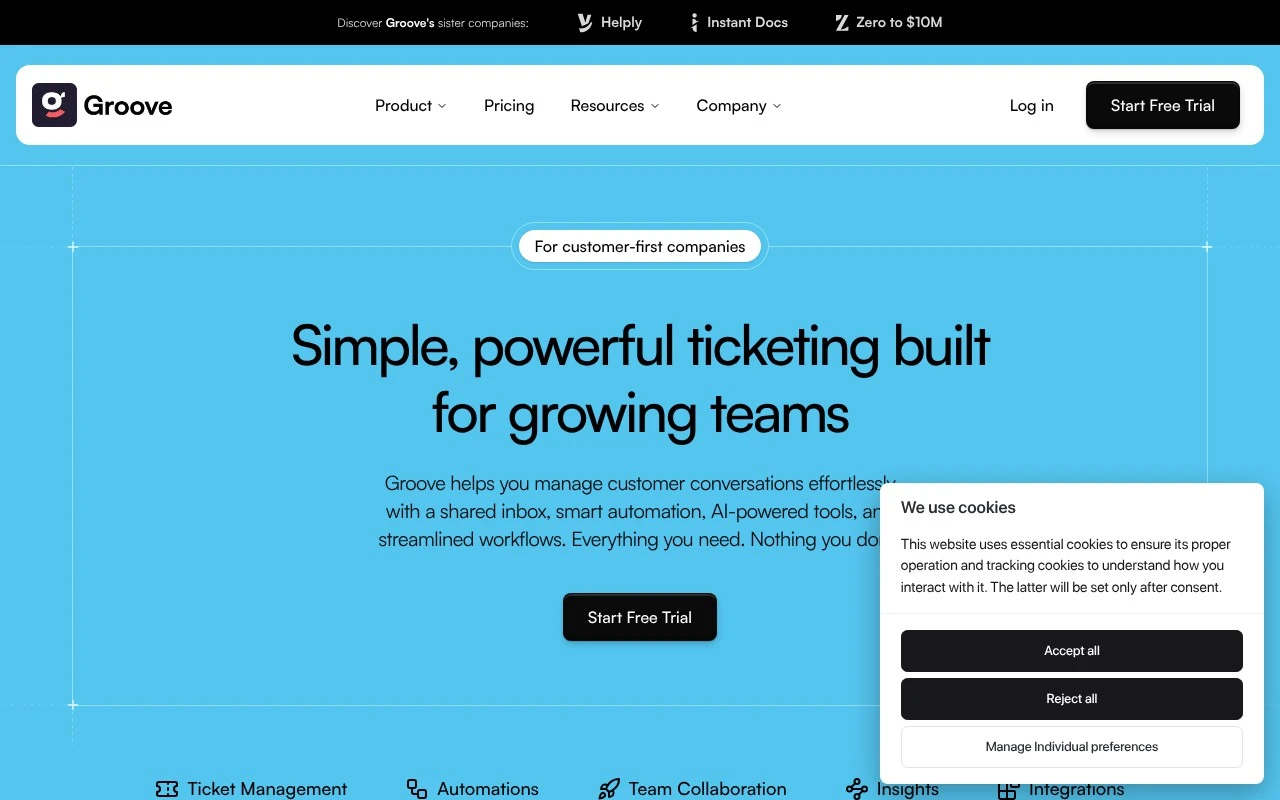
Groove is an AI-native B2B customer support platform, currently presented on its official site as Helply, for teams that want support conversations to be resolved faster and turned into useful signals for customer success, sales, and product work. It combines a shared support workspace with AI agents, drafting assistance, account context, and revenue-signal detection. The result is a help desk that is designed not only to manage tickets, but to understand what those tickets mean for the business. At its core, the platform treats support as an operational system rather than a simple inbox. Conversations from different channels can be handled in one place, while AI helps classify, answer, summarize, and route work. This positions the tool for teams that need customer support automation without losing the context and judgment required in B2B relationships. For B2B support teams, Groove is best suited to companies where every conversation may connect to an account, renewal, expansion opportunity, product issue, or churn risk. Instead of isolating support from the rest of the customer lifecycle, it links support activity to customer records and commercial signals. That makes it especially relevant for SaaS and service businesses where support quality directly affects retention and revenue. Account context is a major part of the product story. Agents are not only responding to a message, they can understand who the customer is, what company they belong to, what history exists, and whether the interaction suggests a wider risk or opportunity. This kind of context can support churn prediction, escalation decisions, and more informed follow-up by success or sales teams. AI is used both to resolve issues directly and to help human agents work more effectively. The platform can draft replies, suggest next steps, summarize threads, and automate repetitive support flows, while more complex or sensitive cases remain available for human handling. In that sense, it is not framed as a chatbot bolted onto a ticketing system, but as an AI-native support layer built around the full conversation lifecycle. The commercial model also reflects this positioning. The official product story emphasizes a free seat-based support layer, with AI charged around outcomes rather than simply adding more paid users. For growing teams, that can make the platform feel different from traditional help desk software where costs often rise directly with every additional teammate. This makes Groove strongest when support is expected to contribute to more than response times. The platform is built for organizations that want to detect patterns in customer requests, surface revenue signals, identify possible churn, and feed product feedback back into the business. Support leaders can use it to improve operational efficiency, while customer-facing teams can use the same conversation data to understand account health. In practice, the tool sits between a modern help desk, an AI support agent, and a customer intelligence layer. It is most compelling for companies that have outgrown a basic shared inbox but do not want support, success, and sales to operate from disconnected systems. Groove turns support interactions into structured, actionable information, while still keeping the immediate job of helping customers at the center.

Use cases

Best for

Customer Support Automation

Groove uses AI to draft replies and suggest resolutions from ticket history and account context inside the support workflow.

Churn Prediction

It flags churn risk by detecting negative sentiment and revenue signals in support conversations and linking them to account context.

Omnichannel Support

It centralizes email, chat, and other channels into one ticket queue so agents can manage conversations in a single workspace.

ANALYSIS

Strengths & limitations

Strengths
  • Best suited to B2B SaaS teams because it combines ticket handling, AI resolution, agent drafting, and account context in one support workflow.
  • Useful for revenue-focused support teams because it detects churn, upsell, product, and competitor signals directly from customer conversations.
  • Helpful for scaling support without simply adding seats because its model includes a free seat-based support layer with outcome-based AI pricing.

Limitations
  • Less suitable for consumer support or non-software businesses because the product is shaped around B2B account context, SaaS signals, and revenue workflows.
  • Less suitable for teams that only need a basic shared inbox because the AI, knowledge, and cross-functional signal workflows add setup and process complexity.
  • Outcome-based AI pricing can make costs rise with successful automation volume, so high-ticket-volume teams should model usage before committing.

Evaluation

FYAI score breakdown

Our structured evaluation across five key criteria

8.3 / 10

Overall score

Based on 195 reviews

  • Ease of use8.5 / 10
  • Features7.8 / 10
  • Pricing8.4 / 10
  • Integrations8.0 / 10
  • Support9.1 / 10

What users say

Findings from public reviews, documentation and community sources.

  • Ease of use

    G2 lists GrooveHQ at 4.6/5 from 195 reviews, and G2’s review summary says users “consistently praise the ease of use” and that GrooveHQ “simplifies email management.” Groove’s page describes “hands-on, one-to-one onboarding.”

  • Features

    Groove’s site positions Groove as an “AI-native B2B Support Platform” with “omnichannel support,” an “AI knowledge base,” an “AI agent,” and an “AI assistant.” Groove’s site also references co-pilot drafting, account context, churn detection, upsell opportunities, support intelligence, and article creation.

  • Pricing

    Groove’s pricing page presents “$0 per seat” with “free support platform, forever” and “pay only for AI outcomes.” Groove’s pricing page also states “No seat fees. No credit card. No time limit.”

  • Integrations

    Groove’s site lists support channels including “Email, chat widget, in-app, Slack Connect, WhatsApp.” Groove’s site lists data connections including “Slack, Stripe, Gong, PostHog, HubSpot, Attio,” and also references an “AI agent for Zendesk.”

  • Support

    G2’s review summary says users praise GrooveHQ’s “responsive support.” Groove’s product page includes the quote “Getting started with Helply was effortless thanks to the hands-on, one-to-one onboarding.”

Who is this for?

Best for B2B support teams that want AI-assisted customer support across multiple channels, Groove’s site positions it as an “AI-native B2B Support Platform” and lists “Email, chat widget, in-app, Slack Connect, WhatsApp.” Less suited to teams looking for a general-purpose conversational-AI platform outside support, Groove’s site frames the product around B2B support workflows.

PRODUCT PREVIEW

Feature highlights

AI ticket resolution

Resolve more tickets with AI answers and suggested next actions.

Omnichannel inbox

Manage email and chat tickets in one place with shared visibility.

Revenue signal alerts

Spot upsell risk and expansion cues from support conversations.

COMPARE

Discover curated alternatives worth comparing

Compare similar AI tools based on features, pricing and use cases

8.1/ 10FYAI score

Helply

Customer Support BotsKnowledge Base Bots
Answers tickets, drafts replies, flags gaps and churn risks
Best for:
Customer support teams
Pricing
Freemium

8.7/ 10Based on 7,757 reviews

Zoho Desk

Customer Support BotsKnowledge Base Bots
Handles routine tickets, flags issues, and drafts replies
Best for:
Customer support teams
Pricing
Freemium

7.8/ 10Based on 31,824 reviews

Zoho

Customer Support Bots
Runs business apps for sales, finance, HR, and support teams
Best for:
Operations teams
Pricing
Freemium

Groove

Deliver faster, more consistent support with Groove. Turn every customer question into a smooth, trackable conversation your team can handle with confidence.

FAQ

Frequently asked
questions

Everything you need to know about this AI tool,
its features, pricing, use cases, and limitations.

Who is Groove best suited for?
Groove is best suited for B2B SaaS and software companies that want support, customer success, sales, and product teams working from the same customer context. It fits teams running omnichannel support across email, chat, in-app, Slack Connect, WhatsApp, and similar channels while using AI to resolve tickets and surface revenue signals.
Is Groove free or paid?
Groove is a paid customer support platform, with current positioning focused on unlimited free seats and charging for specific AI outcomes rather than traditional per-agent licensing. Buyers should confirm the latest pricing structure, usage limits, and billing triggers directly with Groove or Helply before comparing it against seat-based help desk tools.
How does Groove compare with other customer support automation tools?
Groove differs from many support automation tools by combining a shared B2B support inbox with AI ticket resolution, agent reply drafting, and account-level signal detection. It is likely most competitive when revenue context matters, such as churn risk, upsell requests, competitor mentions, and feature feedback, not just faster ticket handling.
How much setup work does Groove usually require?
Groove’s main trade-off is that it is built for B2B support workflows rather than simple consumer help desks or ecommerce ticket queues. Buyers should also verify the current Groove and Helply branding, product continuity, pricing rules, AI outcome definitions, and implementation requirements before committing to it as a core support platform.
What should teams check about Groove’s data privacy and compliance?
Teams evaluating Groove should review how customer conversations, account records, CRM data, billing data, and product-usage signals are processed, stored, and accessed. Security teams should confirm current compliance certifications, data retention controls, permission models, AI data usage policies, and integration safeguards directly with Groove or Helply.