Front
Curated ToolThis tool is part of our curated AI directory. We only include tools that meet our standards for relevance, usability and real-world value.

Front

Front is a customer communication platform that centralizes shared inboxes for email, chat, SMS, and social messages. It helps teams collaborate on customer conversations, assign ownership, automate routing, and track response performance.
Customer Support Bots

Front

FYAI Score

8.6 / 10

Based on 2,499 reviews

Pricing:

Paid

Best for:

Customer-facing teams managing high-volume, multi-channel conversations

Score Breakdown

  • Ease of use8.7 / 10
  • Features9.0 / 10
  • Pricing8.2 / 10
  • Integrations8.9 / 10
  • Support8.3 / 10

PRODUCT PREVIEW

What this AI tool does

Front
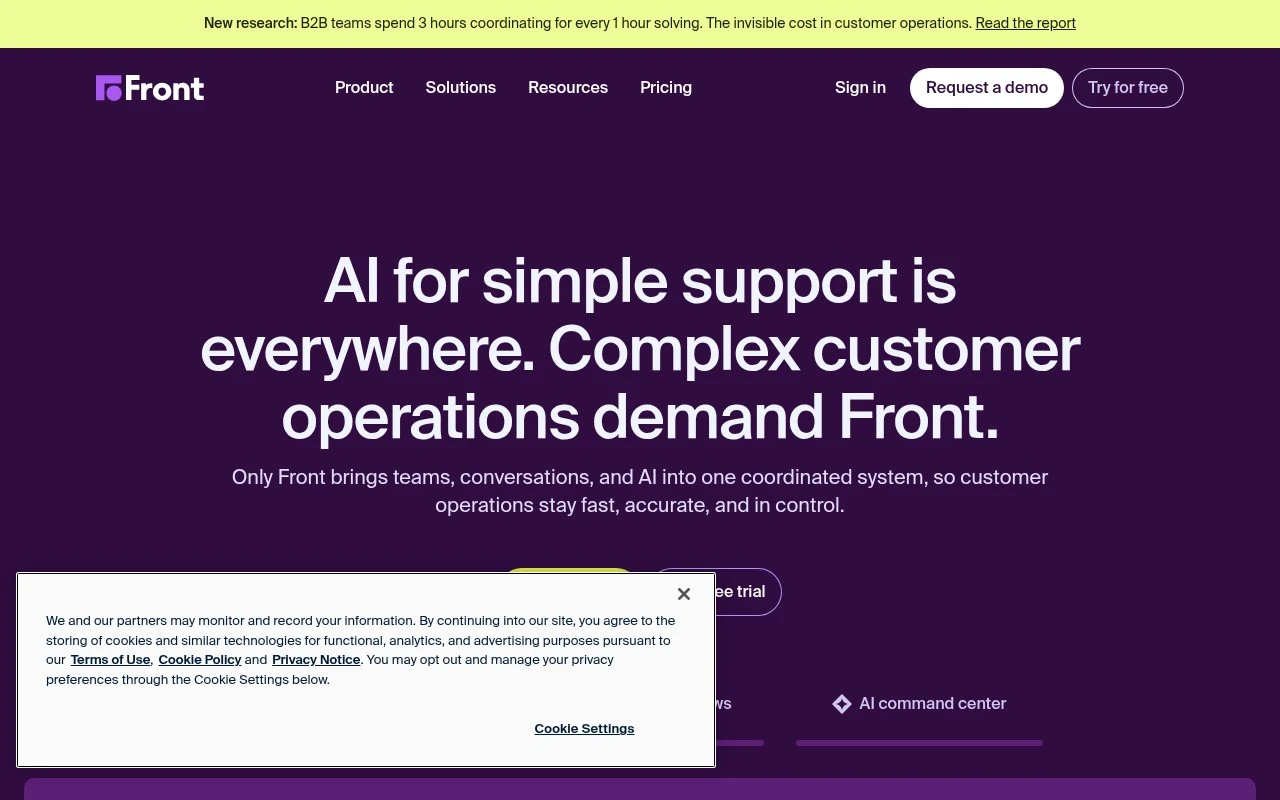
Front is a customer operations platform for customer-facing teams that need to manage email, chat, SMS, and other conversations with shared ownership, internal collaboration, automation, AI, and reporting in one workspace. It is designed for the kinds of customer communication that do not fit neatly into a basic ticket queue, where context, relationship history, and team coordination matter as much as speed. Front is best suited to support, success, operations, sales, account management, and logistics teams that need structure without losing the human feel of an inbox. For teams handling high-value or relationship-based communication, the platform acts as a shared inbox with accountability built in. Messages can be assigned, discussed internally, escalated, routed, and resolved without forwarding threads or losing visibility. The result is a communication hub where every customer conversation has an owner, but the wider team can still contribute context when needed. Unlike a traditional help desk built around case numbers, the product keeps conversations closer to the way customers actually communicate. Email threads, live chat, text messages, and other channels can sit alongside customer history, internal notes, and operational context. This makes it useful for teams that need to solve problems collaboratively, not just close tickets quickly. AI in the platform supports the practical work of inbox triage, response drafting, summarization, and routing rather than replacing the team entirely. It can help surface urgency, reduce repetitive writing, and make long threads easier to understand before someone replies. In this sense, Front uses AI to make customer-facing work faster and clearer while preserving human judgement for nuanced conversations. Workflow automation is a major part of how Front scales beyond a shared mailbox. Rules, assignments, tags, service-level expectations, and handoffs can be shaped around the way a team actually operates. For organizations investing in customer support automation, the platform can reduce manual sorting and repetitive follow-up while still keeping communication personal and traceable. Managers use the reporting layer to understand workload, responsiveness, team performance, and customer communication patterns. Instead of relying only on anecdotal feedback or scattered inboxes, leaders can see where volume is coming from, which conversations are waiting, and where processes may be slowing down. These insights are especially useful for teams balancing service quality, speed, and operational consistency. Front also has a distinct place between email, CRM, and support software. It does not treat every conversation as a simple ticket, but it also adds more process, visibility, and automation than a normal inbox can provide. That middle position is what makes it relevant for organizations where customer communication is both collaborative and operationally important.

Use cases

Best for

Omnichannel Support

Route email, SMS, and chat into shared inboxes with assignments, internal comments, and customer context for each conversation.

Workflow Automation

Build rules and integrations in Front to auto assign, tag, escalate, and notify teammates based on message content and customer data.

Customer Support Automation

Use AI assisted drafts, saved replies, and auto triage to respond faster while tracking ownership and SLA status in one inbox.

ANALYSIS

Strengths & limitations

Strengths
  • Best suited to customer-facing teams managing multi-step conversations because shared ownership, internal collaboration, and customer context stay connected across channels.
  • Strong fit for support and operations teams that want AI assistance inside human workflows because agents can automate responses, routing, and repetitive service tasks without separating collaboration from the inbox.
  • Useful for managers overseeing service quality because reporting and conversation analysis help track workload, performance, and customer experience across teams.

Limitations
  • Less suitable for teams that only need a simple ticket queue because Front’s shared inbox, collaboration, automation, and reporting model can add more structure than basic support workflows require.
  • Less suitable for very small or budget-constrained teams because Front is a paid platform and costs typically scale as more customer-facing staff need access.
  • Requires thoughtful setup for teams with complex operations because inbox rules, ownership models, automations, and cross-team workflows need configuration to avoid confusion.

Evaluation

FYAI score breakdown

Our structured evaluation across five key criteria

8.6 / 10

Overall score

Based on 2,499 reviews

  • Ease of use8.7 / 10
  • Features9.0 / 10
  • Pricing8.2 / 10
  • Integrations8.9 / 10
  • Support8.3 / 10

What users say

Findings from public reviews, documentation and community sources.

  • Ease of use

    G2 lists Front at 4.7/5 across 2,499 reviews, and the supplied G2 review text says Front improved “workflow, team coordination, and customer response times” and references its “ease of use.”

  • Features

    Front’s pricing page references “Front AI,” “AI Autopilot,” “Copilot,” and “Smart QA.” Front’s pricing page also lists shared inboxes, ticketing, omnichannel channels, and automation rules.

  • Pricing

    Front’s pricing page publishes annual tiers: Starter at “$25 /seat/mo,” Professional at “$65 /seat/mo,” and Enterprise at “$105 /seat/mo.” Front’s pricing page lists AI add-ons including Autopilot “Starting at $0.05 /conversation” and Copilot at “$20 / seat / month.”

  • Integrations

    Front’s homepage says users can “Connect your channels and most-used tools” with “160+ integrations” and “no-code workflows.” Front’s homepage also lists API capacity add-ons such as “API Rate Limit Increase.”

  • Support

    Front’s pricing page lists services including “Tailored onboarding,” “Solution design and technical consultation,” “Platform optimization,” and “Training and change management best practices.”

Who is this for?

Best for support teams that need customer conversations connected across channels and workplace tools, Front’s homepage says users can “Connect your channels and most-used tools” with “160+ integrations,” and Front’s pricing page lists shared inboxes and ticketing. Less suited to teams that want AI functions bundled into one seat price, Front’s pricing page lists AI add-ons including Autopilot “Starting at $0.05 /conversation” and Copilot at “$20 / seat / month,” which means those functions require separate add-on pricing.

PRODUCT PREVIEW

Feature highlights

Shared Inbox

Manage email, SMS, and chat together with clear ownership per thread.

Team Collaboration

Comment internally, assign, and loop in teammates without forwarding.

Analytics & Reporting

Track response times, workload, and team performance across channels.

COMPARE

Discover curated alternatives worth comparing

Compare similar AI tools based on features, pricing and use cases

8.1/ 10FYAI score

Helply

Customer Support BotsKnowledge Base Bots
Answers tickets, drafts replies, flags gaps and churn risks
Best for:
Customer support teams
Pricing
Freemium

8.7/ 10Based on 7,757 reviews

Zoho Desk

Customer Support BotsKnowledge Base Bots
Handles routine tickets, flags issues, and drafts replies
Best for:
Customer support teams
Pricing
Freemium

7.8/ 10Based on 31,824 reviews

Zoho

Customer Support Bots
Runs business apps for sales, finance, HR, and support teams
Best for:
Operations teams
Pricing
Freemium

Front

Join teams using Front to respond faster, stay aligned, and deliver standout customer experiences—without the inbox chaos. Start today.

FAQ

Frequently asked
questions

Everything you need to know about this AI tool,
its features, pricing, use cases, and limitations.

Who is Front best suited for?
Front is best suited for customer-facing teams that manage complex, multi-step conversations across departments. It fits support, success, operations, inbound sales, and account management teams that need shared visibility, internal collaboration, routing, escalation, workflow automation, AI assistance, and analytics in one customer operations platform.
Is Front free or paid?
Front is a paid platform, so teams should expect to evaluate it as a commercial customer operations tool rather than a free inbox product. Buyers comparing Front pricing should review current plans on front.com and consider how many users, workflows, integrations, and AI-assisted processes they need.
How does Front compare with other customer support tools?
Front differs from many basic help desks by combining shared inbox communication, team collaboration, automation, AI assistance, integrations, and analytics in one workflow. It is often a stronger fit when customer requests require cross-team coordination, while simpler tools may be enough for low-volume or straightforward ticket handling.
How hard is it to set up Front?
Front may be more platform than necessary for teams that only need simple FAQ support or basic inbox management. Buyers should also test whether its AI capabilities handle their specific request types, policies, tone requirements, and escalation rules well enough before relying on automation for customer-facing workflows.
What should teams check about Front data privacy and compliance?
Teams evaluating Front should review its current security, privacy, data retention, access control, and compliance documentation before deployment. This is especially important for organisations handling regulated customer data, cross-team visibility, AI-assisted responses, integrations, or workflows that route sensitive customer conversations across departments.