Curated ToolThis tool is part of our curated AI directory. We only include tools that meet our standards for relevance, usability and real-world value.

Decagon

Builds AI agents for chat, voice, and email with analytics

Customer Support BotsVoice Agents
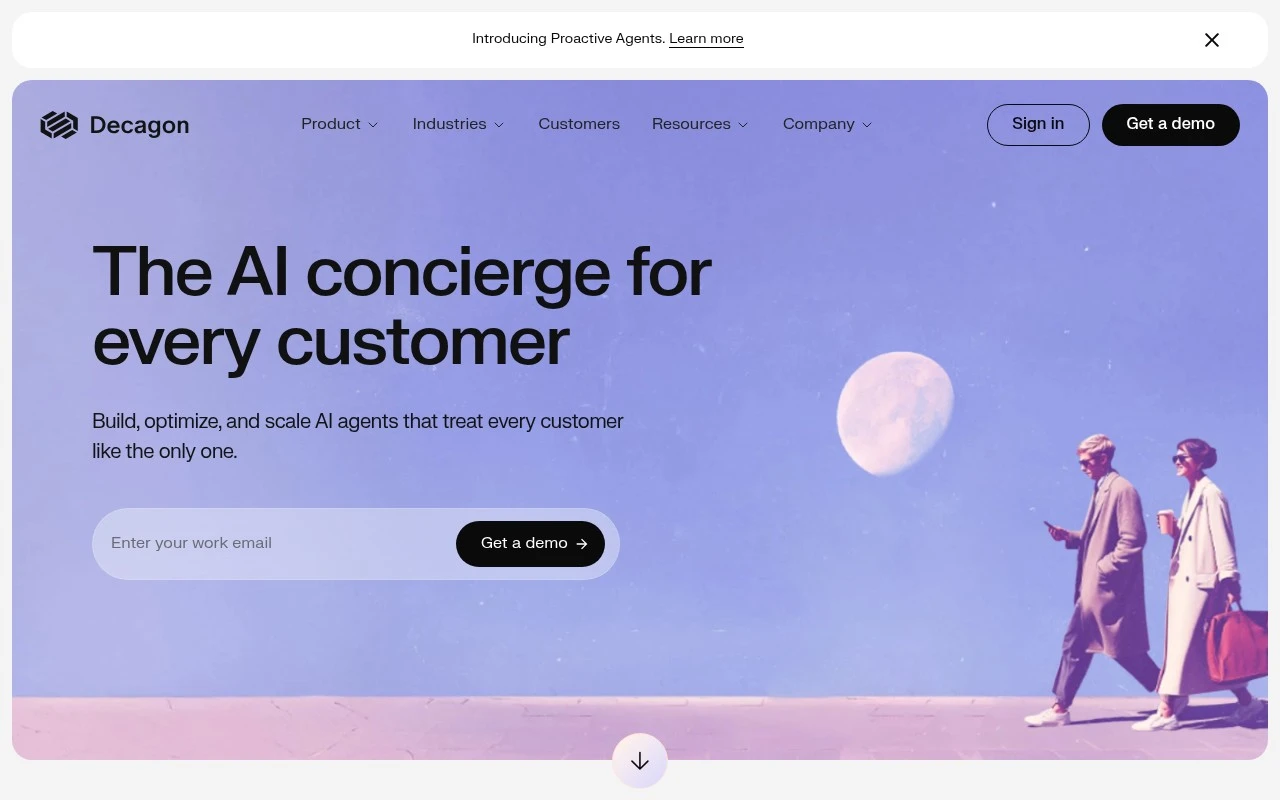
Decagon provides an AI agent platform positioned as an “AI concierge” for customer-facing enterprises. It lets teams build omnichannel agents for chat, voice, and email, define workflows in natural language through Agent Operating Procedures, and use testing, observability, experimentation, and analytics to improve agent performance over time.

FYAI Score

8.0 / 10

Based on 19 reviews + FYAI product analysis

Pricing:

Paid

Best for:

Customer support leaders scaling AI agents across chat, voice, and email

Score Breakdown

  • Ease of use8.0 / 10
  • Features8.6 / 10
  • Pricing7.3 / 10
  • Integrations7.3 / 10
  • Support8.8 / 10

PRODUCT PREVIEW

What this AI tool does

Decagon is an AI tool page intended to help readers understand what the product is and how it may fit into real work. Because the available details about its purpose and main use case are not defined, this description focuses on setting expectations and explaining the kind of information users typically look for when evaluating an AI tool. On a typical tool page, you can expect a plain-language overview of what the tool does, who it is designed for, and the problems it aims to solve. It may also cover how it is used in practice, what inputs it needs, what outputs it produces, and any important limitations or requirements. If more specifics about decagon become available, this page can be updated to reflect its actual workflow, target users, and practical applications.

Use cases

Best for

Customer Support Automation

Automate customer support by routing chat, voice, and email requests to AI agents that follow defined workflows and log outcomes for analytics.

Agent Building

Decagon lets teams build agents by writing Agent Operating Procedures in natural language and iterating with testing and observability tools.

Chatbot Deployment

Deploy chatbots across web chat and messaging channels using omnichannel agents and monitor performance with experimentation and analytics.

ANALYSIS

Strengths & limitations

Strengths
  • Supports chat, voice, and email from a unified intelligence layer.
  • Uses natural-language Agent Operating Procedures to make workflow updates more accessible to non-engineering customer operations teams.
  • Includes lifecycle tools for building, validating, observing, experimenting with, and scaling AI agents.
Limitations
  • The public site emphasizes enterprise demos and does not provide self-serve pricing.
  • Specific third-party integrations and deployment requirements are not detailed in the provided site text.
  • The platform appears focused on customer experience automation, so it is not a general-purpose AI agent builder for unrelated internal workflows.

Evaluation

FYAI score breakdown

Our structured evaluation across five key criteria

8.0 / 10

Overall score

Based on 19 reviews + FYAI product analysis

  • Ease of use8.0 / 10
  • Features8.6 / 10
  • Pricing7.3 / 10
  • Integrations7.3 / 10
  • Support8.8 / 10

What users say

Findings from public reviews, documentation and community sources.

  • Ease of use

    Decagon says “Agent Operating Procedures (AOPs) let you define agent workflows in natural language,” and says updates should not require “an engineering sprint or vendor ticket.” Reddit feedback characterizes Decagon as “Fast to spin up.”

  • Features

    Decagon’s product page describes a lifecycle platform to “Build your agent,” “Optimize your agent” with “testing, observability, and experimentation,” and “Scale your agent” with analytics. Decagon’s product page covers omnichannel deployment across “Voice,” “Chat,” and “Email.”

  • Pricing

    Decagon’s pricing article references “two flexible pricing options,” including “Per-conversation pricing,” and Decagon’s glossary defines “Resolution-based pricing” for successful outcomes. Decagon describes pricing at the model level rather than as a public tier table.

  • Integrations

    Decagon’s integrations page says integrations connect agents to “CRMs, help desks, call centers, and knowledge bases.”

  • Support

    Decagon’s site quotes one customer saying “The Decagon team consistently finds ways to make things work,” “get creative,” and “keep pace with how quickly we want to stand things up.” Decagon’s site reports G2 at 4.9/5 across 19 verified reviews.

Who is this for?

Best for enterprise support teams that need agents across “Voice,” “Chat,” and “Email”, Decagon’s product page also describes testing, observability, experimentation, and analytics for managing agents after launch. Best for teams that want lower-configuration workflow changes, Decagon says AOPs let teams define workflows in natural language and says updates should not require “an engineering sprint or vendor ticket.” Less suited to buyers that need published plan amounts before evaluation. Decagon describes “two flexible pricing options,” including “Per-conversation pricing,” rather than a public tier table.

PRODUCT PREVIEW

Feature highlights

Omnichannel agents

Deploy one AI concierge across chat, voice, and email.

AOP workflows

Define agent workflows in natural language with Agent Operating Procedures.

Testing & analytics

Experiment, monitor, and improve agent performance over time.

COMPARE

Discover curated alternatives worth comparing

Compare similar AI tools based on features, pricing and use cases

8.1/ 10FYAI score

Helply

Customer Support BotsKnowledge Base Bots
Answers support tickets, drafts replies, and flags churn risk
Best for:
Customer support teams
Pricing
Freemium

8.7/ 10Based on 7.757 reviews

Zoho Desk

Customer Support BotsKnowledge Base Bots
Uses Zia AI to triage tickets, draft replies, and flag issues
Best for:
Customer support teams
Pricing
Freemium

7.8/ 10Based on 31.824 reviews

Zoho

Customer Support Bots
Cloud suite for CRM, finance, HR, and business operations
Best for:
Operations teams
Pricing
Freemium

Start turning customer chats into happier shoppers and more sales. See why fast-growing e-commerce teams choose Decagon to scale support without losing a personal touch.

FAQ

Frequently asked
questions

Everything you need to know about this AI tool,
its features, pricing, use cases, and limitations.

Is Decagon a good fit for my e-commerce support and sales use cases?
Decagon is best suited for e-commerce teams that want to automate common customer conversations like order status, returns/exchanges, product questions, and basic pre-purchase guidance. It’s a stronger fit when you can map most inquiries to repeatable flows and connect to your storefront and helpdesk data. If you need highly open-ended troubleshooting or complex, multi-system casework, you may find it less flexible than more general-purpose support platforms.
Does Decagon offer a free plan, and what are the typical paid-plan constraints?
Decagon is generally positioned as a paid, business-focused product rather than a freemium tool, so expect pricing tied to usage and deployment scope. Common constraints to clarify in a quote are conversation volume, number of channels, seats, and which integrations/analytics are included. Ask whether advanced routing, A/B testing, and custom reporting are add-ons or bundled.
How does Decagon compare with other conversational AI tools for e-commerce?
Compared with generic chatbot builders, Decagon tends to be more oriented around e-commerce workflows and personalization tied to storefront/customer data. Versus helpdesk-native automation, it can provide richer conversational experiences but may require more upfront design of flows and ongoing tuning. If you’re comparing, evaluate integration depth (Shopify/BigCommerce, CRM, helpdesk), handoff quality to agents, and how well each tool handles edge cases.
How quickly can I set up Decagon, and what onboarding effort should I expect?
Decagon can be constrained by predefined conversational flows, which may limit performance on unusual or multi-step inquiries. You’ll likely need ongoing maintenance—updating content, monitoring failures, and adjusting flows as policies and catalogs change. If your customers frequently ask novel questions, you may need a stronger human handoff or a more flexible system.
What should I check about Decagon’s data handling, privacy, and compliance before choosing it?
Confirm what customer data Decagon stores, how long it’s retained, and whether conversation logs are used for model improvement by default. Review access controls, encryption, and how it connects to your e-commerce platform and helpdesk to avoid over-sharing PII. If you have GDPR/CCPA or industry requirements, ask for documentation on subprocessors, data residency options, and deletion/export workflows.